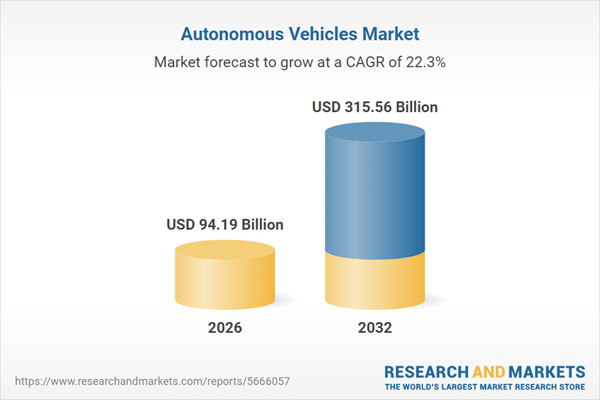
Dublin, July 20, 2026 (GLOBE NEWSWIRE) -- The "Autonomous Vehicles Market - Global Forecast 2026-2032" report has been added to ResearchAndMarkets.com's offering.The Autonomous Vehicles Market is projected to reach USD 94.19 Billion in 2026. It is expected to continue growing at a CAGR of 22.25%, reaching USD 315.56 Billion by 2032. Autonomous vehicles are moving from controlled pilots toward broader operational deployment across passenger mobility, freight logistics, industrial sites, public transport, ports, mining, agriculture, and defense-adjacent mobility systems. The sector is defined by the convergence of advanced driver assistance systems, sensor fusion, artificial intelligence, high-definition mapping, vehicle-to-everything communication, edge computing, cybersecurity, and software-defined vehicle architectures. The strongest momentum is visible where regulatory sandboxes, connected infrastructure, electrification programs, and commercial use cases align to reduce safety, reliability, and cost barriers.Industry demand is shaped by verified structural drivers, including road safety priorities, driver shortages in logistics and public transport, urban congestion, rising e-commerce delivery needs, aging populations requiring accessible mobility, and the pursuit of lower-emission transportation. At the same time, deployment remains constrained by validation complexity, liability frameworks, weather and road variability, cybersecurity exposure, public trust, and the need for resilient supply chains for sensors, semiconductors, and compute platforms. As a result, the autonomous vehicle ecosystem is increasingly prioritizing domain-specific autonomy, geofenced operation, supervised commercial deployment, and incremental automation rather than uniform full autonomy across all road conditions.Transformative Shifts in the Autonomous Vehicle LandscapeThe autonomous vehicle landscape is undergoing a decisive shift from hardware-led experimentation to software-centric, safety-validated mobility systems. Early industry narratives focused heavily on fully driverless passenger cars; current deployment patterns show stronger traction in bounded environments such as warehouses, campuses, ports, mines, fixed-route shuttles, autonomous trucking corridors, and last-mile delivery zones. These use cases reduce operational uncertainty and enable staged safety assurance while still delivering productivity gains.A second transformative shift is the rise of software-defined vehicles, where over-the-air updates, centralized compute, sensor redundancy, and cloud-enabled fleet learning allow continuous improvement after deployment. This has increased the importance of functional safety engineering, simulation, scenario libraries, cybersecurity-by-design, and data governance. Regulators are also shifting from technology-neutral vehicle standards toward performance-based safety cases, incident reporting, automated lane keeping rules, and testing permits that account for operational design domains.The competitive basis is also changing. Leadership is no longer determined solely by vehicle engineering capability; it increasingly depends on access to high-quality driving data, real-world validation capacity, AI model robustness, mapping accuracy, infrastructure readiness, and the ability to integrate autonomy into commercially viable mobility and logistics workflows. Electrification, connected mobility, smart city investment, and intelligent transport systems are reinforcing this shift by creating a broader digital mobility ecosystem in which autonomous vehicles can operate more efficiently.Cumulative Impact of Artificial Intelligence on Autonomous VehiclesArtificial intelligence is the core enabling layer for autonomous vehicles, supporting perception, localization, prediction, planning, control, driver monitoring, fleet optimization, and simulation-based validation. Deep learning models process camera, radar, lidar, ultrasonic, thermal, and inertial data to identify road users, lane markings, traffic signals, hazards, and free-space boundaries. AI-based prediction systems estimate the likely behavior of pedestrians, cyclists, and other vehicles, while planning algorithms determine safe maneuvers under strict timing constraints.The cumulative impact of AI is most visible in the acceleration of scenario testing and validation. Because real-world driving exposes vehicles to rare edge cases slowly, simulation, synthetic data generation, digital twins, and closed-loop testing are being used to expand safety evaluation across complex weather, lighting, traffic, and road conditions. AI also supports fleet learning, enabling operational data from deployed vehicles to refine maps, improve perception models, and update risk models.However, AI introduces material governance requirements. Autonomous driving systems must address model explainability, bias in training data, adversarial vulnerability, sensor degradation, data privacy, and cybersecurity risks. Safety assurance increasingly requires a layered approach combining redundant sensors, deterministic fallback mechanisms, remote assistance protocols, human-machine interface design, real-time monitoring, and post-incident auditability. The industry's next phase will be shaped by how effectively AI performance can be translated into measurable, regulator-ready safety evidence across defined operational design domains.Key Regional Insights for Autonomous VehiclesAsia-Pacific is a central hub for autonomous vehicle development because of dense urban mobility needs, advanced electronics supply chains, strong 5G deployment, and national intelligent transport initiatives. China has supported large-scale autonomous driving test zones and smart road infrastructure, while Japan and South Korea combine automotive engineering strength with robotics, sensors, and connected mobility policy. India's opportunity is shaped by logistics automation, road safety needs, and digital infrastructure expansion, although heterogeneous traffic conditions require highly localized autonomy models. Australia is advancing autonomous operation in mining, long-distance logistics, and controlled industrial environments, where remote operations and safety productivity gains are commercially relevant.Europe is characterized by rigorous safety regulation, cross-border mobility considerations, sustainability policy, and strong automotive engineering capability. The region's emphasis on vehicle safety, data protection, emissions reduction, and intelligent transport systems supports structured autonomous vehicle development. Germany, France, Italy, Spain, and the United Kingdom are advancing connected and automated mobility through testing corridors, regulatory updates, and public transport pilots, while the European policy environment encourages harmonized safety assessment, interoperability, cybersecurity compliance, and responsible data governance.North America remains highly influential in autonomous vehicle testing, software development, trucking automation, robotaxi pilots, safety research, and regulatory experimentation. The United States benefits from extensive highway freight corridors, advanced AI capability, and state-level autonomous vehicle testing frameworks, while Canada contributes through AI research, winter-weather testing relevance, and connected infrastructure initiatives. Mexico's position is strengthened by its automotive manufacturing base and logistics integration with North American supply chains, creating opportunities for automated freight and industrial mobility applications.Latin America is progressing more selectively, with near-term opportunities concentrated in fleet management, mining autonomy, bus rapid transit modernization, logistics corridors, and port operations. Brazil and Mexico are important regional anchors due to vehicle manufacturing, urban congestion challenges, and freight intensity. Adoption depends heavily on infrastructure quality, regulatory clarity, road safety policy, and the ability to deploy autonomy in controlled or semi-controlled commercial environments before wider public-road operation.Africa's autonomous vehicle trajectory is at an earlier stage, but targeted opportunities are emerging in mining, agriculture, ports, long-haul freight corridors, and controlled industrial zones. South Africa is the most advanced regional base for vehicle manufacturing and mining automation relevance, while broader continental adoption depends on road infrastructure, connectivity, regulatory capacity, financing models, and localization for diverse traffic conditions. In many African markets, autonomy is likely to appear first through advanced driver assistance, telematics, remote monitoring, and off-road automation rather than fully driverless public-road vehicles.The Middle East is increasingly relevant for autonomous mobility because of smart city programs, high-capacity infrastructure projects, logistics modernization, and government-backed transport innovation. Gulf economies are testing autonomous shuttles, smart public transport, port automation, and mobility-as-a-service models in environments where planned urban districts and controlled infrastructure can reduce deployment complexity. Extreme heat, sand, glare, and visibility conditions remain important validation factors for sensors, perception systems, and thermal management.Key Group Insights for Autonomous VehiclesNATO member economies are increasingly attentive to resilient mobility, cybersecure transport networks, dual-use autonomy capabilities, and supply chain security for critical vehicle technologies. While civilian autonomous vehicle deployment remains governed by transport and safety regulators, the alliance context reinforces the importance of secure communications, trusted software, sensor resilience, and protection against cyber interference in connected mobility systems. These priorities are especially relevant for autonomous logistics, infrastructure protection, emergency response mobility, and continuity of transport operations.G7 economies are influential because they combine advanced automotive engineering, AI research, safety regulation, semiconductor demand, high purchasing power, and major public-sector road safety agendas. The group is central to standards development, cybersecurity expectations, functional safety practices, and automated driving validation methods. Adoption within G7 markets continues to emphasize safety-certified systems, driver assistance evolution, commercial fleet automation, and defined-domain deployment that can withstand public and regulatory scrutiny.BRICS economies collectively represent a wide range of autonomous vehicle opportunities, from China's smart mobility zones and India's digital logistics expansion to Brazil's freight and urban mobility needs, Russia's harsh-climate testing relevance, and South Africa's mining and industrial automation potential. The group's diversity means autonomy deployment will not follow a single model; instead, commercial success depends on adapting to local infrastructure, regulation, weather, road behavior, industrial demand, and domestic technology ecosystems.The European Union plays a crucial role in establishing harmonized rules for connected and automated mobility, data protection, vehicle safety, cybersecurity, and cross-border transport. EU policy direction supports interoperable intelligent transport systems, safer roads, emissions reduction, and standardized approval pathways. The bloc's influence extends beyond its borders because many global vehicle and component suppliers align engineering processes with European safety, privacy, environmental, and cybersecurity requirements.ASEAN presents a diverse autonomous vehicle environment shaped by high urban density, rapid digitalization, logistics growth, and uneven infrastructure maturity. Singapore stands out for structured autonomous mobility trials and smart transport governance, while larger ASEAN economies are more likely to prioritize logistics automation, port operations, industrial parks, public transport efficiency, and advanced driver assistance technologies. The region's complexity lies in mixed traffic behavior, motorcycle density, tropical weather, and varying road standards, making localized perception and operational design domain definition essential.The GCC is emerging as a high-visibility testbed for autonomous mobility, supported by smart city development, national digital transformation agendas, modern road infrastructure, and public transport modernization. Autonomous shuttles, robotaxi pilots, port automation, and connected mobility services align with urban innovation strategies across Gulf economies. The region also provides a demanding environment for validating sensor resilience under heat, glare, dust, and sand exposure, making climate-specific testing a key differentiator.Key Country Insights for Autonomous VehiclesChina is one of the most active countries for autonomous vehicles, supported by smart city zones, 5G infrastructure, high-volume electric vehicle production, AI development, and extensive public-road testing in major urban centers. The United States leads in diverse autonomous vehicle testing, AI-driven mobility software, trucking automation pilots, and state-level regulatory experimentation, with deployment concentrated in defined urban zones, freight corridors, campuses, and commercial fleets. Japan combines automotive precision, robotics capability, aging-society mobility needs, and automated public transport interest, making it a strong environment for assistive autonomy, shuttles, and advanced driver assistance systems.India offers long-term autonomous vehicle potential through digital infrastructure, logistics modernization, road safety needs, and a large mobility base, but deployment must account for highly complex traffic behavior, variable road markings, and mixed vehicle classes. Germany remains a key country for autonomous vehicle engineering because of its deep automotive manufacturing ecosystem, supplier capabilities, vehicle safety expertise, and emphasis on automated driving legislation. The United Kingdom has advanced automated vehicle regulation, testing programs, insurance discussions, and connected mobility pilots, making it an important market for safety governance and commercial trial design.Australia demonstrates practical autonomy adoption in mining, remote operations, agriculture, and long-distance freight contexts, where controlled routes and labor constraints support automation. France supports connected mobility, public transport automation, and smart infrastructure programs, while South Korea brings advanced electronics, telecommunications, automotive engineering, smart city projects, and 5G connectivity into autonomous mobility development, with emphasis on connected infrastructure, urban testing, and high-reliability vehicle systems.Italy and Spain contribute automotive production capacity, urban mobility pilots, connected transport initiatives, and logistics corridors to the European autonomous vehicle ecosystem. Canada contributes strong AI research depth, connected vehicle work, and cold-weather validation opportunities, while Russia's relevance is linked to harsh-weather validation, long-distance transport, and domestic mobility technology development, although geopolitical and supply chain factors influence access to advanced components and international collaboration.Brazil is the most significant Latin American country for autonomous vehicle relevance due to its vehicle production base, large freight network, mining activity, and urban congestion pressures. Near-term adoption is centered on fleet safety technologies, driver assistance, port automation, mining vehicles, and logistics optimization rather than broad driverless passenger deployment. Mexico's automotive manufacturing base and integration with North American logistics support future automated freight, plant logistics, and supply-chain mobility applications. Across these countries, the most credible deployment paths are those that match autonomous driving capabilities to specific road conditions, safety cases, infrastructure readiness, and commercial operating models.Actionable Recommendations for Autonomous Vehicle LeadersIndustry leaders should prioritize operational design domain discipline by matching autonomous vehicle capabilities to specific environments such as fixed routes, low-speed urban districts, highways, ports, mines, campuses, or depots. This reduces validation uncertainty and improves regulatory confidence. Safety cases should be built around measurable performance indicators, including disengagement context, collision avoidance behavior, response to vulnerable road users, fallback performance, cybersecurity resilience, and post-event traceability.Executives should invest in scalable simulation, synthetic data, scenario-based testing, and real-world validation pipelines that cover rare edge cases, weather variation, sensor occlusion, and regional traffic behaviors. Cybersecurity must be embedded across vehicle architecture, over-the-air updates, cloud connectivity, fleet operations, and supplier interfaces. Strategic partnerships with regulators, infrastructure authorities, insurers, fleet operators, and public transport agencies are essential to convert technical capability into deployable services.Commercial strategy should focus on use cases with clear pain points, including freight driver shortages, yard automation, last-mile delivery, mobility for older adults, industrial safety, and transit gaps. Leaders should also build resilient supply chains for semiconductors, lidar, radar, cameras, compute platforms, batteries, and software components. Transparent public communication, human-centered interface design, privacy governance, and incident reporting processes will be critical for earning trust as autonomous vehicles scale from pilots to everyday operations.Research MethodologyThis executive summary is prepared using a structured secondary-research approach focused on verified public information from transportation regulators, vehicle safety authorities, standards bodies, government mobility programs, academic research, infrastructure agencies, public testing disclosures, and industry technical documentation. The analysis emphasizes observed technology deployment, regulatory developments, operational use cases, AI integration, regional policy direction, and adoption barriers without using market sizing, market share, or forecasting.The methodology applies triangulation across multiple evidence categories, including automated driving regulations, connected mobility initiatives, road safety frameworks, intelligent transport system programs, pilot deployments, vehicle technology standards, cybersecurity guidance, and commercial fleet use cases. Regional, group, and country insights are synthesized by comparing infrastructure readiness, policy maturity, industrial capability, traffic complexity, climate conditions, logistics demand, and public-road testing activity. The resulting perspective is designed to support strategic decision-making while avoiding unsupported claims and speculative numerical projections.ConclusionAutonomous vehicles are entering a more disciplined phase in which practical deployment depends on safety validation, regulatory trust, AI robustness, infrastructure compatibility, and commercially focused use cases. The most credible near-term progress is occurring in defined operational domains such as logistics corridors, industrial sites, smart urban districts, public transport pilots, ports, mines, and assisted-driving passenger vehicles. This staged approach reflects the technical reality that autonomy must perform reliably across complex human behavior, weather, road conditions, and cybersecurity threats.Artificial intelligence, connected infrastructure, electrification, and software-defined vehicle platforms will continue to reshape the autonomous mobility ecosystem. However, success depends less on ambitious promises and more on transparent safety evidence, resilient engineering, localized deployment strategies, and collaboration among transport authorities, fleet operators, technology providers, insurers, and infrastructure planners. Organizations that align autonomous driving systems with real operational needs, measurable safety performance, and responsible data governance will be best positioned to capture the long-term value of autonomous mobility.Key Attributes:
Back to News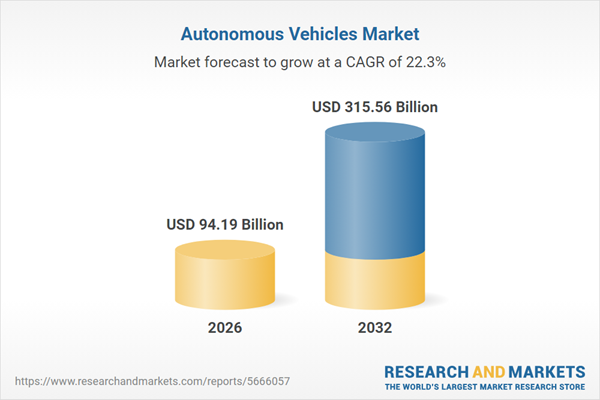
AI
Autonomous Vehicles Market to Reach USD 315.56 Billion by 2032, Growing at 22.25% CAGR
GlobeNewswire·July 20, 2026
AI Summary
The autonomous vehicles market is projected to grow from its current value to USD 315.56 billion by 2032, driven by a compound annual growth rate of 22.25%. Key growth opportunities span freight and logistics, last-mile delivery, industrial operations in ports and mines, public transit systems, and infrastructure supporting connected autonomous vehicles.
Full story reconstructed from GlobeNewswire. Formatting and media may differ from the original.
View original at GlobeNewswireWas this useful?