Circularly polarized bulk-heterojunction memory-computing organic light-emitting diodes for a neural radiance field-based 3D display
Nature.com·July 21, 2026
AI Summary
Researchers have developed circularly polarized organic light-emitting diodes that combine memory, computing, and display functions for 3D visualization applications. The optimized devices demonstrate high brightness exceeding 22,000 cd/m² with a dissymmetry factor of 0.92 while maintaining reduced energy consumption.
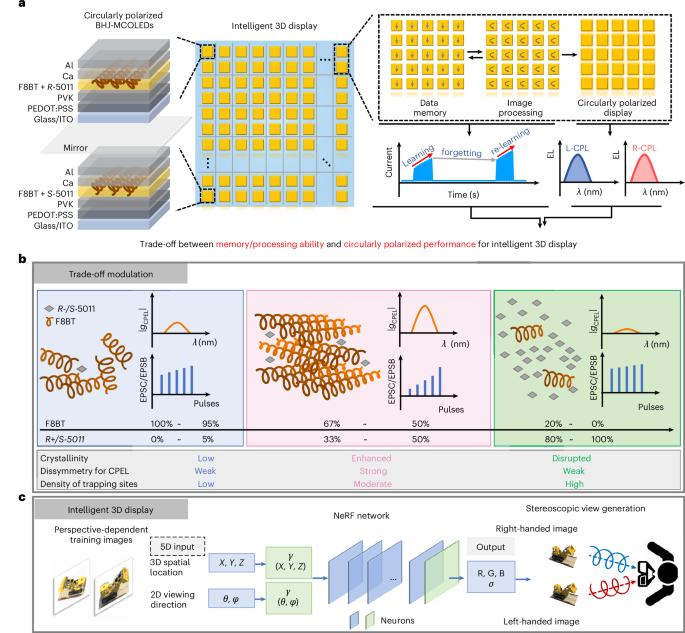
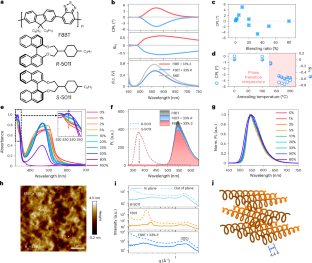
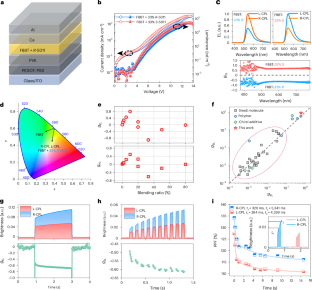
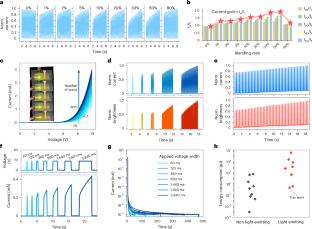
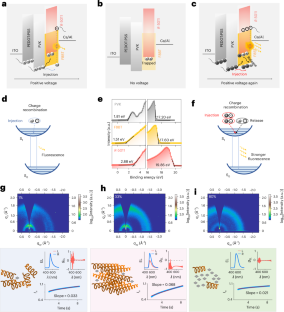
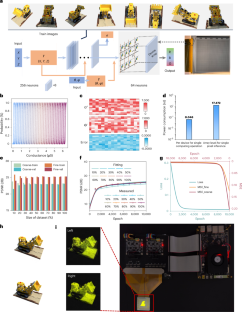
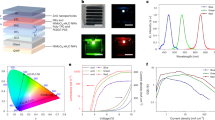
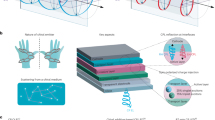
Intelligent three-dimensional displays require both powerful computing capabilities and high display performance, yet these metrics have long been constrained by the inherent trade-off between efficiency and image quality. Here we introduce circularly polarized bulk-heterojunction memory-computing organic light-emitting diodes featuring an integrated memory-processing-display architecture to break this long-standing limitation. The bulk-heterojunction memory-computing organic light-emitting diode incorporates a chiral bulk-heterojunction active layer formed by an achiral emissive polymer and chiral small molecules. Through precise control of the blend composition, we co-engineer supramolecular ordering and carrier dynamics, enabling the in situ modulation of synaptic weights and multilevel conductance states. This effectively transforms organic light-emitting diodes from passive light emitters into an integrated memory-computing-display system with enhanced computing efficiency and polarized emission. The optimized device achieves a peak luminance of 22,306 cd m−2, a high circularly polarized electroluminescence dissymmetry factor of 0.92, together with ultralow energy consumption of 1.78 pJ per spike. Hardware validation using a 64 × 64 device array demonstrates uniform and distinguishable 5-bit conductance distributions, with an energy consumption of 0.046 nJ per device and 17.472 nJ per pixel per computation. We further integrate our bulk-heterojunction memory-computing organic light-emitting diodes into a neural radiance field framework, enabling stereoscopic greyscale three-dimensional scene reconstruction on 100 × 180 arrays. This memory-computing-display integration strategy provides a promising pathway towards intelligent display technologies.
This is a preview of subscription content, access via your institution
Prices may be subject to local taxes which are calculated during checkout
Full story reconstructed from Nature.com. Formatting and media may differ from the original.
All data supporting the results in this study are included in the article and its Supplementary Information. Source data are provided with this paper. Additional data are available from the corresponding author upon request.
The codes used in this work are available via GitHub at https://github.com/Liulixuan1996/Code-used-for-modified-NeRF-framework- (ref. 47). They include the modified NeRF framework for 64-dimensional hardware-aware rendering, stereo view generation with adjustable baseline, rendering-only evaluation scripts, dataset-size sweep and PSNR analysis tools, and the associated modelling codes used in this study.
Heffern, M. C., Matosziuk, L. M. & Meade, T. J. Lanthanide probes for bioresponsive imaging. Chem. Rev. 114, 4496–4539 (2014).
Thoen, H. H., How, M. J., Chiou, T.-H. & Marshall, J. A different form of color vision in mantis shrimp. Science 343, 411–413 (2014).
Sharma, V., Crne, M., Park, J. O. & Srinivasarao, M. Structural origin of circularly polarized iridescence in jeweled beetles. Science 325, 449–451 (2009).
Kable, M. L., Scott, D., Seiwert, Heidmann, S. & Stuartt, K. A three-color, solid-state, three-dimensional display. Science 273, 1185–1189 (1996).
Zhang, X. et al. Toward intelligent display with neuromorphic technology. Adv. Mater. 36, 2401821 (2024).
Xiong, J. H., Hsiang, E. L., He, Z. Q., Zhan, T. & Wu, S. T. Augmented reality and virtual reality displays: emerging technologies and future perspectives. Light Sci. Appl. 10, 216 (2021).
Mehonic, A. & Kenyon, A. J. Brain-inspired computing needs a master plan. Nature 604, 255–260 (2022).
Zhou, F. & Chai, Y. Near-sensor and in-sensor computing. Nat. Electron. 3, 664–671 (2020).
Chen, Z. et al. Cross-layer transmission realized by light-emitting memristor for constructing ultra-deep neural network with transfer learning ability. Nat. Commun. 15, 1930 (2024).
Shan, L. et al. A sensory memory processing system with multi-wavelength synaptic-polychromatic light emission for multi-modal information recognition. Nat. Commun. 14, 2648 (2023).
Xu, Z. et al. Large-scale photonic chiplet Taichi empowers 160-TOPS/W artificial general intelligence. Science 384, 202–209 (2024).
Wan, C. et al. Artificial sensory memory. Adv. Mater. 32, 1902434 (2020).
Roy, K., Jaiswal, A. & Panda, P. Towards spike-based machine intelligence with neuromorphic computing. Nature 575, 607–617 (2019).
Chen, C. et al. Three-terminal quantum dot light-emitting synapse with active adaptive photoelectric outputs for complex image processing/parallel computing. Matter 7, 3891–3906 (2024).
Chen, Y. et al. All-analog photoelectronic chip for high-speed vision tasks. Nature 623, 48–57 (2023).
Zhang, Z. et al. High-fidelity light-field display with enhanced information utilization by modulating chrominance and luminance separately. Light Sci. Appl. 14, 78 (2025).
Ma, W., Zhao, Z., Zhao, C., Ouyang, W. & Zhong, H.-S. Glasses-free 3D display with ultrawide viewing range using deep learning. Nature 648, 76–83 (2025).
Huang, L. et al. Three-dimensional optical holography using a plasmonic metasurface. Nat. Commun. 4, 2808 (2013).
Shi, L., Li, B., Kim, C., Kellnhofer, P. & Matusik, W. Towards real-time photorealistic 3D holography with deep neural networks. Nature 591, 234–239 (2021).
Urey, H., Chellappan, K. V., Erden, E. & Surman, P. State of the art in stereoscopic and autostereoscopic displays. Proc. IEEE 99, 540–555 (2011).
Fattal, D. et al. A multi-directional backlight for a wide-angle, glasses-free three-dimensional display. Nature 495, 348–351 (2013).
Smalley, D. E. et al. A photophoretic-trap volumetric display. Nature 553, 486–490 (2018).
Gopakumar, M. et al. Full-colour 3D holographic augmented-reality displays with metasurface waveguides. Nature 629, 791–798 (2024).
Zhan, X. et al. 3D laser displays based on circularly polarized lasing from cholesteric liquid crystal arrays. Adv. Mater. 33, 2104418 (2021).
Kim, D.-Y. Potential application of spintronic light-emitting diode to binocular vision for three-dimensional display technology. J. Korean Phys. Soc. 49, S505–S508 (2006).
Naaman, R., Paltiel, Y. & Waldeck, D. H. Chiral molecules and the electron spin. Nat. Rev. Chem. 3, 250–260 (2019).
Brandt, J. R., Salerno, F. & Fuchter, M. J. The added value of small-molecule chirality in technological applications. Nat. Rev. Chem. 1, 0045 (2017).
Zhang, D.-W., Li, M. & Chen, C.-F. Recent advances in circularly polarized electroluminescence based on organic light-emitting diodes. Chem. Soc. Rev. 49, 1331–1343 (2020).
Furlan, F. et al. Chiral materials and mechanisms for circularly polarized light-emitting diodes. Nat. Photon. 18, 658–688 (2024).
Yang, X. et al. Recent progress of circularly polarized luminescence materials from Chinese perspectives. CCS Chem. 5, 2760–2789 (2023).
Crassous, J. et al. Materials for chiral light control. Nat. Rev. Mater. 8, 365–371 (2023).
van de Burgt, Y., Melianas, A., Keene, S. T., Malliaras, G. & Salleo, A. Organic electronics for neuromorphic computing. Nat. Electron. 1, 386–397 (2018).
Chen, Y. et al. Synaptic plasticity powering long-afterglow organic light-emitting transistors. Adv. Mater. 33, 2103369 (2021).
Zakhidov, A. A., Jung, B., Slinker, J. D., Abruña, H. D. & Malliaras, G. G. A light-emitting memristor. Org. Electron. 11, 150–153 (2010).
Lian, M. et al. Towards mixed physical node reservoir computing: light-emitting synaptic reservoir system with dual photoelectric output. Light Sci. Appl. 13, 179 (2024).
Donley, C. L. et al. Effects of packing structure on the optoelectronic and charge transport properties in poly(9,9-di-n-octylfluorene-alt-benzothiadiazole). J. Am. Chem. Soc 127, 12890–12899 (2005).
Liu, M., Zhang, L. & Wang, T. Supramolecular chirality in self-assembled systems. Chem. Rev. 115, 7304–7397 (2015).
Albano, G., Pescitelli, G. & Di Bari, L. Chiroptical properties in thin films of π-conjugated systems. Chem. Rev. 120, 10145–10243 (2020).
Lee, D.-M., Song, J.-W., Lee, Y.-J., Yu, C.-J. & Kim, J.-H. Control of circularly polarized electroluminescence in induced twist structure of conjugate polymer. Adv. Mater. 29, 1700907 (2017).
Wade, J. et al. Natural optical activity as the origin of the large chiroptical properties in π-conjugated polymer thin films. Nat. Commun. 11, 6137 (2020).
Song, I. et al. Helical polymers for dissymmetric circularly polarized light imaging. Nature 617, 92–99 (2023).
Hou, L. et al. Optically switchable organic light-emitting transistors. Nat. Nanotechnol. 14, 347–353 (2019).
Wang, M., Lin, J., Hsiao, Y.-C., Liu, X. & Hu, B. Investigating underlying mechanism in spectral narrowing phenomenon induced by microcavity in organic light emitting diodes. Nat. Commun. 10, 1614 (2019).
Yao, P. et al. Fully hardware-implemented memristor convolutional neural network. Nature 577, 641–646 (2020).
Mildenhall, B. et al. NeRF: representing scenes as neural radiance fields for view synthesis. Commun. ACM 65, 99–106 (2021).
Liu, L. X. Code-used-for-modified-NeRF-framework. GitHub https://github.com/Liulixuan1996/Code-used-for-modified-NeRF-framework- (2026).
We thank X. Gan for valuable assistance with the NeRF network simulations.
H.C. acknowledges financial support from the National Natural Science Foundation of China (T2525007 and 62374033). L.L. acknowledges financial support from the National Natural Science Foundation of China (52403230), the Natural Science Foundation of Fujian Province (2024J011310 and 2025J09059) and the Fujian Science and Technology Innovation Laboratory for Optoelectronic Information of China (2023RC102).
These authors contributed equally: Lixuan Liu, Zhenjia Chen.
Institute of Optoelectronic Display, National and Local United Engineering Lab of Flat Panel Display Technology, Fuzhou University, Fuzhou, China
Fujian Science & Technology Innovation Laboratory for Optoelectronic Information of China, Fuzhou, China
CAS Key Laboratory of Nanosystem and Hierarchical Fabrication, National Center for Nanoscience and Technology, Beijing, China
Changsha Semiconductor Technology and Application Innovation Research Institute, College of Semiconductors (College of Integrated Circuits), Hunan University, Changsha, China
H.C. conceived of the idea. L.L. and H.C. guided the project. L.L. performed the material characterization, device fabrication and device measurements. Z.C. carried out the algorithm implementation and developed the hardware system. X.M., X.L. and Y.C. assisted with spectroscopic characterization. S.L. and W.H. contributed to algorithm execution and optimization. D.L. and Z.L. assisted in the construction of the display system. J.Z. performed the GIWAXS measurements and analysis. Y.H. and Z.W. contributed to data analysis and discussion. L.L., Z.C. and H.C. drafted the paper. All authors contributed to discussing the results and commented on the paper.
The authors declare no competing interests.
Nature Photonics thanks Yang Li and the other, anonymous, reviewer(s) for their contribution to the peer review of this work.
Publisher’s note Springer Nature remains neutral with regard to jurisdictional claims in published maps and institutional affiliations.
Supplementary Figs. 1–37, Tables 1–6, Notes 1–4 and references.
Statistical source data for Figs. 2–4 and 6.
Springer Nature or its licensor (e.g. a society or other partner) holds exclusive rights to this article under a publishing agreement with the author(s) or other rightsholder(s); author self-archiving of the accepted manuscript version of this article is solely governed by the terms of such publishing agreement and applicable law.
Liu, L., Chen, Z., Ma, X. et al. Circularly polarized bulk-heterojunction memory-computing organic light-emitting diodes for a neural radiance field-based 3D display. Nat. Photon. (2026). https://doi.org/10.1038/s41566-026-01966-4