AWS released significant serverless innovations and features during Q2 2026 that developers can leverage to enhance their applications. This quarterly recap highlights the most impactful launches and resources from the period that may have gone unnoticed.
In this 33rd quarterly recap post, discover the most impactful AWS serverless launches, features, and resources from Q2 2026 that you might have missed. Stay current with the latest serverless innovations that can improve your applications.
In case you missed our last ICYMI, read about what happened in Q1 2026.
AWS Lambda MicroVMs is a new serverless compute primitive for running user or AI-generated code in isolated, stateful execution environments. Built on the same Firecracker virtualization that powers over 15 trillion monthly Lambda invocations, MicroVMs give you VM-level isolation with near-instant launch and resume. Each MicroVM runs in its own Linux environment with no shared kernel or resources between sessions. This isolation makes it a useful solution for AI coding assistant sandboxes, interactive code or multi-tenant development environments, CI/CD build environments, data analytics platforms, vulnerability scanners, and game servers that run user-supplied scripts.
Standard Lambda functions are best for event-driven, request-response workloads which have a 15-minute timeout. MicroVMs are purpose-built for single end user or session workloads and can preserve state for up to 8 hours. You get full lifecycle controls including launch, suspend, resume, and terminate. You can suspend them during the 8 hours if you don’t need them active. MicroVMs retain memory and disk state for the length of the session, even while suspended. They can auto resume when you need to use them again.
Serverless Land contains example applications and a resources page with more details. The Serverless Office Hours live stream has more explanations and live demos.
Amazon S3 Files makes your S3 buckets accessible as high-performance file systems. S3 files is a fully featured, POSIX-compatible file system to access to your data with approximately 1ms latency.
For serverless workloads, the Lambda integration with S3 Files lets your functions mount an S3 bucket as a local file system. Your function reads and writes files at a local mount path like /mnt/data, and the file system handles synchronization with S3 automatically. You can avoid downloading objects to /tmp from S3 within your function and work directly with files. Applications that assume a file system can now run on Lambda without rewriting their I/O layer. Use cases include sharing data between functions, ML model loading, document processing, media transcoding, or any pipeline that treats data as files rather than objects.
Full story reconstructed from Amazon.com. Formatting and media may differ from the original.
The Lambda durable functions SDK for Java is now generally available, joining Python and TypeScript. This allows Java developers to build multi-step workflows with automatic checkpointing and recovery without adding external orchestration. Durable functions is also now available in 16 additional AWS Regions. Learn how to build fault-tolerant multi-agent AI workflows to coordinate multiple AI agents that call tools, make decisions, and hand off work. There is automatic recovery if any agent fails mid-task. Voice analytics with Amazon Bedrock shows building a pipeline that processes call recordings through transcription, sentiment analysis, and summarization with durable checkpoints between each stage. For best practices, AI patterns, and futures, view the live stream.
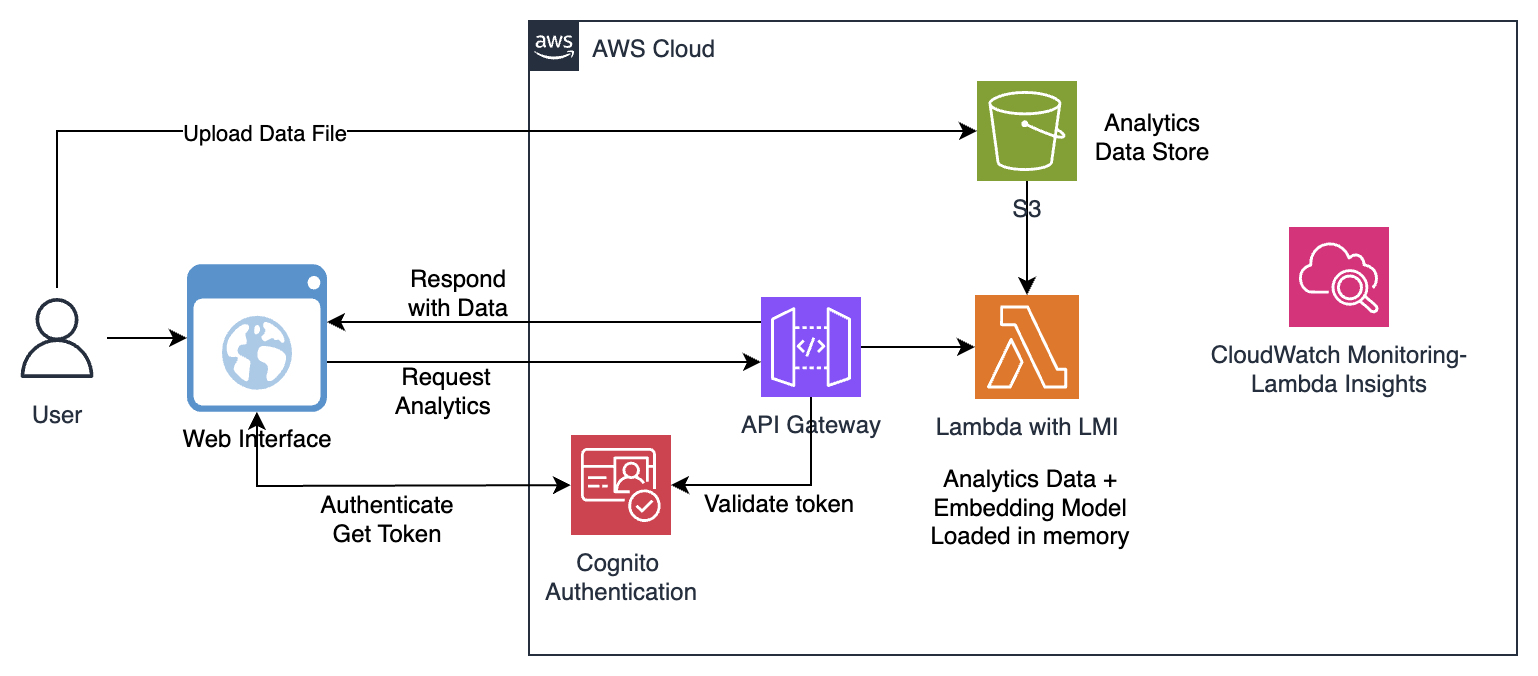
Lambda Managed Instances now allows you to build memory-intensive apps with up to 32 GB (3x more than standard Lambda). This allows use cases like in-memory caching, large dataset analytics, and ML inference that previously required considering other services.
Scheduled scaling lets you pre-warm capacity for predictable traffic patterns with Amazon EventBridge Scheduler. This helps reduce cold start latency during known demand spikes. Tag propagation automatically applies your function tags to the underlying Amazon EC2 instances, Amazon Elastic Block Store volumes, and network interfaces. This helps finance teams with cost allocation visibility without manual tag management.
Response streaming is now available in all commercial AWS Regions, bringing full regional parity for progressively streaming data back to clients. This is useful for LLM-powered applications where users expect to see tokens as they generate rather than waiting for a complete response.
The tenant isolation mode now integrates with Event Source Mappings from Amazon SQS, Amazon Kinesis, and Amazon EventBridge. Multi-tenant SaaS applications can process messages in isolated execution environments without building custom routing logic.
If you have a fleet of functions on older runtimes, you can now upgrade runtimes at scale using AWS Transform custom. This uses AI to analyze your function code, identify breaking changes for the target runtime version, and generate the code modifications needed. This can help teams save manual migration effort across many functions. The Serverless Office Hours live stream has more information.
Lambda added the Ruby 4.0 runtime. In addition to providing access to the latest Ruby language features, Lambda adds support for Lambda advanced logging controls.
AWS Serverless Application Model (AWS SAM) CLI now supports BuildKit for building container images from Dockerfiles. This allows faster multi-stage builds with better caching, cross-architecture image builds, and Docker secrets to keep credentials out of final image layers.
Mama J is back in the second video of a series where Eric Johnson explains what he does all day at work to his mother. Previously, they talked serverless and Lambda. This time it’s containers, what they are, why they exist, and how AWS manages them at scale. Eric goes through the “it works on my machine” problem, how Docker builds images, container orchestration and how containers differ from Lambda.
View the video on the AWS Developers YouTube channel.
AWS Step Functions has an Amazon Bedrock AgentCore-powered agentic reasoning step. You can embed AI agent reasoning directly inside a workflow as a native step type. This bridges structured orchestration with autonomous agent behavior. Your workflow handles the deterministic parts such as branching, retries, timeouts, parallel execution, while the agentic step handles the parts that require flexible reasoning.
Amazon EventBridge Scheduler added 619 new SDK API actions as targets, including Lambda Managed Instances operations. This means you can schedule calls to a much broader set of AWS APIs without writing a Lambda function.
A new post walks through building a multi-Region event-driven failover architecture with Amazon EventBridge and Amazon Route 53. The pattern uses Amazon EventBridge global endpoints with Route 53 health checks to automatically route events to a healthy Region during failures. This provides active-active or active-passive resilience for event-driven workloads.
The Amazon Bedrock AgentCore harness reached general availability. Two API calls give you a running agent in seconds which runs in its own isolated environment with a filesystem and shell. It can read files, run commands, and write code safely.
AgentCore Payments (preview) allows agents to autonomously access and pay for APIs and MCP servers, opening up agent-to-agent commerce. AgentCore Memory has metadata for long-term memory so agents retain and recall context across sessions. Web Search on AgentCore grounds agents in current, cited web knowledge. The Runtime now supports bring-your-own file systems from S3 Files and Amazon Elastic File System, and Node.js for direct code deployment.
The open source Strands Agents SDK shipped three capabilities. Context management that cuts token costs in half by intelligently pruning what goes into the model context window, Strands Shell for sandboxed agent code execution, and Strands Evals 1.0 with chaos testing and adversarial red teaming. This can reduce costs to help make production agent workloads cheaper without sacrificing quality. A Serverless Office Hours live stream covered the new features in depth.
The TypeScript SDK reached general availability, giving JavaScript and TypeScript developers the same model-driven agent framework. Erik Hanchett ran this live stream with more details. A new blog post on building research assistants with Strands walks through the full app from prototype to working application in about 200 lines of Python.
The Agent Toolkit for AWS became generally available with three plugins (aws-core, aws-agents, aws-data-analytics), over 30 curated skills, and the AWS MCP Server. View this video for an introduction. This gives AI coding agents such as Kiro, Claude Code, and Cursor expert AWS knowledge which helps to reduce errors and lower token costs. For more information on the serverless tools available when using AI, see this Serverless Land resources page.
Serverless Office Hours ran a live stream series finding out how experts use AI to build serverless applications. Hear from:
Ran Isenberg, Serverless Hero on how he ships with Claude every day and what actually moves the needle.
AWS Community Builder, Darryl Ruggles on how he built a full-featured blogging platform on AWS serverless services using Claude Code and MCP servers.
Mark Sailes shows how serverless experts built Study from Experts, a focused video learning platform for AWS professionals.
Brian Zambrano and Sean Kendall walk through how to build a serverless application from prompts using Kiro and MCP servers.
Kiro launched Kiro Pro Max and an iOS mobile app for approving and monitoring agentic coding sessions from your phone. Amazon Q Developer IDE plugins are transitioning to Kiro. The Kiro power for AWS DevOps Agent connects your IDE directly to production intelligence. You can investigate incidents and generate fixes without context switching.
Join our live stream every Tuesday at 11 AM PT for live discussions, Q&A sessions, and deep dives into serverless technologies. View episodes on-demand at serverlessland.com/office-hours.
The Serverless landing page has overall information about building serverless applications. The Lambda resources page contains case studies, webinars, whitepapers, customer stories, reference architectures, and even more Getting Started tutorials.
You can also follow the Developer Advocacy team to get the latest news, follow conversations, and interact with the team.
And finally, visit Serverless Land for your serverless needs.