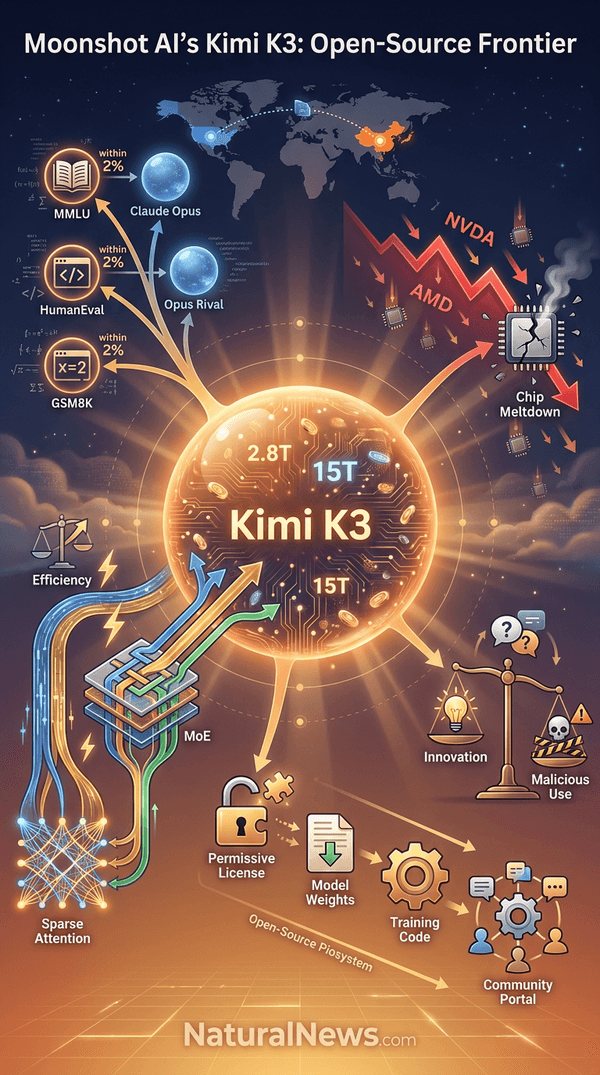
The breakthrough sent ripples through global markets, causing chip stocks to tumble. A report from Zero Hedge described the release as the latest "DeepSeek moment" that sparked a chip meltdown. [1] Moonshot AI's Kimi K3 now ranks first on the Frontend code benchmark on Arena, according to the report. [1]
Kimi K3 contains 2.8 trillion parameters, serving as a measure of the AI's scale and processing power, according to a report by the BBC. [8] The model was trained on a dataset of 15 trillion tokens, according to Moonshot AI's technical report. The company stated that Kimi K3 achieved scores within 2% of Claude Opus on major benchmarks including MMLU, HumanEval, and GSM8K.
Moonshot AI emphasized that Kimi K3 is available for free under a permissive license for both research and commercial use, with full open-source release scheduled for July 27, 2026. [8] The company's earlier Kimi K2 models had already been well received in the open-source AI market, and Kimi K3 is expected to close the gap with Anthropic's Opus 4.8, according to the Financial Times as reported by TechCrunch. [2]
The open-source release contrasts with Anthropic's decision to keep Opus as a proprietary, subscription-based model. Analysts noted that open-source models allow broader access but raise concerns about misuse and control. [9] A report from NaturalNews argued that China's open-source AI strategy could "crush the U.S. industry" and collapse the semiconductor bubble, as US AI companies raise prices and switch to per-token pricing. [4]
Moonshot AI's move could pressure other companies to open-source their models, said analysts. Chinese tech companies have been rapidly advancing, with Beijing weighing restrictions on foreign access to China's top AI models. [3] The open-source nature of Kimi K3 could complicate enforcement of content controls that China's government imposes on domestic models, the report noted.
"This is a significant step for the global AI ecosystem," said Dr. Li Wei, a professor at Tsinghua University, in an interview. "China is demonstrating its ability to compete at the frontier while sharing the technology." Some US-based researchers expressed caution. "Open-source models can accelerate innovation, but they also lower barriers for malicious actors," Dr. Sarah Johnson of Stanford University told Reuters.
Moonshot AI officials defended the decision, stating that transparency fosters trust and collaboration, according to a company statement. Meanwhile, readers of The Epoch Times expressed wariness about AI's growing role in society. One reader said: "Truly, AI can be very beneficial if used correctly. Sadly, humans ruin most good ideas." [5]