Japan's major companies are increasingly hesitant to hire new graduates as AI automation replaces routine work across industries. The shift threatens job security not only for entry-level workers but also for older employees, nonregular workers, and managers facing mounting competitive pressure.
TOKYO - Japan’s major companies are showing growing caution toward hiring new graduates as artificial intelligence begins replacing routine work, while survey results suggest that older employees, nonregular workers and even managers could also face mounting pressure by 2030.
A Kyodo News survey of 111 leading Japanese companies conducted in spring 2026 found that 25 companies, or 23% of the total, planned to reduce the number of new graduates hired for entry in fiscal 2027.
The proportion was up 11 percentage points from the previous year’s survey. Companies planning to reduce recruitment outnumbered those intending to increase hiring for the first time in five years.
Hiring declined sharply during the coronavirus pandemic as economic activity stalled, but companies subsequently expanded recruitment as the economy recovered and labor shortages became more severe. The latest findings suggest that this rapid increase in hiring may now be losing momentum.
Some companies reducing graduate recruitment said they were strengthening midcareer hiring to secure employees capable of contributing immediately. More prominent, however, were responses indicating that companies planned to limit their workforces through digitalization and greater operational efficiency.
The results indicate that AI has already begun replacing some corporate tasks.
Since OpenAI made its conversational generative AI service ChatGPT publicly available in 2022, the technology has become increasingly capable of performing work such as programming, designing systems and preparing documents. These functions include many relatively basic assignments traditionally given to younger employees.
AI is also transforming the recruitment process itself. Job applicants are increasingly using generative AI to write application forms, making it more difficult for companies to evaluate candidates. Students may therefore need to demonstrate skills, experience or judgment that cannot easily be reproduced by AI.
The survey also asked companies how much of their current work they expected AI to replace by around 2030. Sixty-six companies, representing about 60% of respondents, said AI would replace at least some existing duties.
Of these, 51 companies expected AI to replace between 10% and 30% of their work. Fourteen projected that between 40% and 60% would be replaced, while one company expected AI to take over more than 70% of current duties.
Full story reconstructed from Newsonjapan.com. Formatting and media may differ from the original.
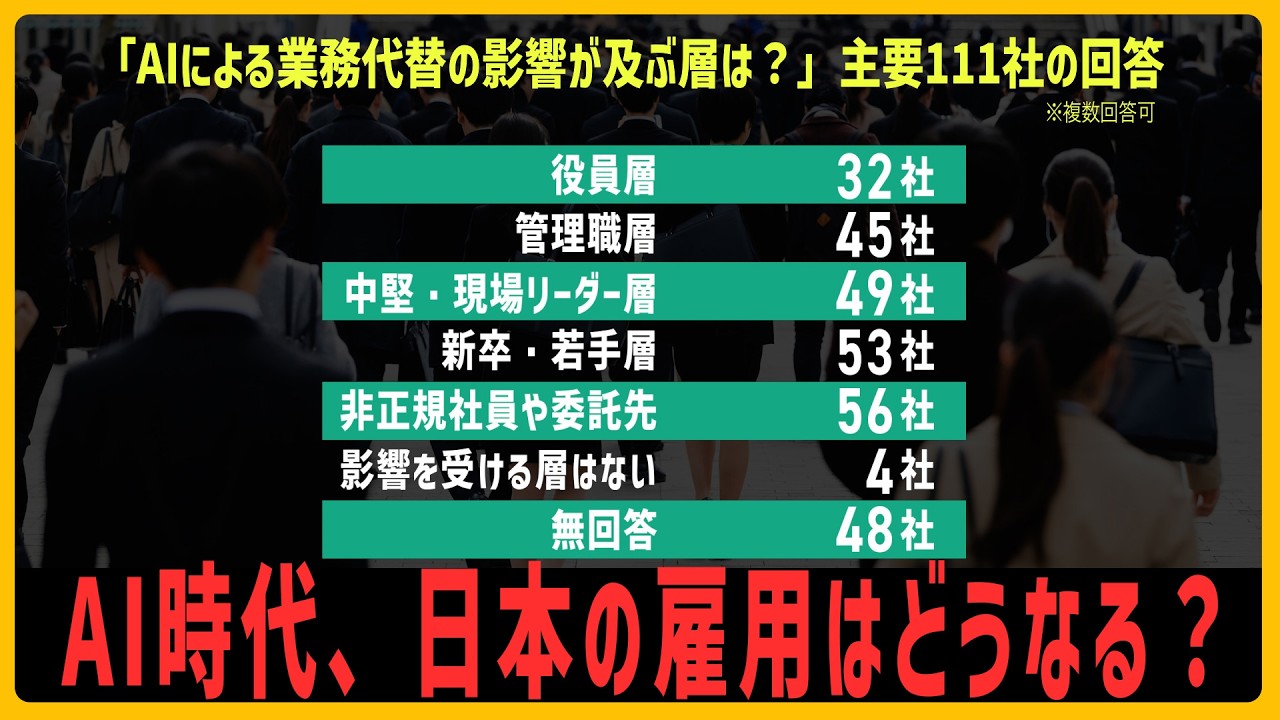
Companies were also asked which groups of workers were likely to be affected, with multiple responses permitted.
Nonregular employees and temporary workers were selected by 56 companies, the highest number among the categories. New graduates and younger employees were cited by 53 companies, followed by midcareer employees and frontline leaders at 49 companies.
Managers were selected by 45 companies, while 32 said corporate executives could also be affected.
The findings suggest that companies generally believe senior managers and executives are less likely to be replaced than younger or nonregular workers. One reason is that executives remain responsible for explaining decisions to clients, shareholders and other stakeholders, a role that companies may be reluctant to delegate to AI.
Senior positions also require judgment and accountability. AI can analyze information and make recommendations, but final decisions must still be made by people who accept responsibility for the consequences.
Physical occupations are also widely considered less vulnerable to immediate replacement. Jobs involving construction, interior finishing and other forms of manual labor remain difficult for AI alone to perform.
Outside such fields, workers may increasingly need to become skilled at using AI, developing it or building systems around it. The ability to evaluate AI-generated advice and make final decisions is also likely to become more valuable.
In the United States, where AI adoption is more advanced, Amazon.com executives said in 2025 that the introduction of AI could lead to reductions in the company’s workforce.
A survey by the Federal Reserve Bank of New York also showed that unemployment among recent university graduates had risen above the rate for workers overall, pointing to increasing difficulty for young people seeking professional employment.
The more work AI replaces, the greater the pressure on companies to reduce staffing and restructure their organizations.
Japan, however, may follow a different path from the United States because of fundamental differences in employment practices.
Japanese companies have traditionally recruited new graduates with the expectation that some will become future executives. Even as AI reduces the amount of work performed by people, companies may continue hiring graduates to secure their next generation of management candidates.
Japan’s severe labor shortage could also help preserve the current seller’s market in which students have an advantage over employers.
As a result, workforce adjustments may fall more heavily on middle-aged and older employees whose roles are considered unclear or redundant, as well as nonregular workers performing administrative duties.
The survey suggests that the risks created by AI will not be limited to students entering the workforce. Middle-aged employees who struggle to use AI may face some of the greatest pressure as companies reassess which roles remain necessary.
By 2030, the dividing line may be less about age or job title than about whether employees can use AI effectively, exercise independent judgment and perform work for which they remain personally accountable.
Japan was gripped by intense heat on July 21, with temperatures reaching 40 C or higher at three observation points in Gifu and Aichi prefectures for the first time this year, while Tokyo recorded its third consecutive day above 35 C.
Prime Minister Sanae Takaichi has drawn criticism over a social media post describing five hours of sleep as a rare luxury, as the extended Diet session prepares to begin Upper House debate on a controversial bill to establish secondary capitals outside Tokyo.
Breathtaking 4K footage filmed from a helicopter offers a sweeping aerial view of Mount Fuji and its majestic surrounding landscape.
A covert network of shuttle tankers is carrying crude through the increasingly dangerous Strait of Hormuz as renewed fighting between the United States and Iran disrupts shipping and raises concerns over how Japan will secure the oil it needs.
Russian Deputy Foreign Minister Andrey Rudenko has criticized moves by Japanese and Ukrainian companies to cooperate on drone technology, warning that such ties would be regarded by Moscow as a "clear hostile act."
Japan’s major companies are showing growing caution toward hiring new graduates as artificial intelligence begins replacing routine work, while survey results suggest that older employees, nonregular workers and even managers could also face mounting pressure by 2030.
More than 40,000 engineers, business leaders and technology enthusiasts gathered at Makuhari Messe in June for AWS Summit Japan 2026, one of Japan’s largest artificial intelligence events, where new systems included an AI platform that has cut the time FC Tokyo staff spend selecting match photographs to roughly one-third of the previous level.
日本は長年にわたり、アジアで最も活発な個人トレーダーコミュニティの一つとして知られてきました。
Building passive income through AI automated trading is one of the most appealing features of MoneySimpler; however, investors who rely on this type of income (such as retirees) must diversify their portfolios to weather market downturns.
Two Taiwan-born suspects believed to be members of a Taiwanese fraud ring have been arrested on suspicion of using AI-generated videos featuring prominent figures to defraud a woman in her 80s of 17 million yen.
Ask ten people for the best AI platform in 2026 and you get ten chatbot names. That is the wrong question.
Handa City in Aichi Prefecture will begin testing artificial intelligence as an interviewer in its recruitment exams, part of a trial that could change how local governments assess job applicants.
Demand for next-generation power semiconductors is expected to grow as artificial intelligence servers place heavier loads on power infrastructure, raising interest in technologies once viewed mainly as a component for electric vehicles.