
Technology has an unusual habit of revealing itself twice. The first version appears quietly, almost unnoticed, inside research papers, patent filings, laboratory demonstrations and corporate presentations that attract little attention beyond specialists. The second version arrives years later, polished into a consumer product that suddenly convinces everyone the breakthrough happened overnight. History repeatedly favors this illusion. By the time society begins discussing a technological revolution, thousands of engineers have already spent years solving problems the public never realized existed. That gap between discovery and public awareness has become one of the defining characteristics of the twenty-first century, and nowhere is it more apparent than in the race to build machines that no longer resemble machines at all.
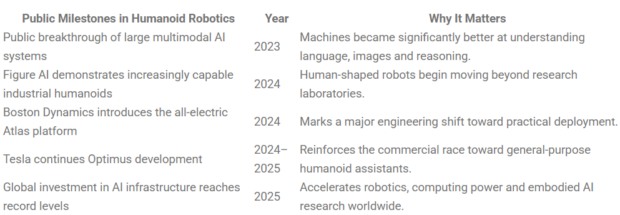
During the last three years alone, humanoid robotics has advanced at a pace few analysts considered realistic even a decade ago. Tesla continues developing Optimus as a general-purpose humanoid assistant, Figure AI has demonstrated robots capable of performing increasingly complex industrial tasks while collaborating with advanced language models, Boston Dynamics has introduced an entirely electric generation of Atlas after retiring one of the most recognizable research robots ever built, and companies such as Sanctuary AI, Agility Robotics and Apptronik are openly competing to place human-shaped machines inside factories, warehouses and commercial environments. Simultaneously, breakthroughs in computer vision, reinforcement learning, synthetic materials and multimodal artificial intelligence have dramatically reduced the distance between experimental prototypes and practical deployment. None of these developments belong to science fiction anymore. They are unfolding in plain sight, documented through academic publications, investor briefings and live demonstrations watched by millions around the world.
Yet an uncomfortable pattern has begun emerging alongside this extraordinary progress. Every major technological leap seems to generate a parallel conversation taking place far from universities and conference halls, unfolding instead across anonymous forums, encrypted chat groups and obscure corners of the internet where speculation often grows faster than evidence. Some theories disappear within hours because they collapse under the weight of obvious contradictions. Others survive for years despite the complete absence of proof, not because they successfully explain reality but because they ask questions that remain surprisingly difficult to dismiss. One recurring idea has become particularly persistent: if companies publicly demonstrate machines capable of walking, reasoning and manipulating objects with human-like dexterity today, what might exist inside research facilities whose work will not become public until five or even ten years from now?
No credible evidence has ever answered that question.