Is Immigration Becoming a Catholic Dogma? Inside Pope Leo XIV’s New Agenda
Freerepublic.com·July 20, 2026
AI Summary
Pope Leo XIV's allies are promoting a new immigration initiative across America that critics argue transforms immigration policy into a moral absolute rather than a prudential political question. The Church's evolving stance on immigration raises debates about whether it is overstepping into political advocacy on matters that allow for legitimate disagreement among Catholics.
On July 15, several outlets reported the news of a very particular tour that Mattia Ferrari, an Italian priest and coordinator of the World Meeting of Popular Movements (WMPM), is carrying out from the end of June across 21 cities in the United States, starting from California and reaching New York, passing through the State of Washington, Texas, Colorado, Pennsylvania, Minnesota, Indiana, Michigan, Louisiana, Washington D.C., and New Jersey. The tour is expected to end around the first days of August.
The ultimate goal of this tour is to receive and listen to the various immigrant families, to understand their suffering and the difficulties of integration, and to raise awareness not only among public opinion in the cities visited, but above all among the bishops of the respective dioceses, so that they may become more sensitive to the issue.
Ferrari is not traveling alone: he is accompanied by two figures whose profiles are highly revealing. The first is Luca Casarini, an Italian pro-migrant activist, no-global activist, and co-founder of the NGO “Mediterranea Saving Humans.” Although Casarini has stated that he “rediscovered himself as a Christian among migrants at sea,” his profile is not exactly that of a devout Catholic. For this reason, when Pope Francis invited Casarini as a “special guest” without voting rights to the XVI Ordinary General Assembly of the Synod of Bishops (October 2023), many understandably wondered on what grounds he should discuss pastoral matters and doctrine alongside bishops, theologians, and cardinals.
The issue of immigration is no longer presented as a political or prudential matter, but as a moral imperative—one that increasingly takes precedence over security, social cohesion, economic sustainability, and the right of nations to regulate their own borders.Tweet this quote
In The Remnant Newspaper I have already discussed about Casarini and his connection with Zuppi, Sant’Egidio, and above all with Pope Francis, with whom he appears to have been friends at least since 2020, in another article to which I refer.
On the one hand, therefore, a friend of Francis. On the other hand, Ferrari was accompanied by another figure, this time a friend of Leo from the days of Chiclayo in Peru. This is César Piscoya Chafloque, a prominent consultant of the Center for Programs and Networks of Pastoral Action of the Latin American Episcopal Conference. A longtime collaborator of Prevost, when the latter was still the “bishop of the peripheries.”
This journey of intra-ecclesial awareness-raising, which presumably will contribute to the drafting of some future document or is part of a broader program, is not merely the result of the initiative of these three figures, but has behind it the support of the Holy See.
Full story reconstructed from Freerepublic.com. Formatting and media may differ from the original.
Indeed, Ferrari is—as mentioned—the coordinator of the WMPM, the “World Meeting of Popular Movements.” As stated on the presentation page of the website, it was founded at the initiative of Francis in 2014 to promote dialogue between the Catholic Church and popular movements.
What are popular movements? The expression is simply an alternative way of referring to what in Spanish are known as comunidades de base, “base communities.” These are small groups of Christians that emerged in Latin America between the 1960s and 1970s, especially in Brazil, as a response to a perceived distance between the institutional Church and the poorest sectors of society.
Hospitality toward the stranger is a work of mercy—but mercy can never be separated from justice and prudence. Christian charity does not abolish prudence; it perfects it.Tweet this quote
Inevitably, these communities became—particularly after the Medellín Conference (1968)—the heart of liberation theology, a heterodox current of Catholicism that seeks to reconcile Marxism and the Gospel, interpreting Christianity as a form of liberation from economic, political, and social injustices.
From liberation theology (let us remember: officially condemned by the Church in 1984 with the Instruction Libertatis Nuntius) originated the theology of the people, a more moderate variant, which differs from the former not so much in doctrine as in method: no longer class struggle and an openly conflictual relationship with the Church, but rather gradual awareness-building and an ambivalent relationship with the hierarchy. Among the creators and founders of the theology of the people was Juan Carlos Scannone, Jesuit and teacher of Jorge Mario Bergoglio.
With the establishment of the Dicastery for Promoting Integral Human Development, the theology of the people has factually become the official framework of the post-Bergoglian Church’s social doctrine. The recent magisterial documents of Pope Leo XIV naturally confirm all this: it is enough to read the apostolic exhortation Dilexi te and the encyclical Magnifica humanitas.
The base communities—let us call them by their original name—fight for three principles very dear to Pope Francis: land, housing, and work. These are obviously sacred rights of every individual. The problem concerns not the rights themselves, but rather how these rights should be guaranteed, according to the comunidades and according to Francis (and to Leo).
Put in extremely simple terms: through redistribution policies and direct state intervention. Pure socialism.
Whoever governs a political community has the moral duty to discern who can be welcomed and under what conditions, because the common good precedes every particular choice.Tweet this quote
The most important aspect to underline is—by now the reader will have understood it—another one: there is a direct, organic, and structural link between the WMPM and the Roman Curia. Indeed, the Dicastery for Promoting Integral Human Development—let us remember: also desired and created ad hoc by Francis—supports, coordinates, and partly promotes the activity of the so-called Popular Movements worldwide. This is a relationship explicitly documented in the official sources of the Holy See.
In light of this framework, Ferrari’s journey in the United States does not appear as an isolated pastoral initiative, but rather as the coherent expression of a precise ecclesial orientation. The issue of immigration is not addressed as a political, legal, or prudential matter, in which different solutions may legitimately confront one another, but as a moral imperative—I would dare say: an ideological one—that tends to prevail over other priority requirements of the common good, such as security, social cohesion, economic sustainability, and the right of States to regulate their own borders.
From this perspective, every restrictive and defensive policy is presented as a form of closure and blameworthy discrimination, while unrestricted acceptance is elevated as the privileged criterion of evangelical authenticity.
In the contemporary ecclesial debate, one speaks only and incessantly about the rights of migrants. We heard this again from Pope Leo XIV during his recent apostolic journey to Spain. They speak of the right to emigrate; sometimes they also remember the right not to emigrate; rarely is there mention of the duty of migrants to respect the laws of the country in which they live.
But one never speaks of the rights of those who welcome migrants, which, on a logical level, should come first and which today are systematically and daily trampled upon. One only needs to open the crime section of any newspaper to realize this.
The migrant is presented as the sole holder of rights, while the host community is reduced to a collection of moral debtors, stripped of any legitimate claim to security, identity, cultural continuity, and political order.Tweet this quote
We are faced with a curious moral asymmetry and a grave omission on the part of the Catholic Church: the migrant is presented as the sole holder of rights, while the host community is reduced to an amorphous collection of holders of duties and moral debtors, a mass deprived of any legitimate claim to security, identity, cultural continuity, and political order.
In the Italian language, the word ospite is a beautiful word because it is polysemous: it can be used both in reference to the one who hosts and in reference to the one who is hosted. I believe this is a very effective way of remembering that the host and the guest must exist in a relationship of strong symmetry, in a mutual recognition of rights and duties, without which it is not possible to speak of coexistence, but rather of invasion or abuse.
Catholic doctrine has always listed hospitality toward the stranger as one of the corporal works of mercy. But mercy is never separable from justice and prudence. The masters of medieval Christian spirituality taught that Virtue is, in reality, one in act, and only by convention and for the sake of understanding do we refer to different virtues in relation to different objects. From this perspective, it is not possible to exercise mercy while lacking justice, or to practice charity while failing in prudence.
The analogy of the family is illuminating. A father who indiscriminately opened his own home to anyone, without evaluating the identity, intentions, or danger posed by his guests, would above all betray his duty toward his wife and children. His primary responsibility is to safeguard the good of the family entrusted to him.
Similarly, whoever governs a political community has the moral duty to discern who can be welcomed and under what conditions, because the common good precedes every particular choice. This is not merely a Traditional Catholic principle. It is a concept that appeals to natural law, which precedes every religious discourse.
From this point of view, it is a source of profound disgust and bitterness that the Catholic episcopate, even before the Holy See itself, constantly bases its social discourse not on the reality of facts, but on international human rights charters and on positive law developed by various supranational organizations. We can say, without fear of exaggeration, that today the various charters of so‑called “fundamental” human rights are the secularized variant of the Decalogue, assuming the same sacral value for a God-less world.
Classical Catholic doctrine has never taught the existence of an absolute right to enter any country regardless of the will and interests of the population residing there. This must today be emphasized and repeated with strength and determination, even to those who should safeguard and defend the rights of Catholics, namely our bishops.
A Church that, in the name of mercy, systematically renounces discernment risks no longer protecting either its faithful or the spiritual and material heritage it has the duty to preserve.Tweet this quote
The consequences of this approach, both outside and inside the Church, are now evident. In Europe and more generally in the West, mass and uncontrolled immigration has contributed to aggravating social tensions, public order problems, and atrocious crimes. When ideological arguments are made about the supposed infinite and inalienable dignity of every human being, the foundations of social disorder are always laid. Order is by definition hierarchical, including in moral principles and values.
The first right sacrificed when the ethical scale is arranged in this way is always that of the honest citizen, the good worker, and the Christian family, while the protection of the common good is subordinated to the wellness of the worst elements, criminals, and welfare recipients.
This, however, is also the natural outcome of democracy, which is not—as the misleading etymology of the term would suggest—the government of the people or the government of everyone, but simply the government of the majority, that is, the government of the worst.
Added to this is an aspect that would deserve further investigation. Around large migratory flows, a significant system of economic and political interests has developed: NGOs, cooperatives, public contracts, international organizations, and other actors derive direct or indirect benefits from the management of immigration.
It would be naïve to exclude that even within certain ecclesial environments there may operate dynamics of power, funding, or influence that favor the continuation of this model. Precisely for this reason, the issue deserves lucid investigation and examination, grounded in the truth about the common good rather than in moral slogans and emotional appeals.
I would like to conclude with an image that, more than many theoretical analyses, seems to take on the value of a tragic allegory of the condition of the contemporary post-Bergoglian Church.
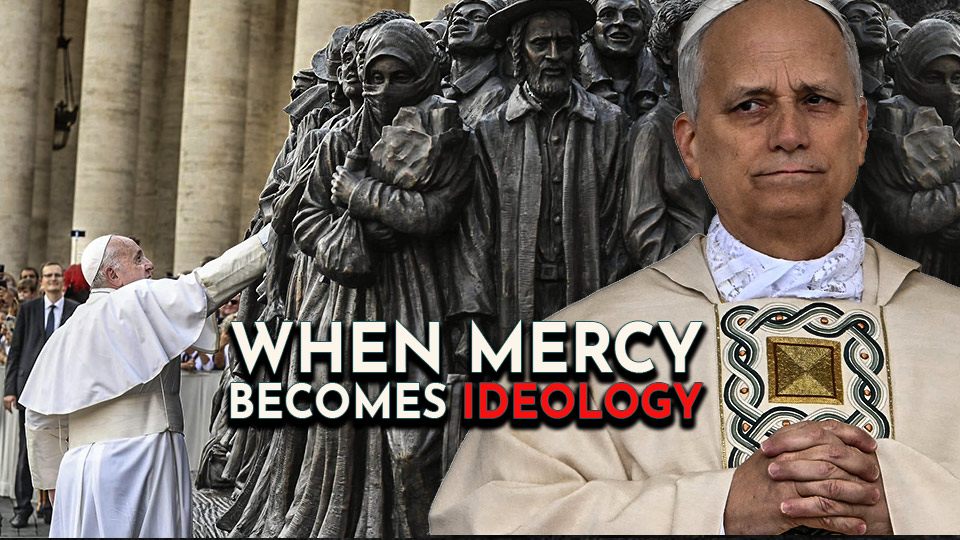
In November 2016, on the occasion of the Jubilee of Mercy dedicated to “socially excluded” people, Pope Francis shook the hand of a Rwandan immigrant, reiterating that the poor and migrants are “more inclined to be artisans of peace” and inviting the Church to “welcome, accompany, support, and integrate” those who arrive from other countries.
That man was Emmanuel Abayisenga. Having later moved to France, on July 18, 2020, he set fire to the Gothic cathedral of Nantes, destroying the great historic organ, numerous stained-glass windows, and a 19th-century canvas, as well as severely damaging the building.
After a few months in detention, the immigrant was granted hospitality by the parish priest of Saint-Laurent-sur-Sèvre, Father Olivier Maire. In 2021, Abayisenga thought it appropriate to thank him by taking his life in a brutal manner. Only in January 2026 did the French justice system sentence him to thirty years in prison followed by expulsion from the national territory.
Perhaps this is the most effective image of Catholic Social Doctrine in recent years: a Church that shakes the hand of those whom it certainly should help, but without remembering any longer that the first duty of the shepherd is to guard the flock and the house entrusted to him from anyone: even from the poor, or from those who are only apparently so.
We need your continuing support to keep FR funded. Your donations are our sole source of funding. No sugar daddies, no advertisers, no paid memberships, no commercial sales, no gimmicks, no tax subsidies. No spam, no pop-ups, no ad trackers.
If you enjoy using FR and agree it's a worthwhile endeavor, please consider making a contribution today:
Or by mail to: Free Republic, LLC - PO Box 9771 - Fresno, CA 93794
Yes, even popes can be corrupt garbage people.
Leo needs to open the Vatican to show all of us The Way.
Despite the warning of JP II, the cardinals disregarded his message and have elected two liberation theologists. Both Francis and Leo were heavily influenced by the Latin American heresy and appear not to hesitate to contaminate the Apostolic faith entrusted to them. This is what many following Vatican II have feared— any form of violence to the teachings of the church can be justified as being in “the spirit of Vatican II” even though VC II did not warrant such actions.
Catholic Charities is one of the NGOs that is facilitating human trafficking.
I am fine with him allowing all the “immigrants” he wants into the Vatican. It would be a shame but it’s his prerogative. He has no business promoting it anywhere else though.
The Dog Mom is the Catholic Church wants to bring in the immigrants to grow their congregations. That is to replace the steady decline of their congregations in America. Creating larger congregations take a little work—not something that is given to you!
Wrong! The synodal "church" makes no attempt to convert souls to the true Faith.
That’s not the same thing as letting illegal immigrants from Mexico and South America, many of whom are Catholic, come into our country and then get them into American Catholic Churches.
It is why JFK campaigned on and fought for this immigration.
I have been to the Vatican. The walls are 20+ feet tall and sloped. Hard to climb. There is airport type security to get into the city including metal detectors. There are cameras everywhere. There are lots of plain clothes security guards mixed in. It is every bit as secure as the White House. And this pope and the last one lectures us that we should allow any and everyone into our country.
A secular organization could perform the same charitable activities, Wisconsin officials argued, and the state’s high court agreed, saying that a truly religious organization would be characterized by “distinctively religious activities” such as “worship, ritual, teaching the faith, or spreading a religious message.” Since the CCB did not “attempt to imbue program participants with the Catholic faith,” the court ruled, it was not a religious organization.
Ah, but there’s the rub: instructing the ignorant. The Wisconsin Supreme Court found that the work of the Catholic Charities Bureau made no “attempt to imbue program participants with the Catholic faith.” If that is true, it is a harsh judgment.
Yes, the Gospel leaves no doubt that we, as followers of Jesus Christ, have an obligation to serve the poor. But poverty comes in many different forms, spiritual as well as material. An authentically Catholic charity would serve the feed the hungry, certainly. But it would not ignore spiritual hunger. The Lord commanded us to serve the poor. He also commanded us to “make disciples of all nations.” A truly “Catholic charity” would strive to do both.
This pope is smart. People immigrating to USA can contribute more to Catholic church compared to what they can contribute living in a poor country.
ebb, I have to give you credit for something.
You have singlehandedly done more to vilify the Roman rite of the Catholic church, cast it in a negative light, and turn people away from it than any ten people I can think of.
You give people 2-5 reasons every day to not only stay away from the Catholic church, but to run fast in the other direction as fast as possible if they get near it.
And considering that there’s very little left in Roman Catholicism that resembles Biblical Christianity, or moral character or integrity at all, it only reinforces people’s decision to stay far away.
What makes you think illegal muslim invaders will contribute to the Catholic church?
That's probably why you have apostatized from the True Church.
Disclaimer: Opinions posted on Free Republic are those of the individual posters and do not necessarily represent the opinion of Free Republic or its management. All materials posted herein are protected by copyright law and the exemption for fair use of copyrighted works.