The AI-Powered Status Quo: AI Transformation is a Test of Leadership
Briansolis.com·July 19, 2026
AI Summary
AI transformation requires strong leadership to navigate organizational change rather than simply adopting new tools and technologies. Leaders must fundamentally rethink how AI reshapes business processes and culture, as demonstrated by insights shared at AI Week in Milan.
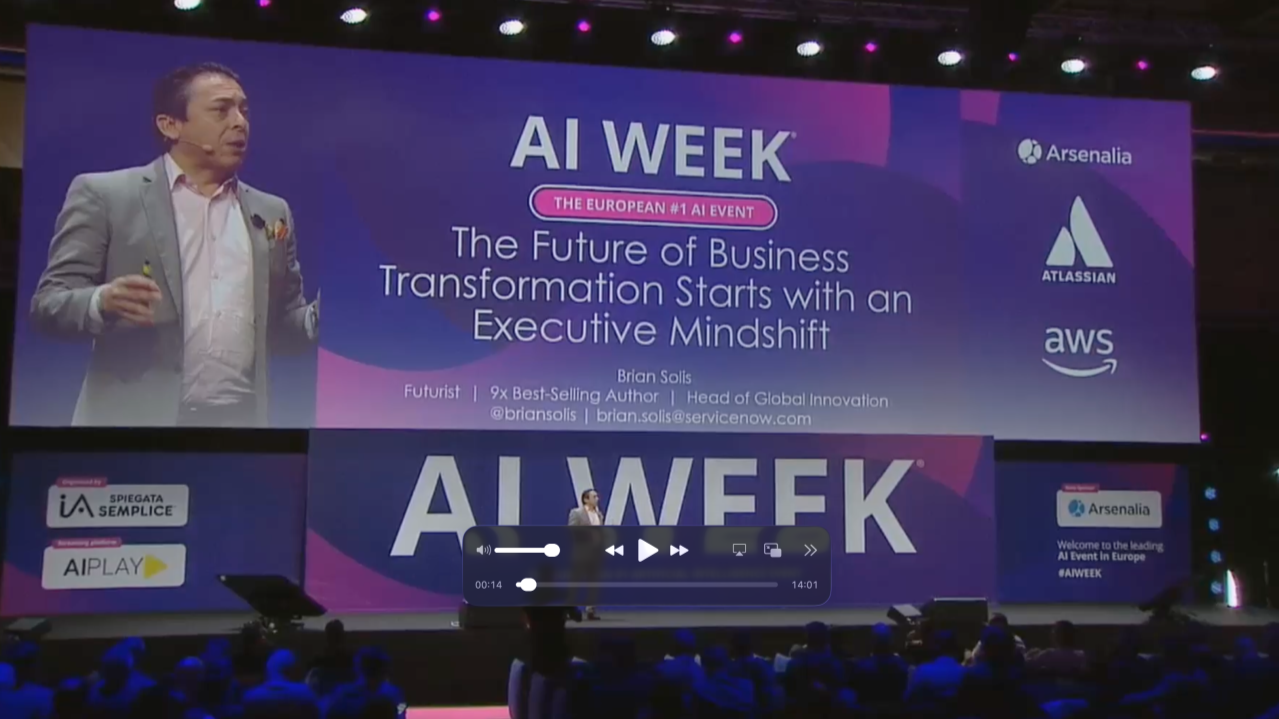
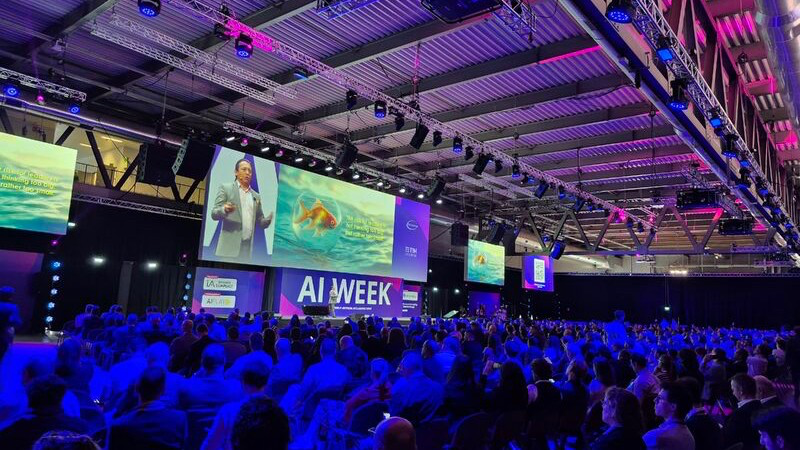
At AI Week in Milan, I had the privilege of representing ServiceNow on a stage filled with people thinking seriously about the future of artificial intelligence. Rather than offer another tour of tools, trends, and predictions, I wanted to challenge the premise guiding much of today’s enterprise investment: that applying AI to the existing business is the same as transforming it.
Most organizations are using AI to accelerate processes, automate tasks, increase output, and extract efficiencies from operating models designed for another era. Those gains are real, particularly when companies have the discipline to convert productivity into measurable value. But a faster version of yesterday’s company is not necessarily prepared for tomorrow. As scrutiny around AI returns intensifies, leaders will have to confront whether their investments are creating new value or simply reinforcing an AI-enabled status quo. The growing effects of AI on judgment, originality, attention, and the rising volume of synthetic mediocrity deserve their own conversation. For now, the more urgent question is whether we are using intelligence to rethink the business—or merely to make the old one run harder.
What if a company successfully deploys AI across the enterprise and still misses the future? What if it becomes more efficient without becoming more innovative, more productive without becoming more valuable, and more automated without ever becoming truly transformed?
AI is capable of helping organizations rethink how they operate, how they create value, how people work, and what customers experience. But technology cannot deliver that future on its own. Leaders must be bold. They must be willing to question the assumptions, processes, structures, and business models that made the current organization successful. Otherwise, AI will simply make the past run faster and more efficient. That’s fine and all, but that hardly makes any organization more competitive.
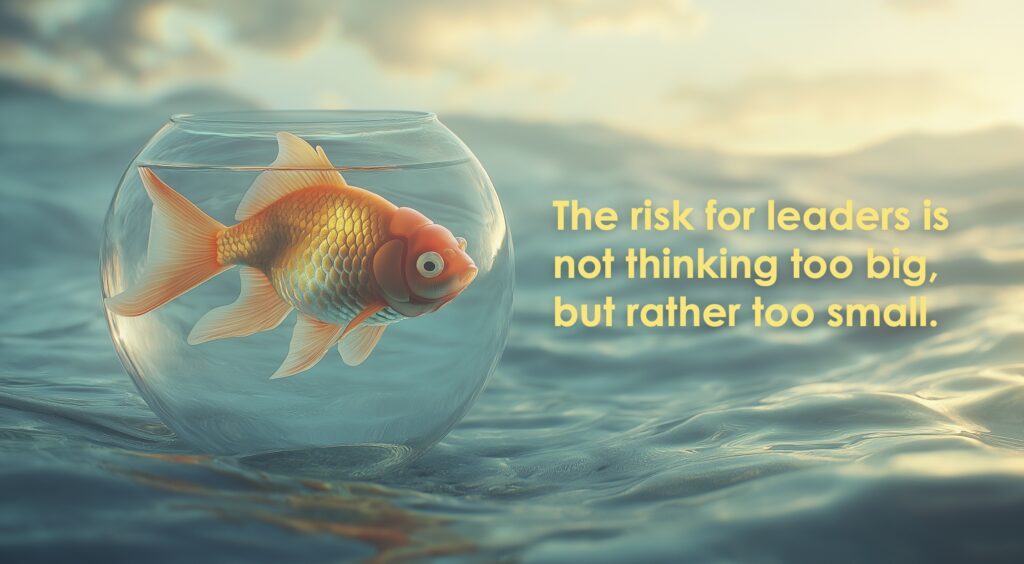
The risk for leaders is not thinking too big, but rather too small. They’re treating a once-in-a-generation platform for reinvention as another program for optimization and cost reduction.
In my keynote, I explore why the future of business transformation begins with an executive mindshift, how organizations can move beyond automating yesterday’s work, and what it will take to compete in a world shaped by augmented employees, AI agents, digital coworkers, and increasingly autonomous operations.
Full story reconstructed from Briansolis.com. Formatting and media may differ from the original.
Digital transformation was supposed to reinvent organizations for a digital world. In reality, much of it digitized the work companies were already doing. Paper forms became online forms. Meetings moved to video platforms. Legacy applications migrated to the cloud. Existing processes became faster and more accessible, but the logic behind those processes often remained untouched.
Many of today’s most popular enterprise use cases focus on summarizing meetings, generating content, responding to customers, writing code, routing requests, reducing queues, deflecting cases, or completing repetitive tasks. These applications are useful and can produce meaningful returns. They can remove friction and give employees time to focus on work that requires judgment, creativity, empathy, and expertise.
But they also begin with a familiar question: How can AI help us do what we already do more efficiently? And in even more narrow thinking, the question prioritizes automating work to displace workers.
When leaders focus exclusively on automating or accelerating existing work, they begin with the assumptions, constraints, and organizational structures of the past. They optimize the process before questioning why it exists. They automate a task before considering whether the task should be necessary in a world with AI. They improve a customer journey without asking whether an entirely different experience could now be designed.
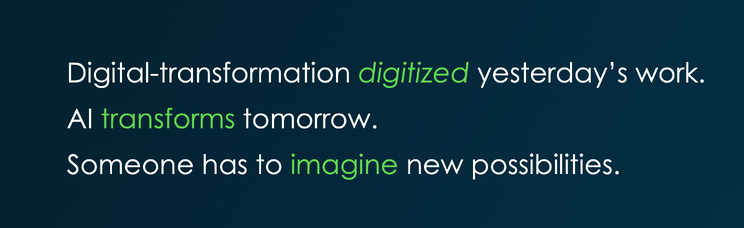
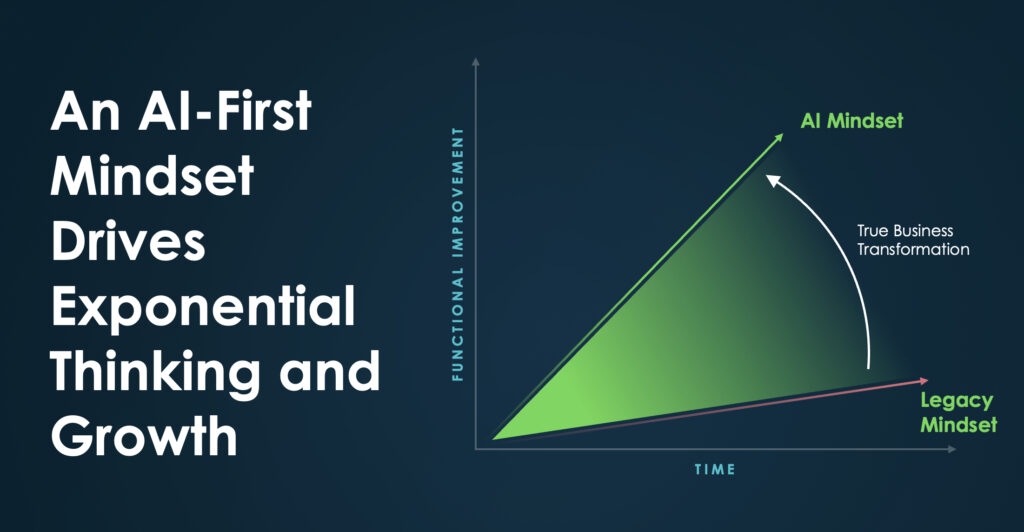
Even though digital transformation digitized yesterday’s work vs. transforming it, AI gives us an opportunity to transform tomorrow. Actually, AI demands it and so will the market. Nonetheless someone still has to imagine what tomorrow could be. If you’re waiting for someone to tell you what to do or if you’re waiting to be disrupted, you’re on the wrong side of innovation…and history.
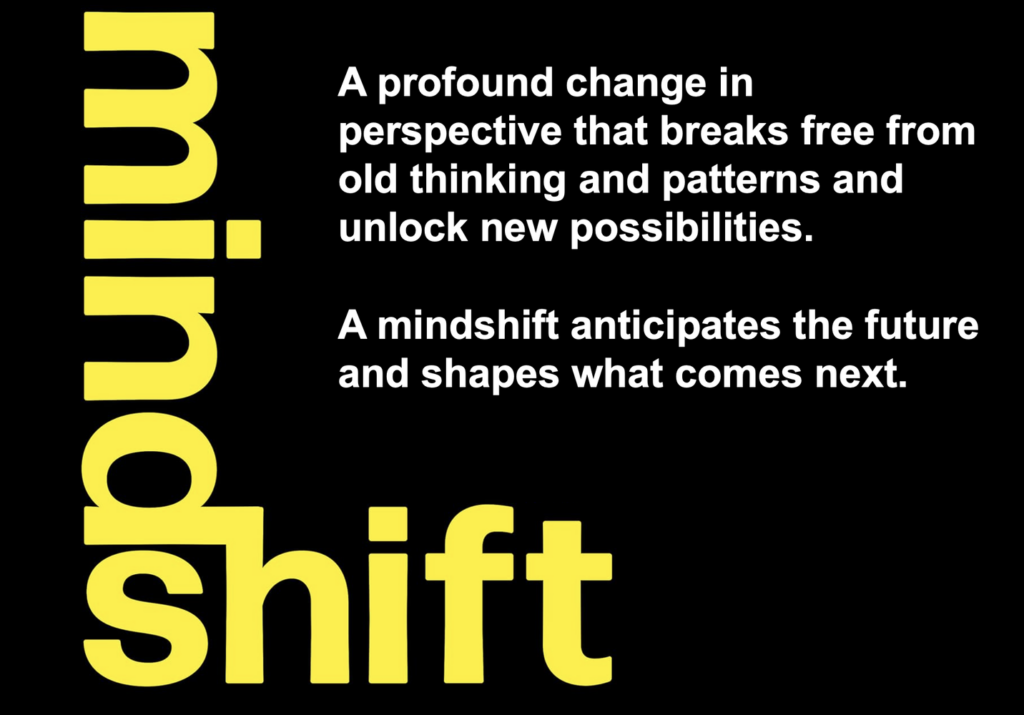
A mindshift is more than an openness to change. It is a profound change in perspective that helps us break free from old patterns and see possibilities that were previously hidden by our experience. And experience can be both an advantage and a limitation.
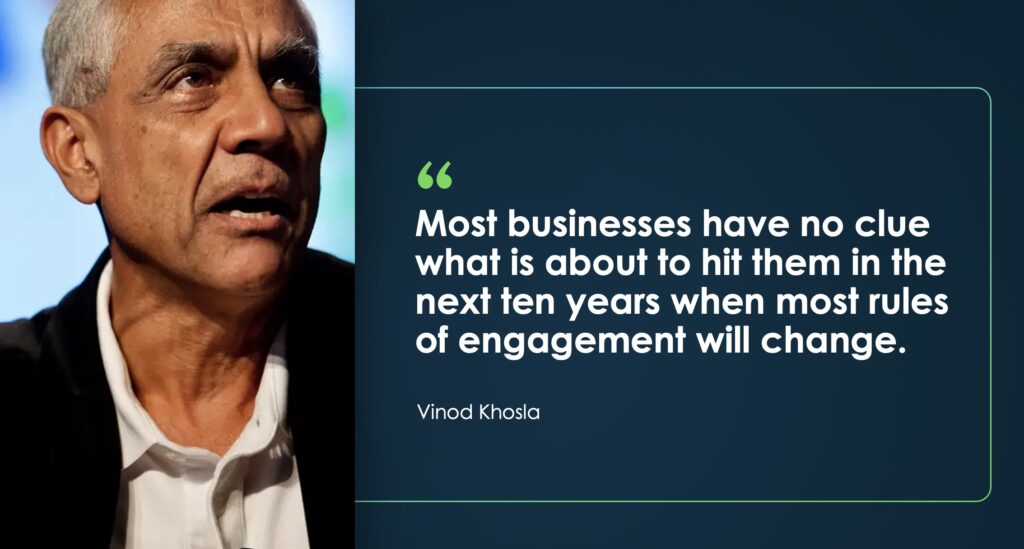
Leaders are often rewarded for knowing how their companies and industries work. They understand the operating model, the economics, the customers, the competitors, and the rules of engagement. But when those rules begin to change, expertise can unintentionally become a defense of the status quo.
The electric light bulb did not emerge from the continuous improvement of candles. It required someone to stop asking how to make a better candle and begin imagining a different way to create light.
AI demands the same break from linear thinking. The strategic question is no longer only how to make today’s business more productive. It is whether the current vision is ambitious enough for a world in which intelligence can be embedded into every process, interaction, product, service, and decision.
What could your company become if it were designed today around intelligence rather than retrofitted with it? What would the organization look like when employees are augmented by AI, agents coordinate work across functions, and digital coworkers execute within clearly defined boundaries? Which roles become more valuable, which skills become essential, and which assumptions about scale no longer apply?
These are not technology implementation questions. They are strategic questions about the future identity of the enterprise. Someone has to be accountable for designing it.
A digital mindset is often defined by “what” and “how.”
What can we digitize? How can we make this process faster? How can we increase performance, reduce effort, or operate more efficiently?
An AI-first mindset adds two more consequential questions: why and what if.
Why does this process take so long? Why are customers asked to repeat information the company already possesses? Why does one workflow move through several departments and disconnected systems? Why are talented employees spending so much time reconciling information, searching for answers, or navigating organizational complexity?
Then comes the question that opens the door to reinvention: What if we did not have to operate this way at all?
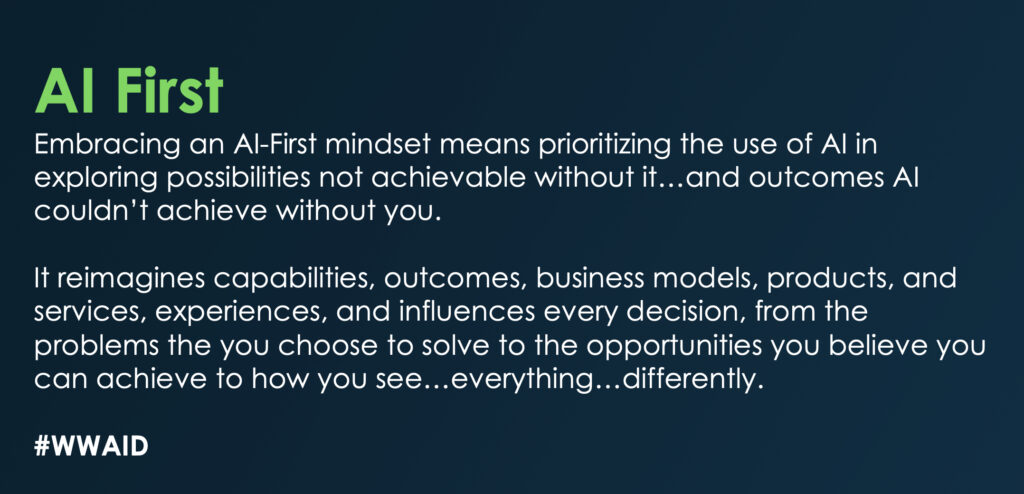
This is the idea behind WWAID: What Would AI Do?
WWAID is not about outsourcing thinking or judgment to machines. It is a pre-prompt mindset that challenges us to rethink the problem before we ask AI to solve it. It helps leaders step outside the limitations that shaped the original process and consider what might be possible when intelligence is available across systems, data, workflows, and decisions.
Before automating a task, ask whether AI could help eliminate the need for it. Before improving a workflow, ask whether the entire experience could be redesigned around the outcome. Before adding AI to a product, ask how intelligence might change the product’s purpose, value, or business model.
The most interesting opportunities emerge when AI is not simply used to replace human effort, but to augment human potential. In that sense, perhaps this is not only about artificial intelligence. It is about augmented intelligence: helping people think more expansively, make better decisions, exercise creativity, and achieve outcomes that neither humans nor machines could accomplish independently.
In Milan, I described two paths organizations need to pursue simultaneously.
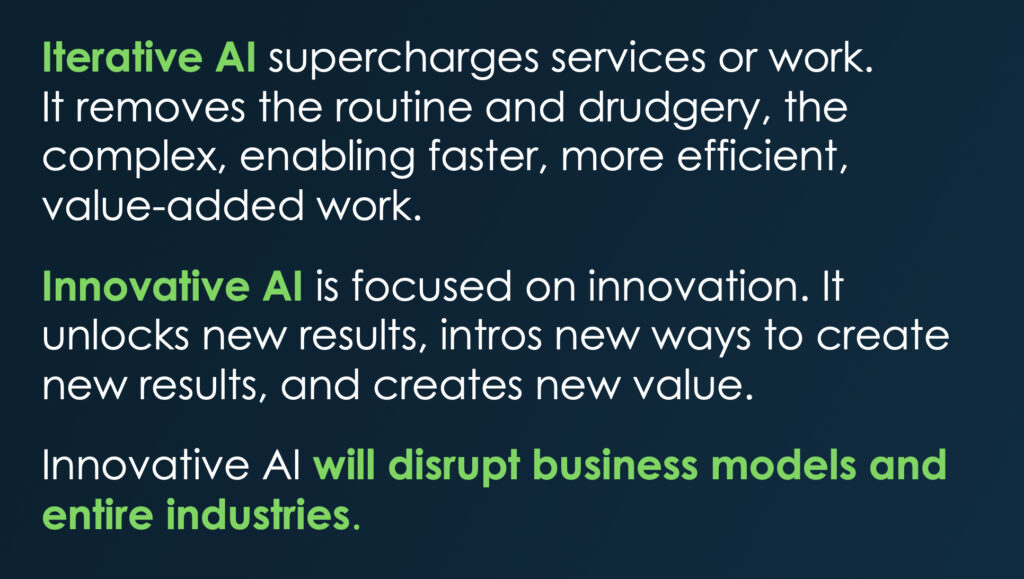
The first is iterative AI. It improves existing services and work. It removes routine tasks and operational complexity, helping people work faster, make better decisions, and spend more time on higher-value activities. Iterative AI is essential because many companies are still burdened by fragmented systems, manual processes, technical debt, and workflows that have accumulated over decades.
The second is innovative AI. This is where organizations use intelligence to create new capabilities, experiences, products, services, and business models. Rather than improving the existing value chain, innovative AI can redefine how value is created and delivered.
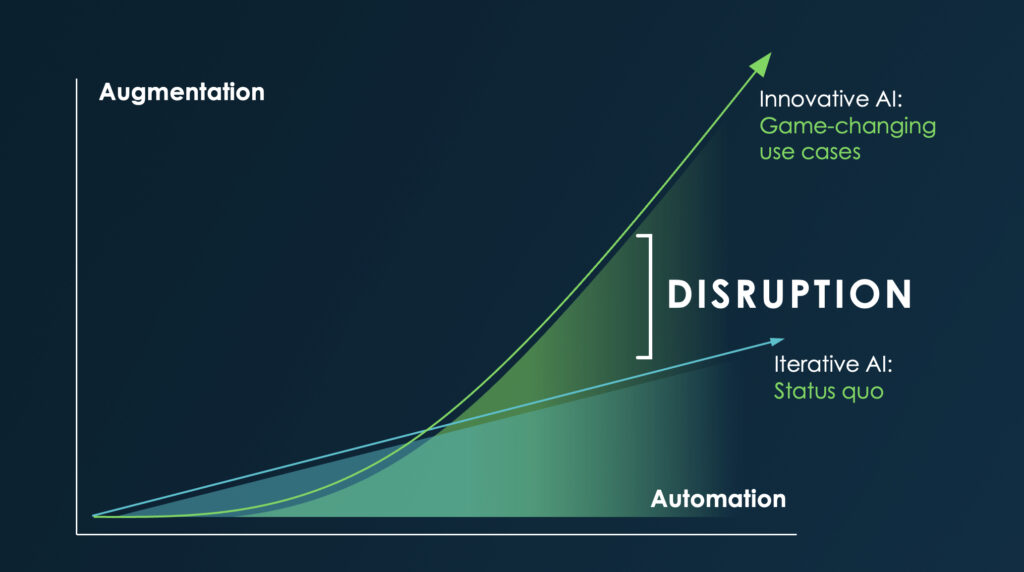
Iterative AI supports efficiency and linear improvement. Innovative AI makes exponential growth and disruption possible.
Automation can generate savings, increase capacity, and improve productivity. But those gains should not disappear entirely into cost reduction. They should also be reinvested into people, experimentation, augmentation, and business reinvention. That right there challenges the traditional ROI model…automate work, take out costs accordingly. The cost of that ROI model though could be argued as one of competitiveness. The organization may become highly efficient at operating a model that is losing relevance.
The duality of AI is one of its most promising qualities. It can help companies reduce costs and improve the work of today while simultaneously creating the capacity to invent the work and growth of tomorrow. The leadership challenge is to prevent the first agenda from consuming the second.
AI maturity is not achieved simply by deploying more tools. It represents an evolution in how intelligence participates in work.
Automation takes existing work and makes it more efficient, scalable, and consistent. Yet many organizations attempt to automate processes they have not sufficiently digitized, unified, or optimized. Automating a fragmented process does not repair it. It can simply help dysfunction fail faster.
Augmentation represents a more advanced relationship between people and AI. Here, AI becomes a cognitive exoskeleton, helping employees expand their expertise, improve decisions, and exercise greater creativity. The objective is not to remove humans from the loop indiscriminately, but to redesign the loop around what people and machines each do best.
Agentic AI takes this further. Agents can interpret context, interact with systems, coordinate tasks, adapt to changing conditions, and take action within defined parameters. Eventually, more workflows will operate autonomously with high-level human supervision, continuously evaluating, learning, and evolving.
This progression changes more than productivity. It changes how businesses are structured and how they scale.
Traditional organizations were designed around human boundaries. Work is divided into departments, passed between systems, and scheduled around working hours. But agents do not necessarily operate within those same limits. They can work continuously and coordinate across functional silos, creating the possibility of an always-on enterprise that responds in event time rather than calendar time.
When AI and agents offer potentially exponential scale, leaders must rethink the org chart, the operating model, and even the relationship between company size and market power. Established enterprises may gain new forms of leverage, but smaller businesses may also gain access to capabilities that were once reserved for organizations with enormous headcount, capital, and infrastructure.
The future organization will increasingly be redesigned around the collaboration of people and intelligent systems…starting today. It is foundational for a new breed of human-machine collaboration.
Many executive teams arevi waiting for AI to become more predictable. They want clearer best practices, more proven use cases, more mature platforms, settled regulations, and competitors they can safely follow.
But if you are waiting for someone to tell you exactly what to do, you are already on the wrong side of innovation.
By the time a new model becomes obvious, the organizations that defined it are already learning, improving, and compounding their advantage. Leaders do not need perfect foresight, but they do need the willingness to question what made the company successful and recognize when those same practices could constrain what it becomes next.
For innovation to succeed, you must be willing to disrupt yourself.
That does not mean abandoning the core business or chasing every new AI trend. It means creating two parallel agendas: one that improves today’s performance and another that explores what could replace, expand, or transcend today’s model. Dave Wright and I explore this as a bi-modal approach to AI strategy in our new book Infinite: How Visionary Leaders Transform Today’s Businesses into AI-Forward Companies.
Start with a meaningful customer, employee, or business outcome. Examine the entire workflow supporting it. Identify where friction, fragmentation, and legacy assumptions shape the experience. Then bring together the people who understand the business, the process, the data, the technology, and the human consequences to reimagine the flow from end to end.
Do not begin with the question, “Where can we add AI?”
Begin with, “What outcome should now be possible, and why are we not already delivering it?”
AI will continue to advance whether your organization is ready or not. Agents will become more capable, AI-native competitors will emerge, competitors will become AI-first, and customers and employees will begin to expect experiences that are intelligent, predictive, personalized, and increasingly autonomous.
The advantage will come from how leaders think about it, what they choose to do with it, and how quickly their organizations can learn.
In an era of disruption, there are still two things leaders can control: their mindset and their actions.
This keynote from Milan is an invitation to pause, watch, and have a different kind of executive conversation…not about AI, but about the organization you are becoming.
After watching, bring this question to your leadership team:
Are we using AI to improve the company we were, or to invent the company we need to become?
Great leaders do more than react to the future. They imagine a better future that would not have otherwise happened. And then they lead others in bringing it to life 🙌