Dublin, July 20, 2026 (GLOBE NEWSWIRE) -- The "Gas Compressors Market - Global Forecast 2026-2032" has been added to ResearchAndMarkets.com's offering.
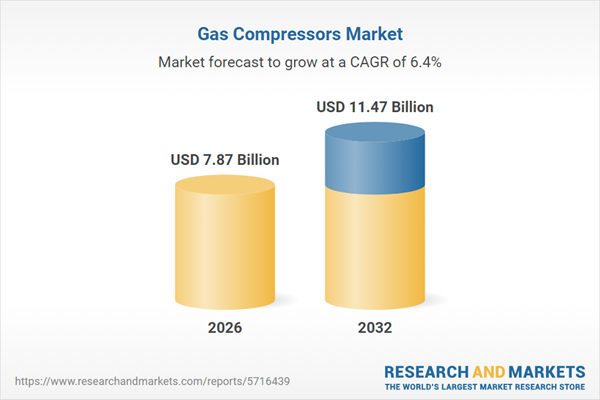
The global Gas Compressors Market research report provides strategic analysis of the technologies, applications, regional dynamics, regulations, and competitive factors shaping industry development. The market is projected to reach USD 7.87 billion in 2026 and expand at a CAGR of 6.39% to USD 11.47 billion by 2032. The findings support strategic planning by clarifying investment priorities, procurement considerations, and emerging opportunities across established and low-carbon gas value chains.
Gas compressors are essential rotating and positive-displacement assets used in gas transmission, processing, storage, refrigeration, petrochemical production, manufacturing, power generation, hydrogen handling, and industrial utilities. Market demand is influenced by:
. Continued natural gas use in power generation and industry. Expansion of liquefied natural gas infrastructure. Modernization of aging pipeline networks. Stricter methane-emissions requirements. Growing reliability needs in process industries. Development of carbon capture, renewable natural gas, and hydrogen projects
Purchasing decisions increasingly balance pressure ratio, flow rate, lifecycle cost, energy efficiency, emissions performance, uptime, digital monitoring, serviceability, and regulatory compliance.
Transformative Shifts in Gas Compression
Procurement is moving from capacity-led selection toward performance, compliance, and lifecycle value. Electrically driven compressors are gaining attention where grid reliability and operating economics support reduced dependence on direct mechanical drives. Reciprocating compressors remain critical for high-pressure applications, while centrifugal and screw compressors serve large-flow and continuous-duty operations.
Operators are also prioritizing advanced seal systems, leak detection, vent reduction, standardized packages, shorter lead times, regional service support, and spare-parts availability. These insights enable buyers to compare technologies against application requirements and reduce operational and compliance risks.
Artificial Intelligence and Digitalization
Artificial intelligence is generating operational value across compressor design, monitoring, maintenance, and energy optimization. Predictive maintenance systems analyze vibration, temperature, pressure, acoustics, lubricant condition, and motor-current data to identify bearing degradation, valve leakage, seal wear, misalignment, fouling, lubrication issues, and surge risk.
