Miacademy Review 2026: Pricing, Pros, Cons and My Honest Parent Verdict
Themattwalshblog.com·July 20, 2026
AI Summary
Miacademy is an online homeschool platform serving kindergarten through eighth grade students with instructional videos, interactive exercises, automatic grading, and parent reporting tools. The platform offers electives, educational games, and optional additional features to support homeschool education.
Miacademy is an online homeschool curriculum designed primarily for students in kindergarten through eighth grade.
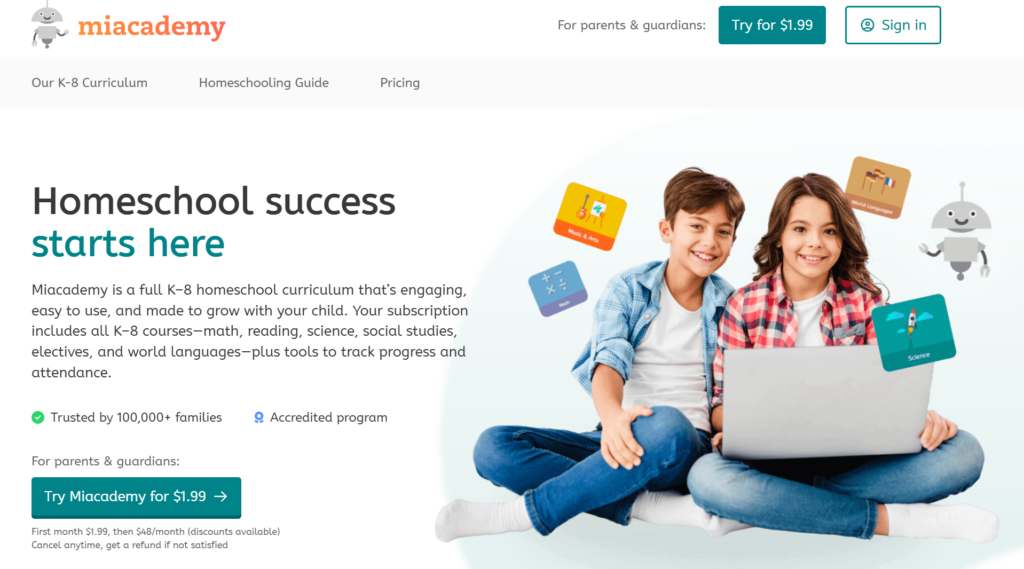
It combines short instructional videos, interactive exercises, automatic grading, parent reports, electives, educational games, and an optional moderated student community. One subscription provides access to courses across every K–8 grade level rather than restricting a child to one fixed grade package.
As a homeschooling dad, I can understand why this model appeals to parents.
Miacademy makes it possible to place a child at different levels in different subjects. A fifth grader could complete fourth-grade language arts, sixth-grade math, and grade-level science without purchasing three separate programs.
It also reduces the amount of daily lesson preparation and routine grading expected from the parent.
However, Miacademy is still a screen-based curriculum. It cannot fully replace physical books, handwritten work, experiments, sustained writing, direct conversation, and time spent learning away from a device.
Miacademy is one of the better online homeschool curriculum options for elementary and middle-school families seeking flexibility, engaging lessons, broad course access, and strong parent controls. It offers good value for one child and can reduce the daily teaching burden, but parents should supplement it with books, writing, hands-on activities, and personal instruction.
Miacademy is a subscription-based online curriculum operated by Miaplaza.
The main Miacademy program covers kindergarten through Grade 8. Its related MiaPrep platform serves older students, while MiaPrep Online High School is a separate accredited school option for Grades 7–12.
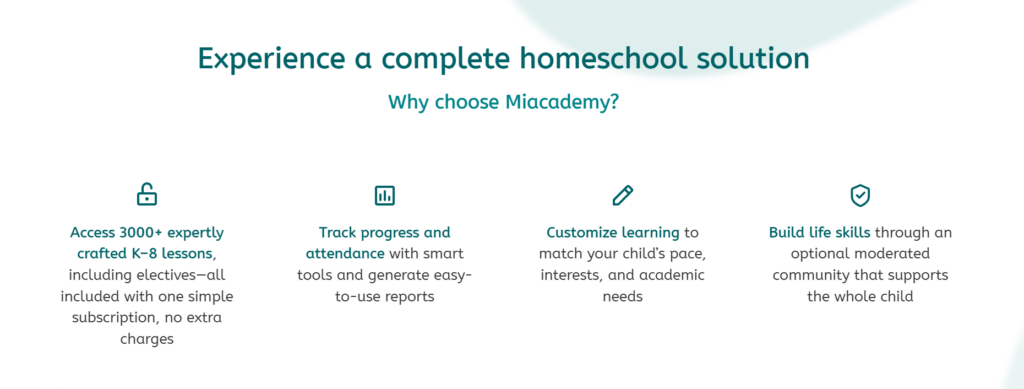
Miacademy currently advertises more than 80 courses and over 3,000 K–8 lessons. A subscription includes access to all grade levels, core subjects, electives, and future course updates.
The course library covers areas such as:
Parents create the student’s course plan, decide which lessons to assign, set expectations, and monitor progress. Students watch teaching videos, complete interactive exercises, take assessments, and earn virtual rewards.
Full story reconstructed from Themattwalshblog.com. Formatting and media may differ from the original.
Miacademy looks as though it was designed to solve two common homeschool problems.
Creating daily lessons, locating videos, printing worksheets, preparing quizzes, and grading every exercise can become exhausting. Miacademy places much of that routine work inside one platform.
Many children resist an online curriculum that looks outdated or feels like a digital textbook. Miacademy attempts to make the experience more engaging through short lessons, visual explanations, rewards, games, creative activities, and optional interaction with other learners.
Parents frequently praise the platform for being easy to use and enjoyable for children. Trustpilot’s summary of hundreds of reviews highlights engaging lessons, customization, user-friendliness, and responsive customer support.
Still, enjoyment is not the same as academic mastery.
A child might become highly motivated to earn virtual currency or unlock site features while rushing through an assignment. Parents should monitor whether the student is actually understanding and retaining the material.
I would use Miacademy as an instructional system rather than as an electronic babysitter.
Miacademy gives subscribers access to courses across kindergarten through Grade 8.
This means parents can create a customized schedule instead of enrolling the child in one rigid grade.
That is particularly helpful when a student is:
Miacademy automatically suggests grade-appropriate courses when a child begins, but parents can remove completed lessons, assign content from other levels, and change the plan.
This subject-by-subject flexibility is one of the platform’s greatest strengths.
Courses use teacher-developed videos followed by practice activities and assessments.
Miacademy says its courses include videos, interactive exercises, and assessments designed to measure student progress.
The shorter lesson format can help children who become overwhelmed by long lectures.
The weakness is that students can become passive.
Watching someone explain fractions is not the same as solving several problems independently on paper. Watching a writing video is not the same as producing and revising an essay.
Parents should make sure online instruction leads to independent work.
Miacademy provides tools for managing courses and monitoring student progress.
The company says grade and attendance reports can be downloaded at any time.
This can be valuable for homeschool recordkeeping.
However, the parent remains responsible for deciding whether the generated reports meet state, portfolio, umbrella-school, or transcript requirements.
Miacademy uses gamification to motivate students.
Children can earn virtual currency and use it within site activities. Depending on current platform features and parental settings, learners may access educational games, creative spaces, virtual businesses, or community activities.
This can make school feel less mechanical.
It may also encourage useful skills involving:
The risk is that rewards become more important than learning.
Parents should review how much time the child spends:
A reward system is helpful only when it supports education rather than competing with it.
Miacademy offers an optional moderated social environment intended to help learners build community and life skills.
For homeschooled children who want online interaction, this may be attractive.
Miacademy has also promoted activities such as a student-run newspaper and moderated opportunities to share work.
Parents should still treat any online community carefully.
A moderated environment is safer than an open social network, but it does not eliminate the need for parental oversight.
Miacademy covers foundational mathematics through middle-school topics such as pre-algebra, geometry concepts, ratios, fractions, decimals, and problem-solving.
The video-and-practice structure can help students see a concept explained before attempting problems.
I would require a physical math notebook.
The platform can teach the lesson, but the child still needs to develop mathematical discipline.
Miacademy language arts includes reading, grammar, spelling, vocabulary, comprehension, sentence structure, and writing.
The elementary program builds foundational reading and simple writing, while later courses move toward text analysis and structured essays.
Miacademy can provide a useful skills framework, but children become strong readers and writers by reading and writing beyond the platform.
Miacademy science includes elementary and middle-school topics such as animals, weather, ecosystems, energy, and broader physical and life-science concepts.
Courses may use videos, visuals, interactive questions, and project suggestions.
For middle school, I would add written lab reports and more demanding nonfiction reading.
Miacademy includes history, geography, communities, early civilizations, civics, and global studies across its K–8 curriculum.
I would use Miacademy as a social-studies spine and add:
The company states that core subjects are presented from a secular perspective, while biblical studies and Jewish Bible study are available as optional electives.
Its biblical content is not interwoven through mathematics, science, language arts, or social studies.
This makes Miacademy accessible to families from different religious backgrounds.
Christian parents can use it while adding:
Families wanting every subject taught through a Christian worldview may prefer a publisher such as BJU Press, Abeka, or Master Books.
Miacademy describes its K–8 curriculum as accredited by ACS-WASC as a supplemental education program.
Miacademy’s accreditation means the curriculum program has undergone an external review process as a supplemental educational provider.
It does not mean that a child using Miacademy is enrolled in an accredited K–8 school.
Miacademy does not issue a K–8 diploma, and parents remain responsible for:
The company itself explains that the supplemental education designation applies because the curriculum does not award degrees or diplomas.
Parents should therefore avoid two inaccurate statements:
Miacademy is an accredited supplemental curriculum program, not a diploma-granting K–8 school.
Families seeking an accredited high school can consider the separate MiaPrep Online High School, which provides teacher-supported courses, official transcripts, and graduation pathways.
Miacademy’s current membership page lists the following prices:
Each child needs a separate account, although Miacademy offers family discounts and payment options.
The main website also advertises a family lifetime plan for up to four students, although displayed promotional pricing can vary by page or offer. Parents should verify the checkout total before purchasing.
The lifetime plan may offer good value when:
A monthly plan is safer when the family is still evaluating the program.
Miacademy advertises a 30-day satisfaction guarantee.
Its FAQ states that annual and lifetime members can request full reimbursement within 30 days, while a monthly member can request reimbursement for the most recent paid month.
The formal terms include additional conditions, including purchasing directly from Miaplaza and requesting the refund within the required period. They also state that some third-party, installment, classroom, or non-use situations may not qualify.
Parents should read the current checkout terms rather than relying only on promotional wording.
The subscription may not cover every homeschool expense.
Independent public reviews are generally positive.
Trustpilot showed hundreds of Miaplaza reviews, with summaries frequently praising:
Some families specifically appreciate being able to assign courses above or below the child’s nominal grade. Others mention that children look forward to logging in and enjoy the platform more than previous online curricula.
Common concerns found across independent reviews and commentary include:
An independent 2026 review from Brighterly praised Miacademy’s flexibility and personalization but questioned whether it was sufficient as a completely standalone program and noted that prerecorded lessons did not engage every learner equally.
The most useful conclusion is not that Miacademy is universally excellent or inadequate.
Miacademy may appeal more to children motivated by creative features, virtual rewards, and social interaction.
Time4Learning may feel more straightforward for parents wanting a conventional online lesson sequence.
Miacademy is generally more child-oriented and gamified.
Power Homeschool may appeal more to students who prefer a simpler video-and-question workflow.
Miacademy can provide a solid K–8 academic foundation, but rigor depends partly on parental expectations.
The platform teaches core concepts and uses assessments to measure progress. It also allows parents to assign harder material when a child is ready.
However, academic rigor also requires students to:
Miacademy can support these goals, but it cannot guarantee them.
Miacademy may work well for some students with learning differences because it offers:
Public reviews include parents reporting positive experiences with autistic learners and children who struggled in other environments.
However, Miacademy is not a replacement for specialized intervention.
A child with ADHD may enjoy the short lessons but become distracted by rewards or site features.
Parents should evaluate the actual student rather than assuming one platform is automatically suited to every diagnosis.
Miacademy is worth considering because it combines broad curriculum access, strong customization, engaging instruction, and useful parent controls at a reasonable monthly price.
As a homeschooling dad, I would be most comfortable using it as the main digital spine of an elementary or middle-school program rather than allowing it to become the entire education.
The annual price is competitive, especially because the subscription includes every K–8 level and elective. The lifetime family option may also make financial sense for households with several younger children.
Miacademy is one of the strongest engaging online curriculum choices for K–8 homeschool families. Its customizable courses, parent tools, electives, and moderated community make it more flexible than many competitors, but parents must control screen time and supplement reading, writing, science, and real-world learning.
Miacademy is an online K–8 homeschool curriculum offering video lessons, interactive practice, automatic grading, electives, parent reports, and an optional moderated student community.
Miacademy currently costs $48 per month per child after a $1.99 introductory month. The annual plan costs $516, while lifetime plans cost $1,168 for one child or $2,598 for up to four children.
Miacademy is accredited by ACS-WASC as a supplemental education program. It is a curriculum provider rather than a diploma-granting K–8 school.
It provides K–8 core courses and electives in math, language arts, science, social studies, languages, arts, and other areas. Parents should still add physical reading, writing feedback, hands-on science, and any subjects required by their state but not sufficiently covered.
Yes. Core subjects use a secular approach. Biblical Studies and Jewish Bible Study are available as optional electives.
The platform automatically grades many interactive assignments and assessments. Parents should still evaluate essays, projects, handwriting, and other open-ended work.
Yes, but each learner needs an account. Miacademy offers family discounts and a lifetime family plan covering up to four children.
Miacademy offers a 30-day satisfaction guarantee, subject to its current refund terms and purchase conditions.
Yes. Its Grades 6–8 curriculum includes pre-algebra, geometry concepts, ratios, text analysis, structured writing, science, geography, history, and civics.
The main Miacademy platform covers K–8. MiaPrep serves older students, and MiaPrep Online High School is a separate accredited school option.