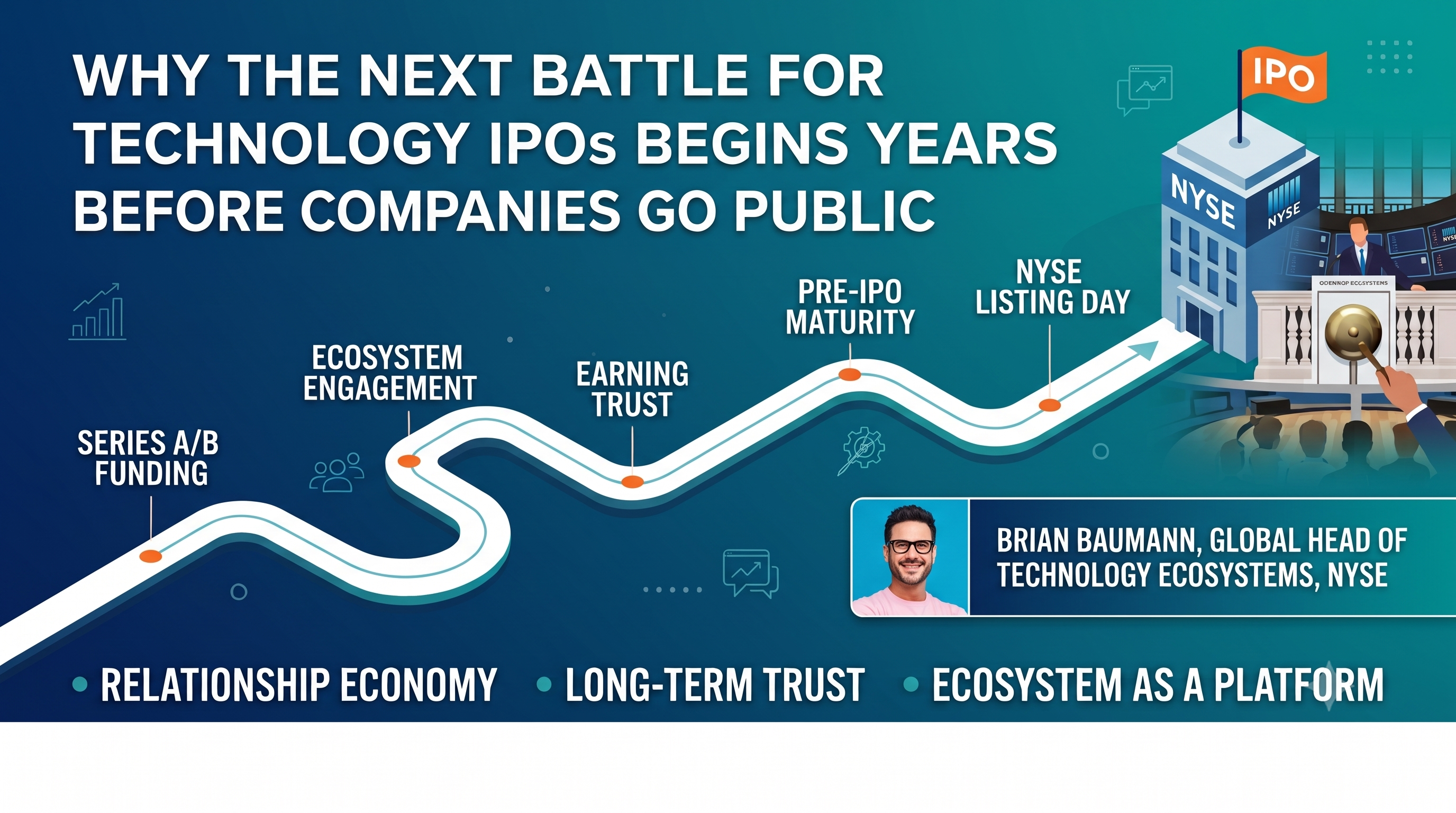
Why the next battle for technology IPOs begins years before companies go public
SiliconANGLE News·July 20, 2026
AI Summary
Major technology companies are building their infrastructure and regulatory compliance years in advance of going public, treating the IPO process as a long-term strategic milestone rather than a sudden event. The competitive advantage in tech IPOs now depends on preparation during the private years, including financial systems, governance structures, and market positioning that determine success once a company lists.
When most people think about the New York Stock Exchange, they think about listing day. The opening bell. CNBC. The trading floor. The moment a private company becomes public.
What they don’t see are the years leading up to that moment. Increasingly, that’s where the real competition is taking place. As artificial intelligence companies remain private longer, venture-backed firms mature at unprecedented scale, and exchanges compete globally for tomorrow’s market leaders, earning trust years before an initial public offering has become a strategic imperative.
This month, the New York Stock Exchange quietly took a meaningful step that reflects this shift, naming Brian Baumann to the newly created role of global head of technology ecosystems, while he continues his capital markets responsibilities.
The announcement was made internally to NYSE employees rather than through a public press release. On its surface, it looks like an executive promotion. In reality, it signals something much bigger. It represents the formal recognition of a strategy that has been developing over several years: engaging founders, technology leaders and innovation communities long before companies begin thinking seriously about an IPO. (* Disclosure below.)
Technology companies don’t wake up one morning and decide where to list.
Those decisions are shaped over years through relationships, trust, shared experiences and credibility. Founders remember who showed up before they needed anything. Enterprise technology leaders remember who invested in understanding their businesses. Investors remember who consistently brought together meaningful conversations instead of transactional meetings.
That long-game approach has increasingly become part of how the NYSE engages the innovation economy. Rather than waiting until companies enter the IPO process, the exchange has been expanding its engagement across AI infrastructure, enterprise software, cybersecurity, digital assets and emerging technology communities while many of those companies are still private.
It’s a subtle shift, but an important one.
Several years ago, Brian Baumann and I began discussing an idea that felt unconventional for a global exchange. What if media wasn’t simply about covering technology companies? What if it became infrastructure for building trusted relationships?
Those conversations eventually evolved into NYSE Wired, a collaboration between the New York Stock Exchange and SiliconANGLE Media’s theCUBE. Each organization contributed something the other could not easily build alone.
Full story reconstructed from SiliconANGLE News. Formatting and media may differ from the original.
NYSE brought one of the world’s most trusted financial institutions, access to business leaders, an iconic global platform and a permanent home for theCUBE inside the exchange.
SiliconANGLE and theCUBE brought an established enterprise and emerging technology community, editorial programming, production capabilities, executive relationships developed over more than a decade and the ongoing investment required to operate a continuous media platform.
Brian became the entrepreneurial leader inside NYSE, building support for a new media model across the organization while deepening the exchange’s relationships with founders, CEOs, investors and technology executives.
Together, the goal wasn’t simply to produce interviews. It was to create a place where technology and capital markets could interact continuously rather than episodically. Media became the connective tissue. Community became the product. Trust became the differentiator.
According to figures shared internally by NYSE, NYSE Wired has engaged more than 2,600 entrepreneurs, connected with more than 5,000 enterprise practitioners, produced more than 1,000 media sessions and participated in more than 100 events since its inception.
Those numbers matter less as isolated media metrics than as indicators of sustained, compounding engagement. They are powered by an even deeper foundation: over the course of 16 years, SiliconANGLE and theCUBE have interviewed more than 17,000 technology leaders, published more than 100,000 blog posts and cultivated an active, elite audience of tens of millions of users.
When you layer NYSE Wired onto this massive existing community network, every conversation creates deeper familiarity. Every interview expands an already colossal ecosystem.
A prime example of this model in action is our recent coverage of Jonathan Hurst, co-founder and chief robot officer of Agility Robotics, on the ground for NYSE Wired. By providing a trusted platform to discuss the commercial scale of physical AI and humanoid deployment, the ecosystem acts as a bridge between deep tech innovation and the capital markets long before a transaction occurs.
Unlike traditional transaction-oriented engagement, this joint model is designed to compound. By the time many founders begin evaluating public-market options, they don’t just know the institution — they are already deeply embedded within its broader platform. That changes the conversation.
One of the more interesting lessons from NYSE Wired is that once a trusted community reaches critical mass, it scales beyond media into an operational ecosystem, one capable of introducing new communities, services and partnerships that create value well before a company reaches the public markets.
Founders don’t just want visibility; they need customers, talent, strategic partners, and access to expertise. By shifting from a media collaboration to a platform model, NYSE Wired can introduce specialized capabilities that help companies actively build their businesses that range from executive roundtables and industry research to specialized developer networks.
One example being explored is the integration of a global hackathon community representing more than 300,000 developers. This isn’t just an adjacent initiative; it represents the ultimate extension of the ecosystem strategy. By connecting the corporate visibility of the exchange with a large audience that consists of technical talent pool, emerging tech companies can simultaneously accelerate product adoption, recruit engineering talent and build credibility with the public markets all in one place.
Successful ecosystems don’t simply generate conversations; they create value for every participant. The media attracts the community. Trust strengthens relationships. Over time, those relationships become the foundation for new services, partnerships and experiences that reinforce the network.
Under Chief Executive Lynn Martin, NYSE has invested significantly in modernizing how the exchange communicates with markets, companies and investors, while broadening the institution’s engagement with the innovation economy beyond the traditional listing process.
The evolution represented by NYSE Wired wasn’t about replacing those investments. Instead, it was about extending them. The lesson has been that media, when combined with community and trusted relationships, can become more than a communications function.
It can become part of business development. It can help institutions participate earlier in innovation cycles. It can create long-term familiarity rather than short-term visibility. And perhaps most importantly, it can build trust before transactions begin. That distinction is increasingly important in industries moving as quickly as artificial intelligence, cloud infrastructure, cybersecurity and digital assets.
Baumann’s expanded mandate formalizes many of these ideas. As global head of technology ecosystems, he has a responsibility that extends beyond traditional capital markets to cultivating relationships with the next generation of technology companies across key sectors while helping shape how NYSE engages emerging innovation communities around the world.
It’s an acknowledgment that ecosystem development deserves institutional focus rather than remaining an experimental initiative. That’s a meaningful milestone not only for Brian personally, but for everyone inside NYSE who believed the exchange could engage technology companies in new ways.
The broader lesson extends beyond the NYSE itself. Institutions are increasingly discovering that trusted media, executive communities and relationship networks are becoming strategic assets in their own right. Rather than treating content as a marketing expense, organizations are beginning to use it as infrastructure for long-term engagement, market intelligence and ecosystem development.
The technology industry increasingly operates through interconnected ecosystems rather than isolated corporate structures. Capital markets are moving in the exact same direction.
Financial institutions that invest in building trusted relationships years before financing events, listing discussions, or market cycles force a decision will always be better positioned than those relying solely on transactional pitches.
NYSE’s creation of the global head of technology ecosystems role formalizes this reality. In today’s innovation economy, content acts as the infrastructure, community is the product, and trust built years before the opening bell is the ultimate competitive advantage.
(Disclosure: SiliconANGLE Media and theCUBE have collaborated with the New York Stock Exchange on the development and programming of NYSE Wired. John Furrier worked with Brian Baumann in developing the initiative. SiliconANGLE funded and operated much of the media production, programming and distribution supporting the collaboration, while NYSE provided the institutional setting, studio location, executive access and organizational support that made the partnership possible.)
Support our mission to keep content open and free by engaging with theCUBE community. Join theCUBE’s Alumni Trust Network, where technology leaders connect, share intelligence and create opportunities.
11.4k+ theCUBE alumni — Connect with more than 11,400 tech and business leaders shaping the future through a unique trusted-based network.
Founded by tech visionaries John Furrier and Dave Vellante, SiliconANGLE Media has built a dynamic ecosystem of industry-leading digital media brands that reach 15+ million elite tech professionals. Our new proprietary theCUBE AI Video Cloud is breaking ground in audience interaction, leveraging theCUBEai.com neural network to help technology companies make data-driven decisions and stay at the forefront of industry conversations.
Why the next battle for technology IPOs begins years before companies go public
ShelterZoom subsidiary Mithra launches AI 'trust infrastructure' platform
Alibaba previews Qwen3.8, claims it's second only to Claude Fable 5
AMD’s next reinvention: A new playbook for the AI era
Anthropic, Meta reportedly discussing $10B data center leasing deal