The science of foresight: how to future-proof your research
Nature.com·July 20, 2026
AI Summary
Researchers can improve their work by proactively identifying potential success and failure pathways at the beginning of a project. This foresight approach helps prevent costly problems and setbacks during later stages of research.
Every research programme is a bet on the future. Yet, scientists rarely examine the assumptions behind those bets. Decisions about grants, infrastructure, hiring, regulation and training often presume that certain technologies will mature, specific skills will be needed, the public will accept the resulting innovations and few risks will materialize. Yet these assumptions are rarely stated, let alone tested or revised in a systematic way1.
The consequence is a mismatch between current research activity and future conditions, a gap that will only grow with the pace of discovery and global change. If they don’t think ahead, scientific institutions will increasingly find themselves pressed to swiftly revise research priorities, training plans and infrastructure investments after a crisis emerges for which they were unprepared.
Could agentic AI topple grant-funding systems?
During the COVID-19 pandemic, for example, researchers had to accelerate vaccine development, scale up telemedicine, redeploy clinical staff, move education online and manage public trust in surveillance and vaccination. They had to do this under crisis conditions and with little initial knowledge of the virus2.
The rapid rise of artificial intelligence is also hard to navigate. Institutions must make decisions about validation, evaluation methods, workforce preparedness, research integrity and governance before long-term evidence is available3.
What is missing is not perfect prediction, but foresight: a structured, forward-looking process for examining multiple plausible futures, identifying the assumptions that matter across them, and defining signals that can trigger changes in research direction, staffing and funding priorities.
The field of ‘futures studies’ offers rigorous methods for analysing trends, planning for a range of outcomes and using ‘horizon scanning’ to scope out future risks and opportunities. Yet these methods aren’t mainstream in scientific practice. It’s time for that to change.
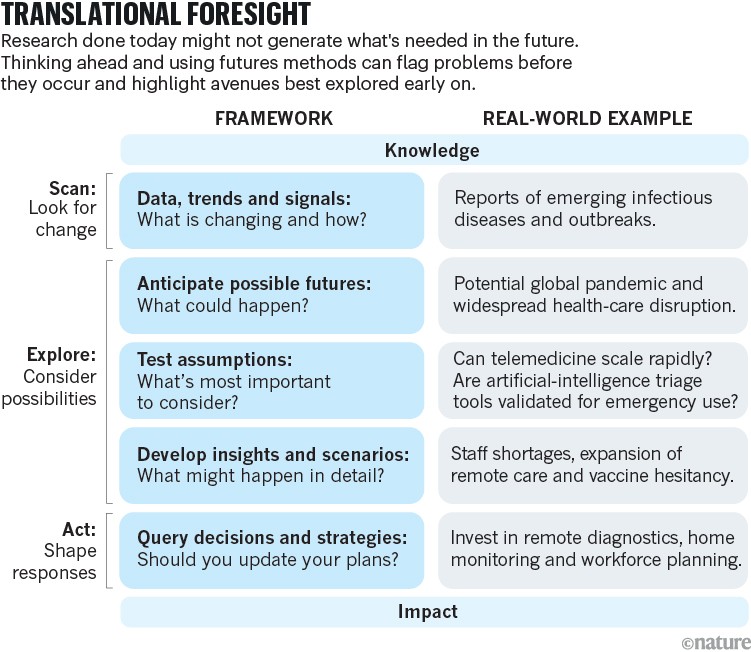
Here, we call for futures methods to be plugged into the core mechanisms of scientific development, to inform decisions about what science should fund, build, teach, validate and evaluate. We call this concept translational foresight. Adopting it would make the promises embedded in research programmes explicit, testable, traceable and revisable (see ‘Translational foresight’).
Full story reconstructed from Nature.com. Formatting and media may differ from the original.
Translational foresight has parallels with translational medicine. In the late twentieth century, molecular biology was advancing rapidly, but that knowledge was not reaching the clinic4. Expressions in medical research such as “bench to bedside” and “crossing the valley of death” highlighted this gap5. In response, scientists reoriented their systems to link discovery to patient outcomes6. This was accompanied by the rise of clinician-scientist training programmes7, changes in the funding model for translational research and the development of dedicated institutions for translational medicine8.
Similarly, the futures-studies field has established methods for exploring future trends, uncertainties and alternative trajectories. These methods are not routinely used in science-research contexts.
The Futures Wheel is a method for graphically visualizing direct and indirect consequences (see ‘Futures-thinking tools’). It was used by some governments to map cascading impacts of the COVID-19 pandemic, revealing shifts towards telemedicine, workforce strain and changes in care delivery, for instance9.
Exercises to explore future research directions and anticipate problems.
Explore consequences of a trend or milestone
State a central change, such as “AI can now co-author scientific papers”; list direct and indirect effects; highlight unintended consequences.
Map of risks, opportunities and ripple effects
Before adopting a technology, submitting a grant or implementing a policy
2×2 Scenario Analysis (One Driver, One Uncertainty)
Structure uncertainty into four plausible futures
Choose one key driver, such as AI growth, and one uncertainty, such as regulation; combine them into four scenarios; ask which strategies work across all four.
Four distinct future worlds; list of robust versus fragile strategies
Strategic planning, long-term research direction, infrastructure investment
Choose a time horizon, such as 2035; write from the perspective of a future researcher or clinician; identify what changed, what worked and what failed.
Clarify long-term aspirations and milestones
Setting a laboratory mission, forming an institution
Propose a future claim; challenge it with failure modes and missing variables; revise the claim with explicit conditions.
Refined assumptions and conditional forecasts
Grant preparation, technology assessment, proposing controversial hypotheses
Scenario analysis is another technique that has informed long-term strategy in industry and policy. For example, energy company Shell has utilized it to respond to energy crises, and governments have used it to develop national policies on climate, infrastructure and mobility.
Forecasting platforms, such as the Good Judgment Project, which is led by researchers at the University of Pennsylvania in Philadelphia, harness the wisdom of the crowd to answer forward-looking questions across the political, economic and social spectrum.
Without such tools, science relies on informal judgment, intuition and short-term planning to anticipate its future implications.
Science in 2050: the future breakthroughs that will shape our world — and beyond
Pandemic-preparedness frameworks, for example, can identify biological and logistical risks, such as whether health systems have enough tests, vaccines, beds, protective equipment and emergency plans. But they rarely shape research priorities, workforce planning or technology validation needs before a crisis begins10.
Translational foresight turns preparedness from a static emergency checklist into a system for testing and updating the assumptions on which future decisions depend. For example, funders could support the testing of remote care, home monitoring and rapid-diagnostics systems before they are urgently needed. Health systems could define trigger points in advance — from occupancy of intensive-care units to levels of public distrust — that would prompt revision of research, staffing or funding targets.
Similarly, personalized and genomics-based vaccine research involves not only designing vaccines, but also making assumptions about the future world in which they will be used11. Scientists and funders implicitly assume who the target populations will be, how microbes will evolve, what genomic data will be available, whether regulators will accept personalized vaccine strategies and whether the public will trust the vaccines. Recognizing these assumptions at the start will enable projects that can adapt if conditions change.
The great university shake-up: four charts show how global higher education is changing
The challenge lies in translating the outputs of futures methodologies into research priorities, funding decisions, infrastructure planning and evaluation. Several barriers have kept this translation from becoming routine.
doi: https://doi.org/10.1038/d41586-026-02231-y
Meslin, E. M., Blasimme, A. & Cambon-Thomsen, A. Clin. Transl. Med. 2, 14 (2013).
Clark, H. et al. Lancet 399, 1995–1999 (2022).
Turner, L., Zhou, C. & Burk-Rafel, J. Acad. Med. 100, S34–S38 (2025).
Dzau, V. J. et al. N. Engl. J. Med. 383, 76–77 (2020).
Curry, S. H. Biotechniques 44, ii–viii (2008).
Utz, P. J. et al. Sci. Transl. Med. 14, eabg7852 (2022).
Dzau, V. J., Laitner, M. H. & Balatbat, C. A. Lancet 400, 1481–1486 (2022).
Rezaei, H. et al. J. Educ. Health Promot. 10, 136 (2021).
Harrington, W. N., Kackos, C. M. & Webby, R. J. Exp. Mol. Med. 53, 737–749 (2021).
Din, M. U. et al. Prog. Biomed. Eng. 7, 022004 (2025).
Meskó, B., Kristóf, T., Dhunnoo, P., Árvai, N. & Katonai, G. J. Med. Internet Res. 26, e57148 (2024).
Miller, R. (ed.) Transforming the future: Anticipation in the 21st century (UNESCO, 2018).
Mangnus, A. C., Oomen, J., Vervoort, J. M. & Hajer, M. A. Futures 132, 102793 (2021).
Meskó, B. J. Med. Internet Res. 25, e50638 (2023).
The authors declare no competing interests.
US politicians push agencies to restrict research collaboration with China
Academia should recognize community partnerships as having societal impact
AI models: one country’s fears become everyone’s constraint
My research on mice is causing me stress. How can I become more resilient?
How voluntary work can boost your career in science
This microbiologist endured a four-year court battle over COVID-19 tests
NSF plans cuts to core science programmes to fund White House initiative
‘This time, it’s the other way around’: how Indonesia is reclaiming the science of human history
How to advance revolutionary science: high turnover, high risk and a licence to fail
Join Tsinghua SIGS as a faculty member and contribute to academic excellence and global impact.
Tsinghua SIGS is located in Shenzhen, a vibrant innovation hub in the Guangdong-Hong Kong-Macao Greater Bay Area.
Tsinghua Shenzhen International Graduate School
Title: Commissioning Editor - Collections Management and Acquisition Location: Beijing, Shanghai, Nanjing, China - hybrid working model Application...
Beijing, Shanghai, Nanjing, China - hybrid working model
INSTITUTE OF PRECISION MEDICINE, is recruiting postdoctoral research associate, assistant professor, associate professor and full professor