From Sun Tzu to Nash: Rethinking Strategy for Small States in a Multipolar World
Khabarhub.com·July 21, 2026
AI Summary
Small states are increasingly leveraging non-military strategic tools to compete effectively in a multipolar world by shaping choices and managing interdependence rather than relying on traditional military power. The article connects classical strategic thinking from Sun Tzu to modern game theory approaches, offering frameworks for how smaller nations can navigate complex geopolitical competition.
The twenty-first century is witnessing a transformation in strategic competition, where power is no longer defined solely by military capability but by the ability to shape choices, influence incentives, and manage interdependence.
This article traces the evolution of strategic thought from Sun Tzu’s emphasis on deception and indirect victory, through Kautilya’s comprehensive theory of statecraft, to modern game theory and John Nash’s concept of strategic equilibrium. It argues that small states should move beyond traditional approaches of balancing power and instead pursue strategic autonomy by balancing interests.
Using Nepal as a case study, the article proposes an emerging framework—the Kathmandu Doctrine—based on Active Non-Alignment, Smart Neighbourhood Policy, economic statecraft, and strategic equilibrium. It suggests that small states can transform geopolitical constraints into strategic opportunities by making cooperation with them valuable to competing powers.
The defining feature of the twenty-first century is not simply the return of great-power competition; it is the complexity of strategic interaction. The global order is being reshaped by rivalry between the U.S. and China, Russia’s challenge to the existing security architecture, India’s emergence as a major power, and the growing influence of middle and regional powers.
Yet, unlike previous eras, competition today is not confined to military alliances or territorial contests. It extends across technology, supply chains, critical minerals, artificial intelligence, energy security, infrastructure, and economic connectivity.
In an era of intensified geopolitical competition, Nepal requires a coherent doctrine that moves beyond reactive diplomacy toward purposeful statecraft. This emerging framework may be described as the Kathmandu Doctrine—a strategic approach that seeks to translate Nepal’s geopolitical constraints into diplomatic opportunities.
For small states, this changing environment presents a fundamental strategic question: how can countries with limited material capabilities preserve sovereignty, expand choices, and avoid becoming arenas of competition among larger powers?
Traditional approaches often frame the answer in terms of balancing, alignment, or neutrality. But these concepts alone are insufficient for a world where no state operates independently and every decision influences the choices of others. A more useful perspective emerges from the evolution of strategic thought—from Sun Tzu and Kautilya to modern game theory and John Nash.
Full story reconstructed from Khabarhub.com. Formatting and media may differ from the original.
Their combined wisdom suggests a powerful conclusion: strategy is not merely about possessing power; it is about understanding, influencing, and shaping the choices of others.
The origins of strategic thought lie in civilizations that confronted uncertainty, rivalry, and conflict. Although separated by geography and historical context, Sun Tzu in ancient China and Kautilya in ancient India developed remarkably sophisticated approaches to statecraft that remain relevant today.
Sun Tzu’s The Art of War represented a revolutionary departure from the idea that victory depended primarily on military strength. Writing during China’s Warring States period, he argued that the highest achievement of strategy was not the destruction of an enemy but the ability to achieve political objectives without unnecessary conflict.
His central insight was that information, deception, timing, and psychological influence could overcome material disadvantages. The wise strategist does not simply react to an opponent’s actions; he shapes the conditions under which the opponent makes decisions.
Sun Tzu’s famous emphasis on winning without fighting was not a rejection of force. Rather, it reflected an understanding that the most effective strategy is one that alters the adversary’s calculations before conflict becomes inevitable.
Centuries later, Kautilya expanded strategic thought from warfare into a comprehensive theory of governance and international relations. His Arthashastra examined diplomacy, intelligence, economics, administration, military organization, and political survival as interconnected elements of state power.
Kautilya’s Rajamandala theory presented international relations as a dynamic environment where alliances and rivalries change according to interests rather than permanent friendships or enmities. A neighbour could be a competitor, but circumstances could also create opportunities for cooperation.
His four instruments of policy—conciliation (sama), inducement (dana), division (bheda), and coercion (danda)—demonstrated that statecraft requires multiple tools. Power is not only military capability; it also includes diplomacy, economic influence, intelligence, and strategic communication.
Both Sun Tzu and Kautilya understood a fundamental truth: successful strategy depends on anticipating the behaviour of others.
The twentieth century transformed strategic thinking. The emergence of industrial warfare, nuclear weapons, and global economic interdependence created challenges that traditional military wisdom alone could not explain.
The development of game theory by John von Neumann and Oskar Morgenstern introduced a new way of understanding strategic decision-making. Instead of viewing actors as making isolated choices, game theory examined situations where the outcome depended on the decisions of multiple players.
John Nash advanced this thinking through the concept of equilibrium. His work demonstrated that actors often reach stable outcomes when each understands that changing their strategy independently would not necessarily improve their position.
The importance of this insight extends far beyond mathematics. International politics itself is a continuous strategic interaction.
During the Cold War, the U.S. and the Soviet Union possessed enough nuclear weapons to destroy each other, yet direct conflict was avoided. The reason was not trust but strategic calculation. Both sides understood the consequences of escalation. Deterrence created a fragile equilibrium based on credibility, communication, and the expectation of retaliation.
Strategists such as Thomas Schelling further demonstrated that influence often comes not from the use of force but from the ability to shape another actor’s expectations. The power to deter, persuade, and negotiate depends upon credible signals and carefully designed incentives.
In the modern era, this logic applies not only to military affairs but also to economic competition. Sanctions, technology restrictions, investment decisions, trade agreements, infrastructure projects, and control over supply chains have become instruments of strategic competition.
The battlefield has expanded. Strategy now operates simultaneously across military, economic, technological, diplomatic, and informational domains.
Beyond Balancing Power: The Strategic Value of Small States
For small states, the implications are profound.
Historically, smaller countries have often been viewed through a limited strategic framework: they must either balance against stronger neighbours, align with dominant powers, or remain neutral. While these choices may sometimes be necessary, they do not fully capture the possibilities available in a multipolar world.
A game-theoretic perspective offers a different approach. Instead of asking which major power a small state should choose, the more important question is:
How can a small state make cooperation with itself beneficial to all major actors?
Several successful small states demonstrate this principle.
Singapore has maintained extensive economic engagement with both the U.S. and China while preserving strategic flexibility. Qatar has transformed its energy wealth, diplomacy, and mediation capacity into global influence far beyond its geographic size. Switzerland has converted neutrality into an instrument of international engagement. Finland has developed resilience through strong institutions, economic competitiveness, and strategic preparedness.
Their influence does not come from overwhelming power. It comes from creating value, maintaining credibility, and ensuring that multiple actors have an interest in their stability and success.
The lesson is clear: small states should not seek importance by becoming part of great-power rivalry. They should seek relevance by becoming valuable partners to multiple actors.
Nepal and the Logic of Strategic Equilibrium
This perspective is particularly relevant to Nepal.
Situated between two major Asian powers, India and China, while expanding engagement with Europe, Japan, the U.S., and other partners, Nepal occupies a strategically significant position. Its geography creates challenges, but it also provides opportunities.
The traditional narrative often portrays Nepal as vulnerable because of its location between larger neighbours. However, geography is not destiny. The strategic value of geography depends on how effectively it is managed.
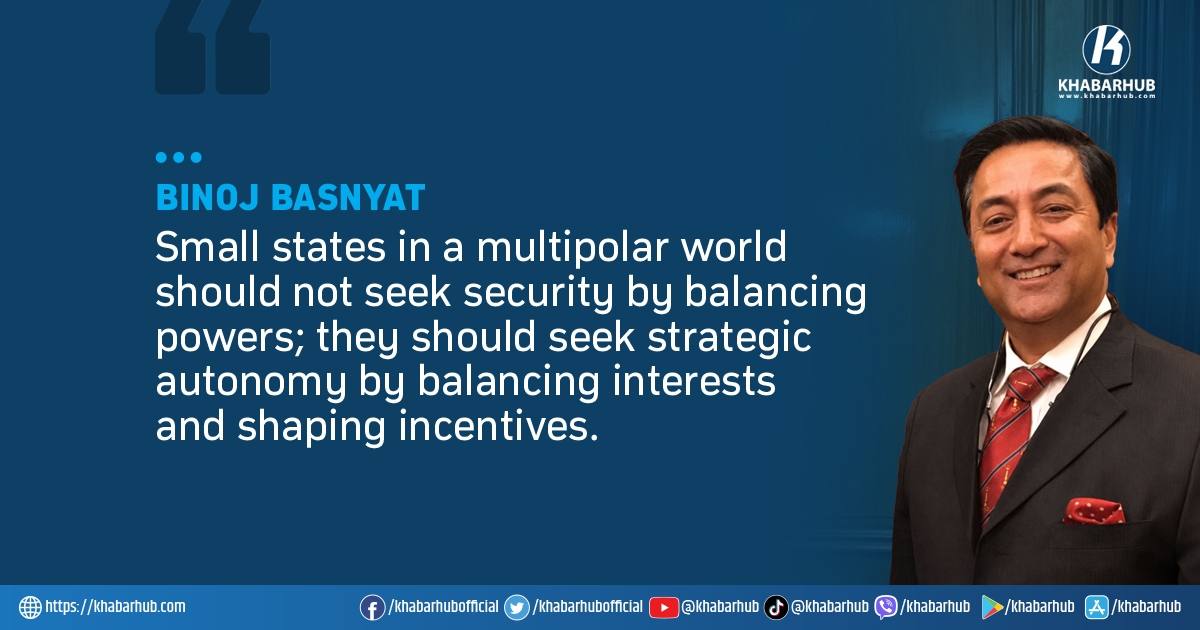
A game-theoretic approach suggests that Nepal’s objective should not be to balance China and India against each other. Such an approach risks placing Nepal inside a zero-sum competition. Instead, Nepal should pursue strategic equilibrium by balancing interests.
This means creating conditions where all major partners see value in Nepal’s stability, sovereignty, and economic development.
Economic statecraft becomes central to this strategy. Hydropower, tourism, digital connectivity, infrastructure, trade, and human capital are not merely development objectives; they are instruments of strategic influence.
A prosperous and connected Nepal creates mutual benefits:
India benefits from energy cooperation and regional connectivity.
China benefits from stable economic engagement and trans-Himalayan cooperation.
Western partners benefit from a resilient, democratic, and open partner in South Asia.
Nepal benefits by expanding choices and reducing dependency.
This is the essence of strategic equilibrium.
The convergence of Sun Tzu, Kautilya, and Nash provides the intellectual foundation for what may be described as the Kathmandu Doctrine.
Together, these pillars seek to transform Nepal from a passive participant in geopolitical competition into an active contributor capable of shaping strategic outcomes. The objective is not to balance competing powers against one another, but to create an environment in which cooperation with Nepal becomes valuable to all.
Recognizing that geography inevitably shapes strategic relationships, Nepal’s external engagement should be understood through a layered approach encompassing its immediate neighbours, the broader Asian neighbourhood, the U.S.-led Western order, emerging middle powers, and international institutions. Together, these relationships form the foundation for Nepal’s economic transformation, diplomatic flexibility, and strategic resilience.
The Kathmandu Doctrine rests upon four interconnected pillars that together provide Nepal with a coherent framework for strategic autonomy, economic transformation, and diplomatic resilience.
First, Active Non-Alignment as a Grand Strategy: Nepal should preserve its strategic autonomy by maintaining constructive engagement with all major powers while avoiding exclusive geopolitical alignments that constrain independent decision-making. In a multipolar world, active non-alignment should not be interpreted as passive neutrality but as an active strategy of diversification, flexibility, and sovereign choice.
Second, Smart Neighbourhood Policy as a Regional Strategy: Nepal’s immediate neighbourhood will remain the primary determinant of its strategic environment. Relations with China and India should therefore be managed through maturity, mutual respect, economic interdependence, and sensitivity to legitimate security concerns.
The objective should be to transform geographical proximity from a source of vulnerability into an opportunity for connectivity, cooperation, and shared prosperity.
Third, Strategic Regional Engagement through Extra-Regional Partnerships: Nepal’s strategic space should extend beyond its immediate neighbourhood through deeper engagement with middle powers, emerging regions, and international institutions.
Diversified partnerships with countries and organizations across Asia, Europe, North America, and beyond can enhance Nepal’s economic opportunities, diplomatic flexibility, and resilience in an increasingly competitive international environment.
Fourth, Economic and Resource Statecraft as National Power, Supported by Smart Diplomacy:
In the twenty-first century, economic capability is a fundamental pillar of national security and strategic influence. Nepal’s diplomacy must therefore be directly connected with economic transformation by leveraging its resources, including hydropower, water, tourism, human capital, biodiversity, and strategic location.
Connectivity, contribution, investment, trade, and resource partnerships should become instruments of diplomatic influence. Smart diplomacy serves as the operational mechanism that translates these national assets into strategic outcomes by ensuring consistency, credibility, and alignment with long-term national interests.
Underlying all four pillars is the principle of strategic equilibrium and smart diplomacy—the diplomatic method through which Nepal seeks to align interests among competing partners so that cooperation with Nepal becomes more beneficial than geopolitical competition over Nepal.
For Nepal, the path forward is therefore neither alignment nor isolation. It is strategic equilibrium and smart diplomacy—a deliberate effort to convert geography into opportunity, diplomacy into influence, and national interests into a coherent strategy for a changing world.
The objective is not to eliminate rivalry among larger powers, which is beyond Nepal’s control, but to create conditions in which Nepal’s stability, sovereignty, and prosperity become a shared strategic interest.
The significance of this framework extends beyond Nepal. Many small and medium-sized states face similar challenges in an era of renewed great-power competition. They cannot compete through military power alone, nor can they afford isolation. Their survival and success depend on strategic creativity—the ability to transform limitations into opportunities and vulnerability into relevance.
The history of strategy demonstrates that influence does not always belong to the strongest. Sun Tzu challenged the assumption that victory requires overwhelming force. Kautilya demonstrated that statecraft could compensate for structural disadvantages. Nash revealed that rational strategy depends on understanding the choices of others.
The twenty-first century will reward states that understand this enduring truth: power is not only the ability to compel; it is also the ability to shape choices.
From Sun Tzu to Nash, the evolution of strategic thought offers Nepal a profound lesson: small states do not survive by becoming invisible. They survive by becoming indispensable.
(Basnyat is a Maj. Gen. (Retd.) of the Nepali Army and writes on international affairs and geopolitical strategy. He is also a researcher affiliated with Rangsit University in Thailand)