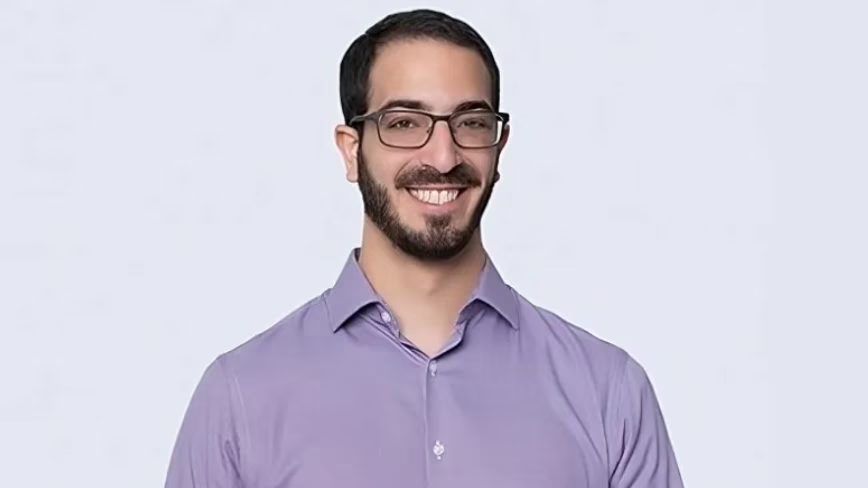
AI makes it trivially easy for anyone in an organization to deploy internet-facing applications, often outside established security processes. CyCognito CEO Rob Gurzeev says the resulting blind spots are more dangerous than known vulnerabilities. His answer: continuous, outside-in attack-surface mapping that validates what is actually exploitable rather than scanning a known asset list.
Artificial intelligence is transforming how software is built, deployed, and secured. While AI has accelerated innovation across industries, it has also expanded the number of internet-facing assets organizations need to protect. According to Rob Gurzeev, CEO and Co-Founder of CyCognito, the challenge is no longer just identifying known vulnerabilities. It is understanding what is actually exposed, how those assets connect, and how attackers can exploit them.
Drawing on years of experience in cybersecurity and intelligence, Gurzeev believes many organizations still operate with an incomplete view of their attack surface. That gap, he says, is becoming more dangerous as AI makes it easier than ever to create and expose new applications.
Gurzeev’s path into cybersecurity began long before AI entered the picture. As a teenager, he spent time exploring computers and Internet Relay Chat (IRC) communities, where curiosity about hacking first took hold. That interest eventually led him to an intelligence unit, where he worked on reconnaissance and attack-surface operations.
“Honestly, this work chose me more than I chose it,” Gurzeev said. He explained that the role often started with little more than a name and required finding “the path of least resistance into something that mattered.”
Those experiences continue to shape how he approaches cybersecurity today. “I was taught you never actually know what reality is. You have to go find it. Validate it,” he said. “Most of the security industry was built the other way around, on the assumption that you already know where your stuff is. That gap is the whole reason CyCognito exists.”
CyCognito approaches security by working from the outside in, beginning with nothing more than a company’s name. The platform maps everything exposed to the internet, including forgotten or unmanaged assets, then tests those systems to identify weaknesses that could be exploited by attackers.
“In a nutshell, we map everything a company has exposed to the internet, then trace the handful of paths that actually lead to its internal networks and sensitive data,” Gurzeev explained.
Rather than relying solely on vulnerability scans, the platform validates which weaknesses are genuinely exploitable. According to Gurzeev, “If I had to name the one thing that makes us unique, it’s that our platform thinks like an attacker. That should be obvious. It isn’t.”