Dublin, July 20, 2026 (GLOBE NEWSWIRE) -- The "RegTech Market - Global Forecast 2026-2032" report has been added to ResearchAndMarkets.com's offering.The RegTech Market is projected to reach USD 29.20 Billion in 2026. It is expected to continue growing at a CAGR of 21.33%, reaching USD 93.48 Billion by 2032. RegTech, or regulatory technology, has become a critical layer of modern financial services, digital banking, payments, insurance, capital markets, and increasingly non-financial regulated industries. The discipline applies automation, data analytics, cloud computing, artificial intelligence, application programming interfaces, identity verification, and workflow orchestration to help organizations meet obligations related to anti-money laundering, know your customer controls, sanctions screening, fraud monitoring, prudential reporting, conduct supervision, data protection, operational resilience, and audit readiness. Its relevance is reinforced by the rising complexity of cross-border regulation, faster digital onboarding, real-time payment adoption, cyber risk exposure, and heightened supervisory expectations for accurate, timely, and explainable compliance evidence.The RegTech landscape is being shaped by a clear regulatory direction: authorities are demanding stronger governance, better data lineage, faster suspicious activity detection, resilient technology operations, and more transparent use of automated decisioning. Financial institutions and regulated enterprises are responding by replacing fragmented manual controls with integrated compliance platforms that connect customer identity data, transaction behavior, regulatory rules, case management, reporting workflows, and model governance. As a result, RegTech has moved from a cost-control tool to a strategic capability for risk intelligence, operational resilience, and trusted digital growth.Transformative Shifts in the RegTech LandscapeThe RegTech landscape is undergoing transformative shifts as compliance moves from periodic, document-heavy processes toward continuous, data-driven supervision. Digital identity verification, eKYC, perpetual KYC, transaction monitoring, sanctions screening, and regulatory reporting are converging into unified compliance architectures. This shift is supported by supervisory technology initiatives, open banking frameworks, real-time payment systems, stronger beneficial ownership transparency rules, and growing expectations for machine-readable regulatory reporting.A major structural change is the migration from rule-only compliance engines to hybrid systems that combine rules, behavioral analytics, network analysis, and risk scoring. This improves detection of suspicious activity while reducing false positives when properly governed. At the same time, stricter data privacy and cybersecurity rules are reshaping vendor selection, with buyers prioritizing data minimization, encryption, access controls, audit logs, explainability, and residency options. The adoption of cloud-based RegTech is also accelerating where regulators permit outsourced technology arrangements, although institutions must maintain oversight of third-party risk, business continuity, concentration risk, and exit planning.Another shift is the expansion of RegTech beyond banking. Digital asset service providers, fintech platforms, insurers, asset managers, gaming operators, telecom-based financial service providers, and large enterprises with sanctions or anti-bribery exposure are increasingly using regulatory technology to manage cross-jurisdictional compliance. This broadening creates demand for configurable platforms that can adapt to local rules while maintaining centralized governance and enterprise-wide risk visibility.Cumulative Impact of Artificial Intelligence on RegTechArtificial intelligence is having a cumulative impact on RegTech by improving pattern recognition, document processing, anomaly detection, alert prioritization, and compliance workflow automation. AI-enabled systems can analyze large volumes of structured and unstructured data, including customer records, transaction patterns, adverse media, corporate ownership documents, regulatory texts, and case notes. Natural language processing supports regulatory change management by helping teams identify relevant obligations, map them to internal controls, and maintain compliance inventories. Machine learning supports fraud and AML monitoring by identifying unusual behaviors that static rules may miss.However, the adoption of AI in RegTech is increasingly governed by requirements for explainability, human oversight, model validation, data quality, bias control, and auditability. Financial regulators across major jurisdictions have emphasized that the use of AI does not reduce accountability for compliance outcomes. This means organizations must maintain transparent model documentation, testing evidence, change-control records, performance monitoring, and escalation procedures. Generative AI is also emerging in compliance operations for summarizing regulations, drafting investigation narratives, preparing audit evidence, and assisting analysts, but its use requires controls against hallucination, unauthorized data exposure, and unverified legal interpretation.The cumulative effect is a shift toward augmented compliance teams rather than fully autonomous compliance. The most defensible AI use cases are those that improve analyst productivity, enhance risk segmentation, and strengthen decision traceability while keeping final accountability with trained professionals and governance committees.Key Regional Insights Across Global RegTech AdoptionAsia-Pacific is a high-activity region for RegTech adoption because of rapid digital payments growth, advanced digital identity initiatives, fintech licensing regimes, and increasingly sophisticated AML and cyber resilience supervision. Jurisdictions such as Singapore, Hong Kong, Australia, Japan, India, China, and South Korea have promoted regulatory sandboxes, eKYC standards, digital finance oversight, and data protection rules that encourage automated compliance. The region's diversity creates demand for multilingual screening, local data residency configurations, and adaptable regulatory reporting tools.Europe is shaped by comprehensive regulation covering AML, data protection, digital operational resilience, crypto-asset supervision, open finance, payments modernization, and AI governance. The region's regulatory density increases the need for integrated RegTech platforms that can support cross-border compliance, privacy-by-design, auditability, incident reporting, and operational resilience. North America remains a leading RegTech adoption environment due to mature banking supervision, extensive AML obligations, sanctions compliance requirements, consumer protection enforcement, cybersecurity expectations, and a large digital financial services ecosystem. In the United States and Canada, organizations prioritize transaction monitoring, fraud analytics, identity verification, regulatory reporting, third-party risk management, and model governance as regulators continue to scrutinize technology risk and financial crime controls.Latin America is gaining momentum as digital banking, instant payment systems, open finance, and financial inclusion initiatives expand. Brazil and Mexico are especially important due to stronger fintech regulation, digital onboarding, and payment modernization. RegTech demand in the region is closely linked to AML compliance, fraud prevention, tax transparency, customer authentication, and supervisory reporting modernization. Africa is developing RegTech adoption through mobile money oversight, financial inclusion, digital identity, AML supervision, and payment modernization, with demand strongest where regulators are formalizing fintech and electronic money frameworks. The Middle East is advancing RegTech through financial center modernization, digital banking licensing, AML reforms, fintech sandboxes, national digital identity programs, and virtual asset supervision, particularly across the Gulf.Key Group Insights Shaping RegTech DemandNATO-related markets, while not a financial regulatory bloc, influence RegTech demand through sanctions compliance, cybersecurity coordination, critical infrastructure protection, and geopolitical risk monitoring, especially for institutions exposed to defense, dual-use goods, cross-border payments, and trade compliance. The G7 remains influential in shaping RegTech priorities through advanced financial supervision, cyber resilience standards, financial crime enforcement, sanctions coordination, cross-border data governance, and responsible AI principles. Organizations operating across G7 markets face heightened expectations for governance, audit trails, regulatory reporting accuracy, operational resilience, and technology risk management.BRICS economies represent diverse RegTech adoption pathways, ranging from large-scale digital identity and instant payments to stricter financial crime monitoring and data localization requirements. The group's scale and heterogeneity increase demand for adaptable compliance platforms that can manage domestic regulatory requirements while supporting international sanctions, trade finance, and correspondent banking expectations. The European Union is one of the most regulation-intensive environments for RegTech, driven by data protection, AML reform, digital operational resilience, payments regulation, crypto-asset oversight, and emerging AI governance. This creates sustained demand for solutions that demonstrate explainability, control mapping, incident reporting readiness, third-party risk oversight, and cross-border regulatory consistency.ASEAN is becoming an important RegTech group due to expanding digital finance ecosystems, regulatory sandboxes, cross-border payment initiatives, and strong policy emphasis on financial inclusion. Member economies vary in regulatory maturity, which creates demand for flexible compliance tools that support localized KYC, AML screening, privacy controls, and supervisory reporting while enabling regional scalability. The GCC is accelerating RegTech adoption through digital government infrastructure, financial free zones, fintech licensing, virtual asset regulation, AML modernization, and national identity systems. The region's regulatory priorities favor secure onboarding, transaction monitoring, sanctions screening, and compliance automation that can support both conventional finance and Islamic finance operations.Key Country Insights for RegTech ImplementationChina's RegTech priorities are closely linked to digital payments, platform finance oversight, data security, financial risk monitoring, and regulatory reporting. The United States is characterized by extensive AML, sanctions, consumer compliance, prudential reporting, cybersecurity, and model risk expectations, making RegTech highly relevant for banks, fintech platforms, insurers, broker-dealers, and payment providers. Japan emphasizes stable financial supervision, cyber resilience, AML modernization, and digital finance governance, while India is a major adoption environment due to digital public infrastructure, real-time payments, eKYC, AML controls, and financial inclusion.In Europe, Germany's demand is linked to strict data protection, banking supervision, digital identity, AML controls, and operational resilience, while the United Kingdom remains a major RegTech hub due to advanced financial supervision, open banking, AML obligations, operational resilience requirements, and active fintech regulation. France emphasizes conduct supervision, financial crime prevention, data governance, and digital finance oversight. Italy and Spain are advancing RegTech through banking digitalization, payment innovation, AML compliance, and European regulatory harmonization. Russia's RegTech environment is shaped by domestic financial supervision, sanctions complexity, digital payment infrastructure, and data localization considerations.Australia has mature demand for AML modernization, consumer data rights compliance, prudential reporting, fraud prevention, and operational resilience, making it a sophisticated market for integrated regulatory technology. South Korea combines advanced digital banking, strong identity infrastructure, fintech innovation, and cybersecurity regulation. Canada emphasizes financial crime compliance, privacy, cyber resilience, and responsible innovation, with strong demand for identity verification, transaction monitoring, and regulatory reporting automation. Brazil benefits from instant payments, open finance, digital banking, and regulatory modernization that increase the need for fraud analytics and compliance automation, while Mexico's RegTech adoption is supported by fintech regulation, digital payments, AML controls, and growing use of electronic onboarding.Actionable Recommendations for RegTech LeadersIndustry leaders should treat RegTech as an enterprise risk capability rather than a narrow compliance expense. The first priority is to build a unified compliance data foundation that connects customer identity, beneficial ownership, transaction activity, sanctions exposure, case management, audit evidence, and regulatory reporting. Clean, governed, and traceable data improves both compliance accuracy and AI performance.Organizations should prioritize explainable automation, especially in AML, fraud detection, sanctions screening, and regulatory reporting. Rules and AI models should be documented, validated, monitored, and reviewed through clear governance structures. Leaders should also strengthen third-party risk management by assessing vendor security controls, data residency, service resilience, subcontractor exposure, audit rights, and exit strategies.To improve regulatory readiness, compliance teams should adopt continuous control monitoring, regulatory change management workflows, and scenario-based testing. Cross-functional collaboration between compliance, legal, risk, technology, cybersecurity, operations, and internal audit is essential. Institutions operating globally should design platforms with configurable local rules and centralized oversight to balance regional compliance with enterprise consistency. Finally, leaders should invest in workforce upskilling so analysts can interpret AI outputs, challenge automated decisions, and maintain accountability for regulatory outcomes.Research Methodology for RegTech InsightsThis executive summary is developed through a secondary research approach focused on verified regulatory, supervisory, and industry sources. The methodology considers public materials from financial regulators, central banks, international standard-setting bodies, financial intelligence units, data protection authorities, cybersecurity agencies, and official policy publications. It also incorporates observed regulatory themes related to AML, KYC, sanctions compliance, digital identity, operational resilience, AI governance, data protection, fraud prevention, open banking, digital payments, and supervisory reporting.The analysis is qualitative and evidence-led, avoiding market sizing, market share, and forecasting. Regional, group, and country insights are synthesized by examining regulatory maturity, digital finance adoption, supervisory priorities, technology governance expectations, and compliance modernization initiatives. The research framework emphasizes cross-validation across official guidance, legislation, enforcement trends, consultation papers, and recognized industry standards to ensure that insights remain grounded in verifiable developments rather than speculative claims. Conclusion: RegTech as a Foundation for Trusted Digital FinanceRegTech is becoming essential to the future of compliant digital finance as regulatory expectations intensify and financial activity becomes more real time, cross-border, and data-driven. The strongest adoption drivers include AML modernization, digital identity, sanctions screening, fraud prevention, regulatory reporting automation, cyber resilience, data protection, and responsible AI governance. Across regions, the common direction is clear: regulators expect institutions to demonstrate control effectiveness, traceable decisioning, reliable reporting, and resilient technology operations.The next phase of RegTech will be defined by integrated platforms, explainable AI, continuous monitoring, and stronger alignment between compliance and enterprise risk management. Organizations that invest in high-quality data, defensible automation, auditable workflows, and skilled compliance teams will be better positioned to manage regulatory complexity while enabling trusted innovation.Key Attributes:
Back to News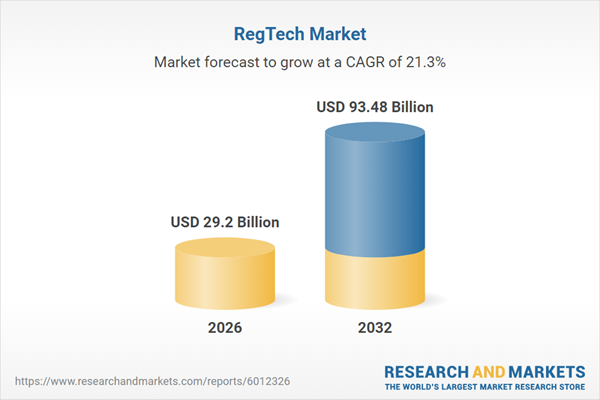
AI
RegTech Market to Reach USD 93.48 Billion by 2032, Growing at a 21.33% CAGR
GlobeNewswire·July 20, 2026
AI Summary
The global RegTech market is projected to reach USD 93.48 billion by 2032, expanding at a compound annual growth rate of 21.33%. Key growth drivers include AI-powered anti-money laundering, electronic know-your-customer processes, fraud detection, sanctions screening, automated compliance reporting, and cloud-based solutions for regulated industries.
Full story reconstructed from GlobeNewswire. Formatting and media may differ from the original.
View original at GlobeNewswireWas this useful?

