The world's largest open-source AI model packs 2.8 trillion parameters and costs a fraction of its American rivals
Moonshot AI just dropped what it calls the largest open-source AI model on the planet. Kimi K3, unveiled at the World Artificial Intelligence Conference in July 2026, carries 2.8 trillion parameters and a context window of 1 million tokens, putting it in a weight class that only a handful of American labs have occupied until now.
Here’s the thing. It’s not just big. It’s cheap. Moonshot is pricing Kimi K3 at roughly $3 per million input tokens and $15 per million output tokens, dramatically undercutting the rates charged by US competitors like OpenAI and Anthropic.
The model uses a Mixture-of-Experts architecture, a design approach that activates only relevant portions of the model for any given task rather than firing up all 2.8 trillion parameters at once. The result is better efficiency without sacrificing capability.
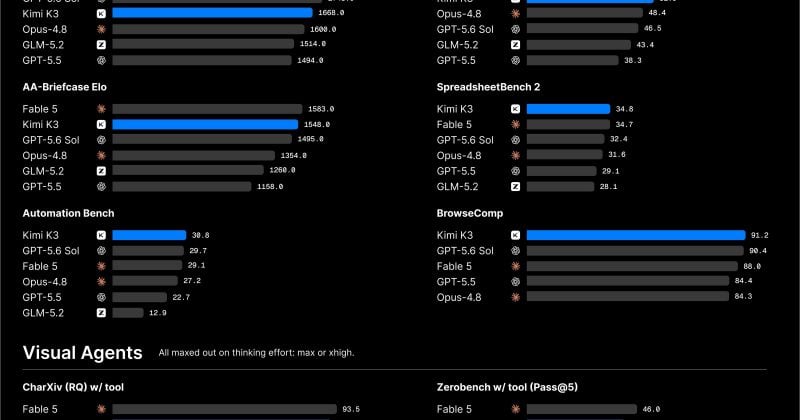
According to Moonshot’s own benchmarks, Kimi K3 ranks behind only OpenAI’s Claude Fable 5 and GPT-5.6 Sol in overall performance.
The model’s particular strength appears to be visual understanding. Its 1 million token context window also means it can process enormous documents, entire codebases, or lengthy research papers in a single pass, a capability that Moonshot CEO Yang Zhilin has framed as a stepping stone toward artificial general intelligence.
Moonshot plans to fully open-source Kimi K3 by late July 2026.
Moonshot AI was founded in March 2023 by Yang Zhilin, Zhou Xinyu, and Wu Yuxin, all alumni of Tsinghua University. Yang holds a PhD from Carnegie Mellon University. In roughly three years, the company has gone from founding to releasing what it claims is the world’s largest open-source model.
The speed is especially notable given the headwinds. US chip export restrictions have made it significantly harder for Chinese AI companies to access the most advanced Nvidia GPUs that power model training in American labs. The fact that Moonshot built a competitive frontier model despite those constraints has drawn comparisons to the DeepSeek moment earlier in the year, when another Chinese lab surprised observers with unexpectedly strong results on limited hardware.
First, pricing pressure. If a model that benchmarks near the top of the leaderboard costs a fraction of what OpenAI or Anthropic charge, it forces American companies to either justify their premium or cut margins.