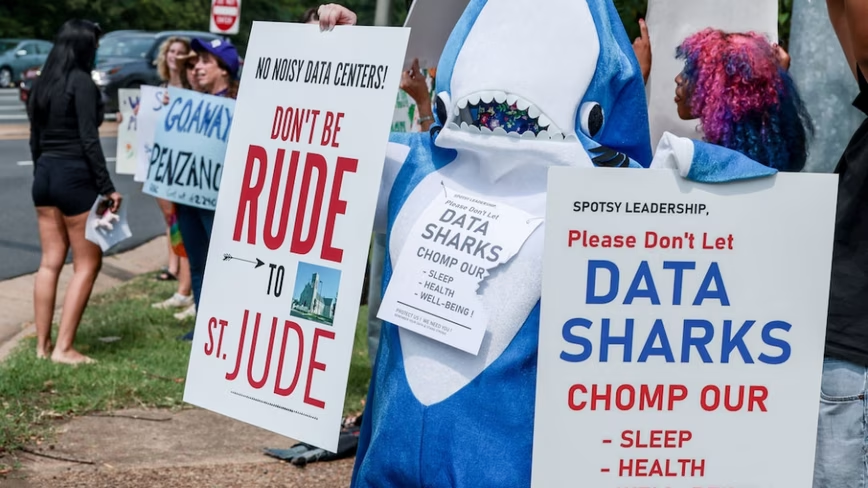
On Saturday, American opposition to data centres stopped being a scatter of zoning-board arguments and started behaving like a movement.
More than 140 rallies across 42 states unfolded under a single banner, in what organisers billed as the first national day of action against the industry pouring the concrete for artificial intelligence.
The rallies were coordinated by HumansFirst, a group co-founded by the former Tea Party leader Amy Kremer, and they arrived after months in which local campaigns had already stalled dozens of projects.
Data Center Watch, which tracks the fights, counts tens of billions of dollars in construction blocked or delayed by community pressure.
Texas hosted the most events, with 18, followed by Georgia with 11 and California with eight. The map is the point: these are red states and blue states, and the coalition threading through them, part conservative tax revolt and part environmental campaign, refuses to sort along the usual lines.
TNW City Coworking space - Where your best work happens
A workspace designed for growth, collaboration, and endless networking opportunities in the heart of tech.
The money maths has curdled, too. Virginia’s sales-tax exemption for data centres has swelled to roughly $1.9bn, and by one advocacy estimate the state now forgoes about $13m in incentives for every data centre job it lands, figures that read differently once the power bill arrives.
That bill is the engine of the anger. In the PJM grid region, the annual cost of guaranteeing electricity supply leapt from about $2.2bn to $14.7bn in a single capacity auction, a jump the market’s own monitor pinned largely on data centre demand.
Households are absorbing the pass-through. Estimated monthly increases run to roughly $21 in Washington DC, $18 in western Maryland and $16 in Ohio, and the picture of rising bills in old factory towns is doing more political work than any pitch about jobs or latency.
Water is the other pressure point. Texas data centres consumed an estimated 49 billion gallons last year and could reach 399 billion by 2030 on one university projection, while a proposed facility in Imperial County, California, would draw 260 million gallons a year from the Colorado River.
“It’s dystopian that you would use this much fresh water for AI,” said Ivan DelSol, a California organiser. In Richland Parish, Louisiana, residents near Meta’s $1.3bn complex have reported rust-coloured tap water and switched to bottled.