Indian Workers Are Resisting Efforts to Train Their AI Robot Replacements
Open Democracy·July 18, 2026
AI Summary
Indian workers are actively resisting programs designed to train AI systems that would automate their jobs, raising concerns about workplace surveillance and technological displacement. Their resistance demonstrates potential strategies for workers globally to challenge the implementation of automation technologies that threaten employment and increase monitoring in the workplace.
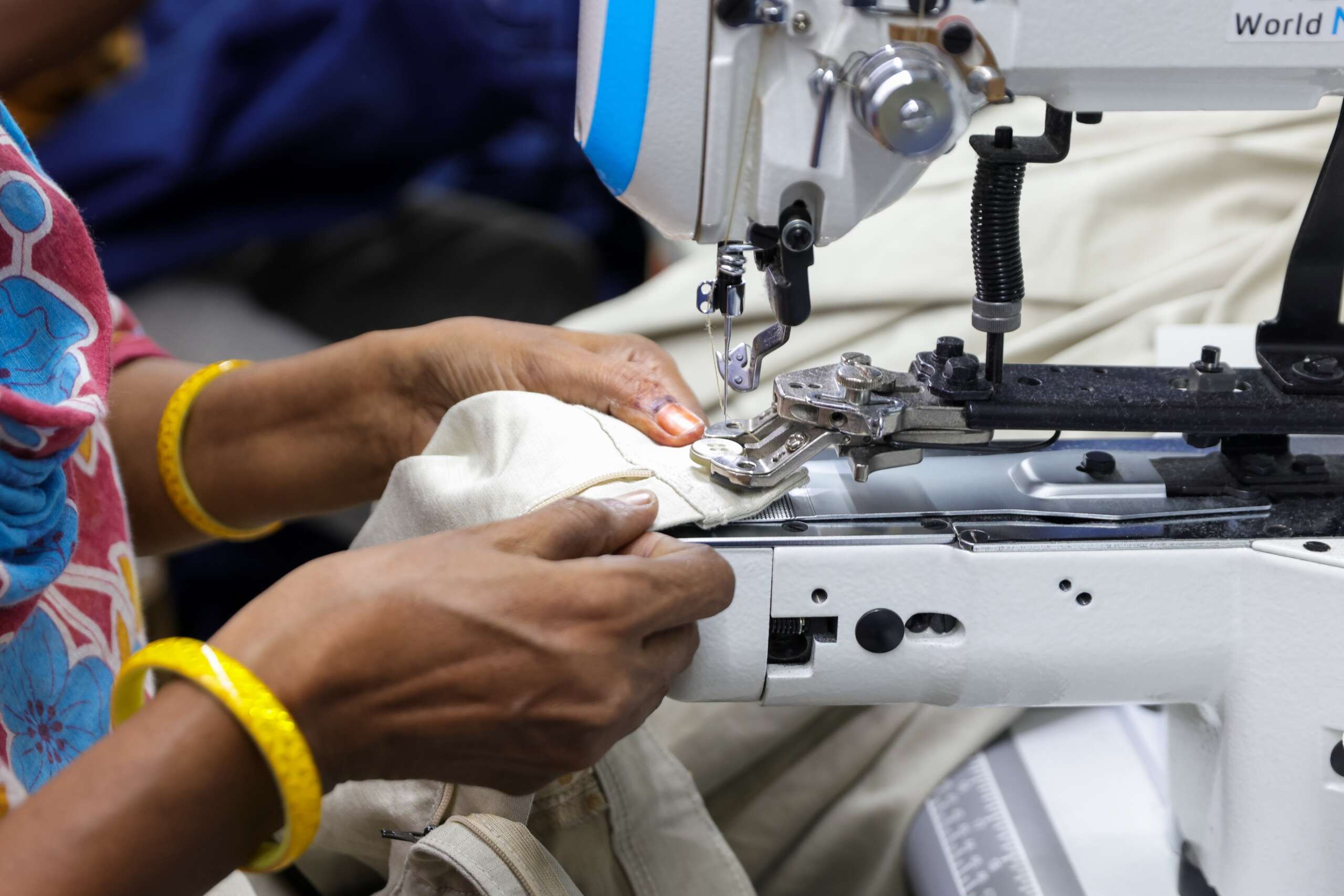
HR staff claimed the tiny cameras affixed to each tailor’s head would mean prospective clients saw the quality of their products and placed more orders, resulting in pay rises for everyone at the garment factory on the outskirts of India’s capital.
But the workers suspected the real reason was AI.
So Ankush Yadav, a young tailor, and his friends pried open the cameras, pulled out the memory cards and plugged them into their phones.
“We viewed the footage on our mobiles and found it was recording our voices, everything we said, our hands, our work, everything, in three-minute clips,” Yadav said. “After every three minutes, it would record afresh.”
As policymakers and ordinary people struggle to make sense of how large-language models such as ChatGPT, Claude and Gemini will disrupt millions of office jobs, AI companies are racing to solve one of technology’s knottiest problems: dexterity, or training AI models to touch, feel, and manipulate objects in the real world. Robots are already good at regulated non-contact tasks, such as welding and spray-painting, but struggle with unstructured tasks such as stitching, sewing, or blindly groping in a handbag for a phone.
In theory, artificial general intelligence coupled with human-like dexterity would result in the human-replacing “robot army” that tech moguls such as Elon Musk, the world’s richest man, have long dreamed of. But first, the robots need to learn to change a lightbulb.
One increasingly popular approach is training models on millions of hours of recordings of humans performing dexterous tasks, in the hope of achieving a dexterity breakthrough akin to how language models like ChatGPT acquired the ability to mimic language and cognition after ingesting the vast corpus of data available on the internet. One estimate projects that over the next three years, robotics labs may spend over $1.5bn to acquire between 100 million and one billion hours of footage of people performing perhaps the most human of actions: the skilled use of their hands.
A handful of AI startups such as OpenAI and Anthropic have achieved multi-billion-dollar valuations by stealing the intellectual property of writers, artists, musicians and everyday internet users without their consent. Now, a new cohort of companies is looking to repeat their success with manual workers. These firms are striking deals with factory owners in India, offering the use of their cameras to surveil employees like Yadav, who already labour under exploitative conditions, in exchange for the footage.
But savvy Indian factory workers told openDemocracy how they have thus far resisted such attempts, offering a template for workers elsewhere to disrupt the relentless onslaught of surveillance capitalism.
Full story reconstructed from Open Democracy. Formatting and media may differ from the original.
“Before deploying cameras and sensors and harvesting the physical movements of people on the other side of the world, we must ask ourselves the question: What would it look like if we designed our technology for everyone involved?” said Caitrin Lynch, professor of anthropology at Olin College of Engineering, Massachusetts. “What would it look like to partner with the workers to find out what tech they would welcome, and work from there?”
Lynch, who researches the intersection of robotics and society, said that rather than extracting data from workers, this could be an opportunity to design AI applications and robotics technology to benefit both workers and companies.
“As technologists, we cannot simply wait for policy to catch up to our technological capabilities,” she said. “We have a responsibility to look at the history of colonial extraction and recognise when we are repeating its patterns.”
Technologists at the cutting edge of robotics research told openDemocracy their field faces “a massive data problem”. In short, the large and diverse datasets that robots require to learn are hard to come by.
The current gold standard approaches to training involve a human remotely controlling a robot to perform physical tasks such as lifting or sorting, or a human performing a manual task while wearing a glove-like “gripper” that mimics a robot hand. These are effective, but hard to scale and very expensive.
A cheaper approach is to use simulation data, in which an AI model designed to train robots is run and tested in a controlled virtual environment – but this has its own drawbacks.
“You can easily scale in simulation, but nothing is as good as real data,” said Jigar Kumar Patel, a roboticist machine learning engineer at the Robotics and AI Institute in Cambridge, Massachusetts. “Physical properties do not easily translate into models. Simulators are getting better but we are not there yet,” he explained, describing a “simulation gap” in which the properties of objects in the real world – weights, noises, malleability to touch, unpredictability – do not translate accurately into data.
In this context, technologists are turning to “egocentric data”, or footage obtained from head-mounted cameras, which accurately capture the positions and configurations of human hands as they perform complex tasks. Predictably, a number of startups have sprung up to service this need.
One startup making the headgear required for this data is Egolab.AI, which was founded in January this year by two Indian teens living abroad, one of whom had dropped out of an engineering programme at a US university.
openDemocracy spoke to 20 workers from two factories in Delhi’s industrial belt who were asked to wear Egolab’s head-mounted cameras earlier this year, but were not told why they would be doing so. Yadav works at the smaller of the two factories, owned by Pearl Apparel, which employs around 500-600 workers at two units outside the Indian capital. The second factory is owned by Pearl Global Industries, a multinational with a workforce of more than 30,000 people across India, Bangladesh, Vietnam, Indonesia and Guatemala, which supplies brands such as Zara, Ralph Lauren, Gap and Primark. The two factories are not connected, despite their similar names.
Around the same time that the factory employees we spoke to were trialling its headgear, Egolab was snapped up by another startup headed by two similarly youthful founders. Build Artificial Intelligence Inc. describes itself as the “largest egocentric data collection effort in history”, with an aim to “build AI on a human foundation”. It was registered last year in the US state of Delaware by Edward Xu, 19, and Jonathan Jia, 21.
Egolab offered prospective factories a deal that perfectly encapsulates the oppressive dynamics of technology in the modern workplace.
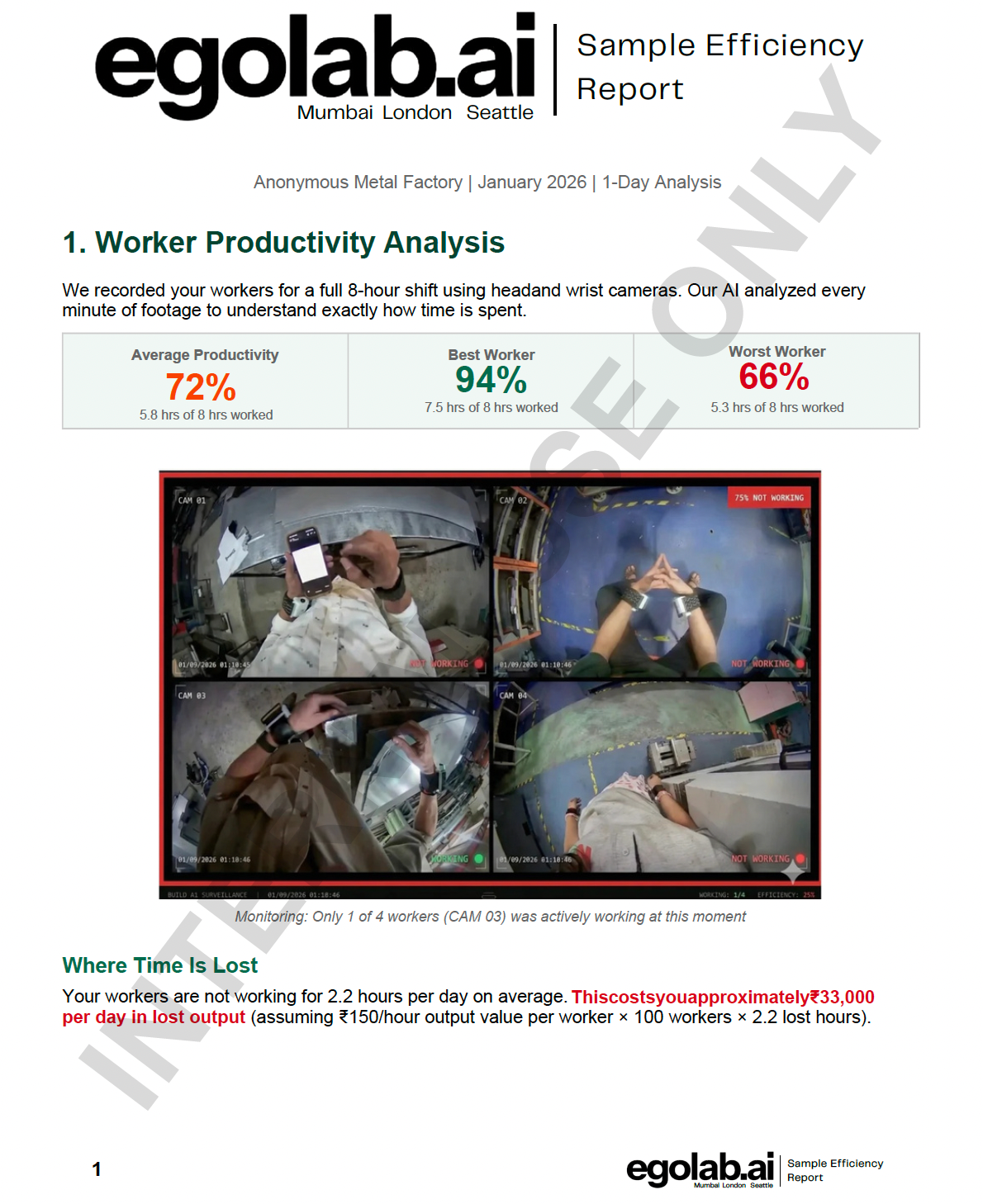
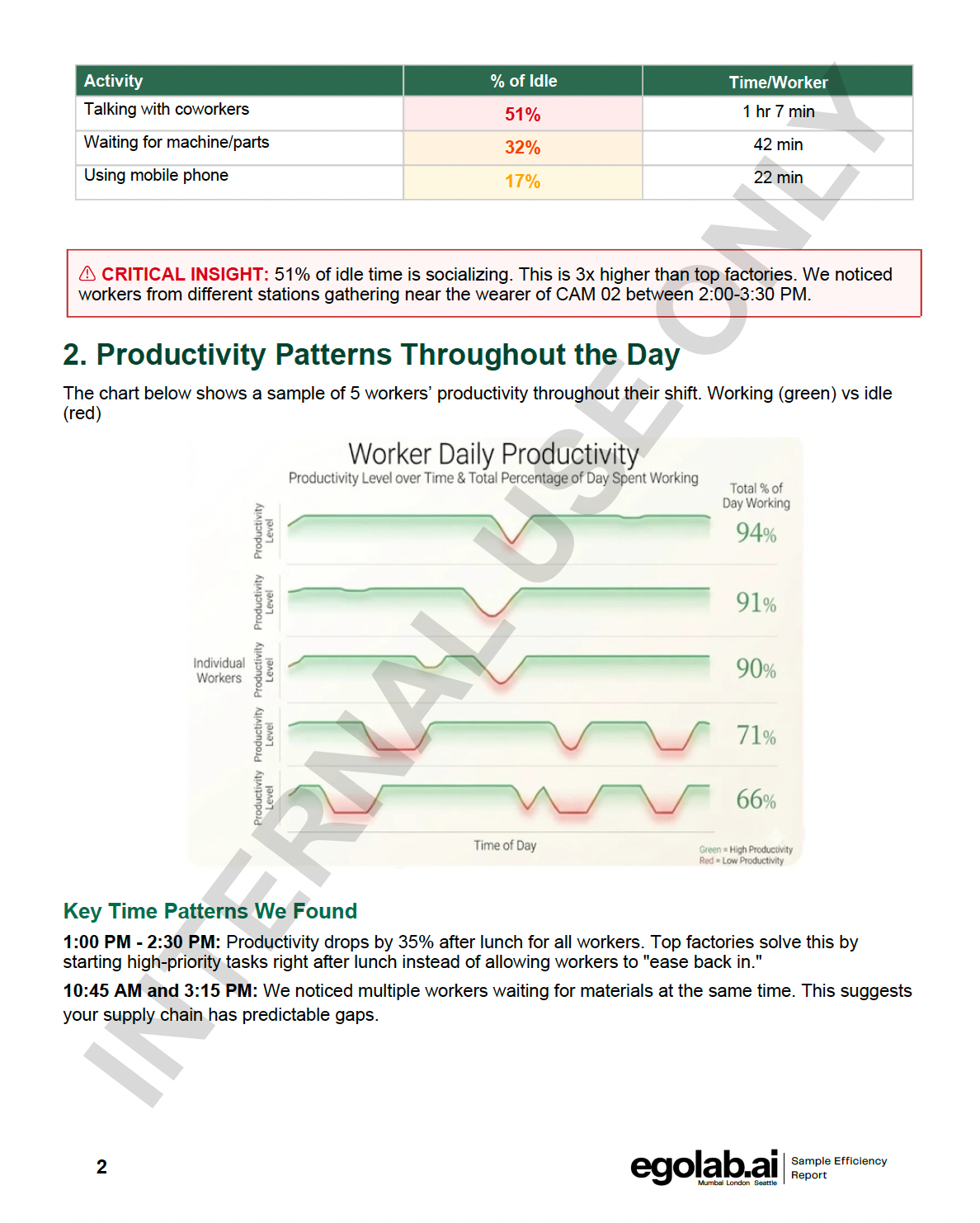
In a pitch deck obtained by Indian news site Scroll.in and shared with openDemocracy, Egolab invited Indian manufacturing firms to “lead global AI data revolution” by helping it collect authentic footage of workflows of “assembling, machining, loading”. In return, it offered the companies free access to so-called “AI-powered efficiency reports” derived from surveilling workers through the same cameras, which would monitor how they used their time on the shop floor, whether they were idle, or even whether they congregated for a few seconds. The startup called this snooping “productivity analytics” based on its proprietary models.
A sample report produced by the company included “critical insights” such as “51% of idle time is socialising. This is 3x higher than top factories. We noticed workers from different stations gathering near the wearer of CAM 02 between 2:00-3:30 PM” and “Productivity drops by 35% after lunch for all workers. Top factories solve this by starting high-priority tasks right after lunch instead of allowing workers to “ease back in”.
Egolab’s pitch deck said “workers opt in voluntarily” to wearing the cameras and that they “can withdraw anytime” – claims that contradicted the experiences of workers interviewed by openDemocracy.
“By taking data of employees who are a captive workforce and already have little bargaining power, such companies are collecting data in a regulatory vacuum,” said Shruti Narayan, a New Delhi-based technology lawyer.
India still does not have robust data protection legislation. Its primary data privacy law, the Digital Personal Data Protection Act, suffered years of delay and deferral before being passed hastily in one week in 2023, amid a walkout by Parliament’s opposition members. The bulk of its privacy provisions – particularly on consent – were deferred and will not come into effect until mid-2027.
Egolab.AI and Build AI did not respond to requests for comment.
At both Pearl Global and Pearl Apparel, workers were required to wear the headgear for two weeks in late March and early April. On one hand, the cameras were just one more instance of exploitation in a country where less than 20% of factory employees hold a written contract. On the other, there was something clearly uncanny about the trials, which stopped as mysteriously as they started.
Yadav said workers at Pearl Apparel were initially bemused by the strange new intrusion on the factory shop floor.
“They were asking us to wear [the headset] all eight hours, seeing how long we work, how long, say, we use mobiles; they were recording everything,” he said, adding: “They could listen to everything we said.” In company documents, Egolab.AI claims it blurs faces and mutes voices in the data it makes further available, but that was not the workers’ experience.
“A team would arrive around 9 am and ask tailors, helpers – who cut threads, pack garments, emboss stickers – to wear the camera on their heads,” said one of Yadav’s colleagues, Arun Ram, an experienced master tailor who stitches the prototype for other tailors to replicate. “Then, at 5:30 pm, when the general shift was over, they took the devices away.”
At both factories, the workers’ compensation for sharing skills perfected over years of labour, through which they earn their livelihoods, with a company that hopes to train robots to be able to do their jobs, was a warm tetrapak of Mango Frooti, an artificially fruit-flavoured drink.
When their pleas to take the cameras off fell on deaf ears, workers quietly stopped wearing them or repeatedly took them on and off to render the footage useless and hinder the ‘productivity analysis’.
“Wearing it would hurt my head and I would take it off,” recounted Veena Devi*, who worked on the same floor as Ram. Devi migrated to the industrial pockets surrounding Delhi from her village in Uttar Pradesh ten years ago. “I would try to remove it, but my supervisor would ask again and again to wear it, so I had to put the camera back on my head.”
Devi said she and her colleagues enquired about the purpose of data collection several times, but neither their supervisors nor the team of young people who arrived every morning to distribute the headsets responded to them. “We would ask, ‘Why are you making us wear this?’ but the supervisors would not say.”
Sonu Kumar, a young tailor at Pearl Global, said his supervisor told him the data collection was for “training” – but not who the training was for. On hearing that the footage may be used for automation and training AI, Kumar added: “If I knew it was for training a robot, I would prefer not to wear it. If they want a robot to do this work, then why don’t they get one to do stitch clothes already?”
Mid-level managers and HR staff at both factories seemed equally in the dark. At Pearl Apparel, a HR manager said that because the senior management had not shared the cameras’ purpose with them, they told the workers that it was for “training other workers in the future”. At Pearl Global, HR staff said their role was limited to providing a room for the startup team operating the camera devices, where they could gather, monitor and charge devices daily. “A team of six to ten young girls and boys would arrive and divide themselves to place the cameras on the five floors above in the different departments: production, finishing, packing.”
A mid-level manager at Pearl Apparel who spoke to openDemocracy on the condition of anonymity said they found it hard to “motivate” staff to wear the cameras because they, too, didn’t know what they were being used for. “Their camera teams would say this was being done for ‘Output and time calculation’. Workers would come and tell us, ‘No, sir, it’s for AI,’” said the manager. “If the workers had taken the devices off to go to the toilet, most of them would not wear them again. The senior management would call and tell us: ‘Why aren’t you making them wear it through the shift? This way, no productivity analysis can happen’. But not even one worker wore it all eight hours.”
Kumar, like most tailors in the industrial belt, worked eight-hour shifts daily and did an hour or two of overtime a week, for which he received a monthly salary of 15,108 rupees, around £115, for most of the past two years. This rose to 18,500 rupees (£142) in April, after Delhi’s industrial region was hit by a wave of strikes as long-simmering grievances over stagnant wages and harsh work conditions came to a head when cooking gas prices soared in the wake of the US-Iran war. Picketing workers clashed with the police until the state government announced a 35% rise in the minimum wage.
During the unrest, workers at Pearl Global stopped work twice, staff at the factory’s unit told openDemocracy. The first time, workers on the shop floor downed tools for over an hour. “The next morning, more than a thousand of them gathered outside the gate and refused to go inside the factory for the general shift,” one worker said.
Staff resumed work only after the company representatives agreed to increase their wages in line with the new minimum wage. Several workers complained that the camera headsets were generating heat and causing them headaches, said a supervisor. The data collection continued for a day or two after their return to work, but workers were increasingly failing to cooperate with wearing the headsets for much of the day. Two weeks into the experiment, the video-collection experiment was quietly shelved at both factories.
Neither Pearl Apparel nor Pearl Global responded to openDemocracy’s request for comment.
openDemocracy asked Chintu Pal, a garment worker in his mid-30s who works at Pearl Global, what would happen if, in the near future, robots did learn to sew in place of workers. “I think they are not able to make such machines right now,” he said. “Or else, they would feel no need for a kaarigar (a skilled craftsman). The first thing they would do would be to chase the poor away. ‘Bhag jao!’ (Be off!), they would like to tell us”.
He thought for a few seconds before adding: “I believe this might already be happening in China.”
*Worker names have been changed to protect their privacy