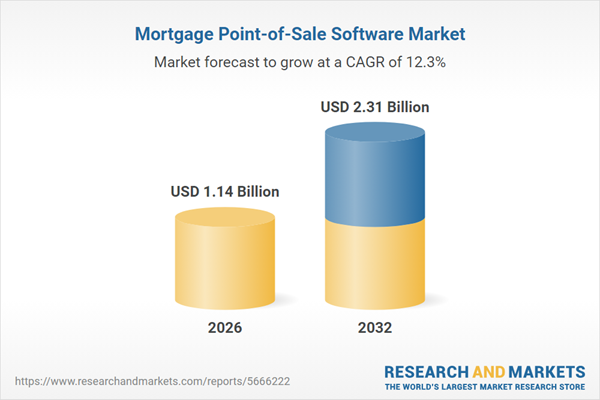
Dublin, July 20, 2026 (GLOBE NEWSWIRE) -- The "Mortgage Point-of-Sale Software Market - Global Forecast 2026-2032" report has been added to ResearchAndMarkets.com's offering.The Mortgage Point-of-Sale Software Market is projected to reach USD 1.14 Billion in 2026. It is expected to continue growing at a CAGR of 12.33%, reaching USD 2.31 Billion by 2032. Mortgage point-of-sale software has become a core digital layer in modern lending, connecting borrowers, loan officers, brokers, processors, and underwriters through online mortgage applications, document collection, borrower portals, automated disclosures, pricing workflows, and status communication. Demand is being shaped by borrowers' expectations for fast, transparent, mobile-first mortgage experiences and by lenders' need to reduce cycle times, improve pull-through, strengthen compliance controls, and integrate origination workflows with customer relationship management, loan origination systems, credit bureaus, verification providers, e-signature tools, and servicing platforms. The category is also increasingly influenced by open banking, digital identity, eClosing, real-time income and asset verification, and configurable workflow automation. In an operating environment marked by interest-rate volatility, affordability pressure, and stricter scrutiny of fair lending, data privacy, and cybersecurity, mortgage POS software is shifting from a front-end application portal into an intelligent engagement and decision-support environment. The most successful deployments emphasize borrower self-service, omnichannel communication, compliant automation, auditability, and seamless interoperability across the lending technology stack.Transformative Shifts in the Mortgage POS Software LandscapeThe mortgage point-of-sale software landscape is being transformed by three structural shifts: digitization of borrower engagement, expansion of automated verification, and modernization of regulatory compliance workflows. Borrowers increasingly expect to begin, pause, resume, and complete mortgage tasks from any device, making mobile responsiveness, secure messaging, real-time status updates, and intuitive document upload essential capabilities. Lenders are prioritizing integrations that reduce manual rekeying and accelerate prequalification, application intake, conditions management, and closing readiness. Regulatory expectations are also shaping product architecture, with stronger emphasis on consent management, disclosure timing, data retention, accessibility, identity assurance, and transparent audit trails. Another major shift is the move from standalone portals to ecosystem-based platforms that connect application capture with lead management, product-and-pricing engines, automated underwriting systems, income and employment verification, credit decisioning, title and appraisal coordination, and digital closing workflows. Cloud deployment, API-first connectivity, configurable workflow rules, and embedded analytics are becoming critical for lenders seeking operational resilience and faster adaptation to product, policy, and compliance changes.Cumulative Impact of AI on Mortgage POS PlatformsArtificial intelligence is increasingly influencing mortgage POS software by improving borrower guidance, workflow prioritization, document handling, and operational quality control. AI-enabled assistants can help applicants understand required information, identify missing documents, answer routine questions, and route complex issues to human staff. Machine learning and rules-based intelligence are being applied to lead scoring, next-best-action prompts, application completeness checks, fraud signals, exception management, and pipeline visibility. Optical character recognition, natural language processing, and automated document classification are reducing manual review effort across pay stubs, bank statements, tax documents, identification files, and disclosures. At the same time, the cumulative impact of AI is elevating governance requirements. Mortgage lenders must ensure explainability, bias monitoring, model validation, data minimization, secure data handling, and human oversight, especially where AI influences eligibility, pricing, communications, or prioritization. The most defensible AI strategies in mortgage POS environments are those that enhance productivity and borrower experience while preserving compliance with fair lending, consumer protection, privacy, and cybersecurity obligations.Key Regional Insights for Mortgage POS SoftwareIn North America, mortgage POS software adoption is closely tied to high digital banking penetration, mature mortgage origination infrastructure, e-signature acceptance, regulatory reporting requirements, and lender demand for borrower portals that integrate with loan origination systems and automated underwriting workflows. The United States and Canada emphasize compliance-ready digital intake, consent tracking, credit and verification integrations, and omnichannel borrower communication. Europe's landscape is shaped by strong data protection requirements, open banking regulation, digital identity initiatives, and cross-border technology harmonization, making privacy-by-design, consent management, accessibility, and secure API connectivity central to adoption. In Asia-Pacific, growth in digital financial services, mobile-first consumer behavior, urban housing demand, and government-backed digital identity and payment infrastructure is supporting wider use of online mortgage application and document exchange tools, particularly in markets with advanced digital banking ecosystems. Latin America is progressing through fintech-led digital lending innovation, expanding smartphone access, and modernization of credit infrastructure, though lenders must address fragmented documentation practices and uneven digital identity maturity. The Middle East is seeing increased adoption through digital banking transformation, national smart government programs, and real estate finance modernization, with emphasis on secure onboarding, identity verification, and workflow efficiency. Africa presents a more heterogeneous environment, where mobile financial services, digital identity development, and efforts to formalize property and credit data are creating long-term opportunities for mortgage POS software, particularly when platforms are designed for low-bandwidth access, modular deployment, localized compliance, and alternative data integrations.Key Group Insights Across ASEAN, GCC, EU, BRICS, G7, and NATOAcross ASEAN, mortgage POS software opportunities are linked to mobile-first banking behavior, expanding digital payment ecosystems, and national digital identity efforts that can support faster onboarding and verification, although localization across languages, regulatory regimes, and property documentation standards remains critical. In the GCC, high investment in digital government services, smart city programs, and banking modernization supports adoption of secure mortgage application portals, document automation, and identity verification workflows aligned with real estate finance expansion. The European Union provides one of the most structured environments for mortgage POS innovation due to strong consumer data protection rules, open banking frameworks, electronic identification initiatives, and regulatory expectations around transparency, consent, and data portability. BRICS economies show diverse adoption patterns: large populations, rapid fintech development, and active digital public infrastructure programs create strong use cases for scalable borrower portals and automated verification, while lenders must account for varied mortgage maturity, credit data depth, property registration practices, and local compliance standards. G7 markets generally lead in enterprise-grade digital mortgage transformation, with mature financial infrastructure, broad cloud adoption, advanced compliance requirements, and demand for integrated borrower engagement platforms. NATO member markets, many of which overlap with North America and Europe, tend to prioritize cybersecurity, operational resilience, data sovereignty, secure cloud governance, and third-party risk management, all of which directly influence mortgage POS procurement and implementation standards.Key Country Insights for Mortgage POS Software AdoptionThe United States remains one of the most advanced environments for mortgage point-of-sale software due to the scale of its mortgage origination ecosystem, widespread use of credit scoring and automated underwriting, and strong demand for digital borrower engagement, compliance workflows, and integrations across loan origination, pricing, verification, and closing systems. Canada emphasizes secure digital banking, mortgage broker connectivity, privacy compliance, and streamlined document collection across a highly regulated lending environment. Mexico and Brazil are advancing through fintech adoption, digital banking expansion, and improving credit data infrastructure, creating demand for mobile-first mortgage application tools and automated document workflows that can adapt to diverse borrower profiles. In the United Kingdom, open banking, digital identity initiatives, and mature broker-lender distribution are supporting sophisticated borrower portals and affordability assessment workflows. Germany, France, Italy, and Spain are shaped by European data protection rules, bank-led mortgage distribution, and growing interest in secure, integrated digital application experiences, with country-specific requirements around documentation, language, and compliance. Russia's mortgage technology environment is influenced by domestic financial infrastructure, digital banking capabilities, sanctions-related technology localization considerations, and localized compliance needs. China's advanced mobile finance ecosystem and digital identity infrastructure support highly integrated digital lending experiences, while mortgage workflows remain closely tied to domestic policy and financial regulation. India presents significant long-term potential driven by digital public infrastructure, expanding formal credit access, and rising demand for paperless onboarding, though income documentation diversity and regional variation require flexible workflow design. Japan and South Korea bring mature digital banking, high connectivity, and strong consumer expectations for secure, efficient online experiences, supporting advanced integrations and automation. Australia combines high digital banking adoption, broker-driven distribution, and strict responsible lending obligations, making compliance-ready mortgage POS platforms valuable for borrower engagement, verification, and auditability.Actionable Recommendations for Mortgage POS Software LeadersIndustry leaders should prioritize API-first mortgage POS architectures that integrate cleanly with loan origination systems, customer relationship management platforms, pricing engines, verification services, e-signature providers, and eClosing workflows. Lenders should invest in borrower-centric design, including mobile optimization, plain-language guidance, multilingual support where relevant, real-time status tracking, secure messaging, and proactive document checklists. Compliance and risk teams should be involved early in platform configuration to ensure disclosure timing, consent capture, audit trails, accessibility, data retention, privacy, and cybersecurity controls are embedded into workflows. Organizations adopting AI should define governance policies for model validation, bias testing, explainability, human review, and monitoring of automated recommendations. Technology buyers should also evaluate configurability, implementation speed, integration depth, uptime performance, role-based access, encryption standards, data residency options, business continuity controls, and vendor support for regulatory change. To improve return on digital transformation initiatives, leaders should measure operational outcomes such as application completion rates, document cycle times, borrower responsiveness, condition clearance speed, staff workload, compliance exceptions, and customer satisfaction rather than focusing only on technology deployment milestones.Key Attributes:
Back to News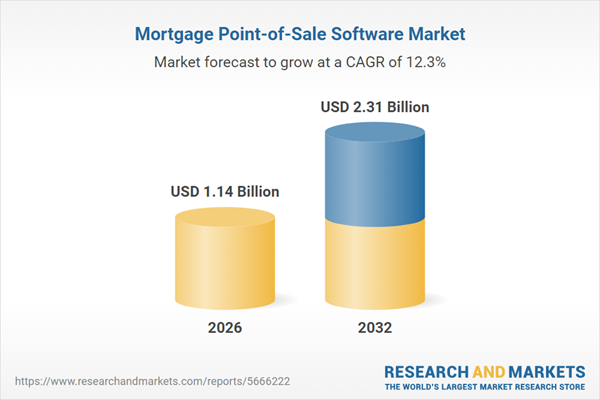
AI
AI-Powered Mortgage POS Software Accelerates Document Automation, Borrower Support and Compliance Workflows
GlobeNewswire·July 20, 2026
AI Summary
AI-powered mortgage point-of-sale software is streamlining document automation, borrower support, and compliance processes through enhanced efficiency. The technology leverages mobile-first platforms, AI automation, open banking, digital identity verification, eClosing capabilities, and API integrations to modernize mortgage workflows.
Full story reconstructed from GlobeNewswire. Formatting and media may differ from the original.
View original at GlobeNewswireWas this useful?