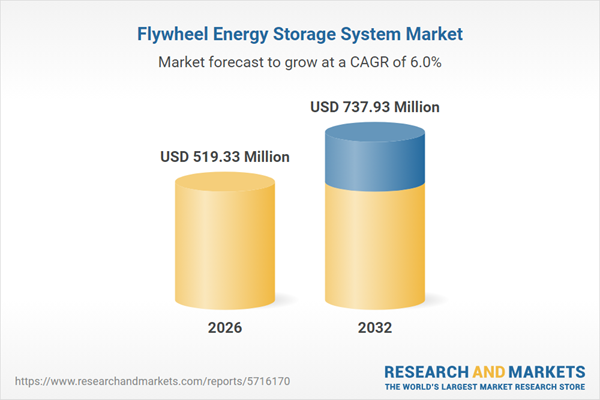
Dublin, July 20, 2026 (GLOBE NEWSWIRE) -- The "Flywheel Energy Storage System Market - Global Forecast 2026-2032" report has been added to ResearchAndMarkets.com's offering.The Flywheel Energy Storage System Market is projected to reach USD 519.33 Million in 2026. It is expected to continue growing at a CAGR of 5.96%, reaching USD 737.93 Million by 2032. Flywheel energy storage systems are gaining strategic importance as power networks, industrial facilities, data centers, transit systems, and critical infrastructure seek fast-response, high-cycle, and low-maintenance energy storage. Unlike electrochemical batteries, flywheels store energy mechanically in a rotating mass and deliver power within milliseconds, making them especially relevant for frequency regulation, voltage support, uninterruptible power supply, regenerative braking, microgrid stabilization, and power quality management. Their ability to perform frequent charge-discharge cycles with limited capacity degradation positions flywheel energy storage as a compelling solution where reliability, rapid response, long operational life, and reduced hazardous material dependence are priorities.The industry is being shaped by the global shift toward renewable energy integration, grid modernization, electrified transportation, and resilient energy infrastructure. As solar and wind penetration increases, grid operators require technologies that can smooth short-duration fluctuations and maintain system stability. Flywheel energy storage systems address these needs by providing high power density, rapid ramping, and operational durability across demanding environments. This makes the technology particularly valuable in applications where seconds-to-minutes energy response matters more than long-duration energy shifting.Transformative Shifts Reshape Flywheel Storage Applications and System DesignThe flywheel energy storage landscape is undergoing a significant transformation as the technology moves beyond traditional backup power and industrial power conditioning into grid-scale ancillary services, transportation energy recovery, and hybrid energy storage architectures. Modern systems are increasingly built around advanced composite rotors, magnetic bearings, vacuum enclosures, and power electronics that improve efficiency, reduce friction losses, and enable faster response to grid signals. These design advances are strengthening the role of flywheels in high-cycle applications where conventional batteries may face thermal stress, cycle-life limitations, or replacement cost challenges.A major shift is the emergence of hybrid storage systems that combine flywheels with lithium-ion batteries, supercapacitors, hydrogen systems, or other storage assets. In these configurations, flywheels absorb rapid power fluctuations while batteries or longer-duration assets handle sustained discharge requirements. This architecture can reduce battery cycling stress, improve system life, and enhance operational flexibility. Another transformative trend is the growing demand for resilient power in data centers, semiconductor manufacturing, hospitals, defense facilities, rail networks, and airports, where even brief power interruptions can cause operational disruption. Flywheel-based uninterruptible power supply solutions are increasingly assessed for their fast discharge capability, compact footprint, and reduced dependence on chemical storage.Policy and infrastructure trends are also reshaping adoption pathways. Grid codes in multiple regions increasingly emphasize stability, inertia, frequency response, and power quality as renewable generation expands. Although flywheels do not replace long-duration storage, they provide valuable synthetic inertia and fast frequency support that complement renewable-heavy grids. The landscape is therefore shifting from single-purpose storage deployments toward integrated energy resilience ecosystems where flywheels perform targeted, high-value grid and facility functions.Artificial Intelligence Strengthens Flywheel Storage Control, Uptime, and Grid ValueArtificial intelligence is increasingly influencing flywheel energy storage systems through predictive maintenance, real-time dispatch optimization, grid signal interpretation, and lifecycle performance management. AI-enabled monitoring can analyze vibration patterns, bearing behavior, temperature changes, rotor speed, vacuum integrity, and power electronics performance to detect anomalies before failures occur. This is especially important for high-speed rotating equipment, where continuous condition monitoring supports safety, uptime, and asset longevity.In grid and microgrid applications, AI can optimize when flywheel systems absorb or discharge power based on frequency deviations, renewable generation variability, load volatility, and electricity price signals. Machine learning models can improve response strategies by learning site-specific operating patterns and coordinating flywheels with batteries, generators, solar photovoltaic systems, electric vehicle charging infrastructure, and building energy management platforms. This creates operational value by improving power quality, reducing unnecessary cycling of other storage assets, and supporting automated resilience planning.AI also enhances digital twin development for flywheel systems. By combining sensor data with physics-based models, operators can simulate rotor dynamics, thermal behavior, degradation patterns, and power conversion efficiency under varying duty cycles. These insights can guide maintenance scheduling, system sizing for specific applications, and control tuning without relying on generic assumptions. As energy systems become more distributed and dynamic, artificial intelligence is making flywheel energy storage more adaptive, predictive, and interoperable across complex power environments.Regional Dynamics Highlight Grid Stability, Renewable Integration, and Resilience NeedsAsia-Pacific is advancing as a highly relevant region for flywheel energy storage due to rapid grid expansion, dense urban infrastructure, renewable energy integration, and electrified rail development. China, Japan, South Korea, India, and Australia are all pursuing grid modernization and higher renewable penetration, creating technical demand for fast-response storage that can support frequency regulation, renewable smoothing, and power quality. The region's extensive metro, high-speed rail, and industrial manufacturing base also supports applications in regenerative braking and critical power stabilization.Europe is shaped by decarbonization policy, renewable energy expansion, rail electrification, and stringent reliability standards. The region's emphasis on grid flexibility, system balancing, energy efficiency, and reduced environmental impact supports continued evaluation of mechanical energy storage technologies. Flywheel energy storage is especially relevant for ancillary services, electrified transport, industrial power quality, and hybrid storage designs that can complement battery systems while limiting unnecessary battery cycling in fast-response duty cycles.North America benefits from established demand for ancillary services, data center reliability, defense energy resilience, and industrial power quality. The United States and Canada have mature grid service frameworks in several jurisdictions and a strong focus on resilience against outages, extreme weather, and cyber-physical infrastructure risks. Flywheel systems are particularly relevant where operators require immediate discharge, high cycling, and reduced maintenance compared with some conventional backup technologies.Latin America presents selective opportunities tied to renewable integration, mining operations, isolated grids, and industrial reliability. Countries with growing solar and wind generation require technologies that support grid stability, while remote industrial sites can benefit from hybrid energy storage systems that reduce generator cycling and improve power quality. Africa's relevance is anchored in mini-grids, renewable-powered infrastructure, mining, telecom resilience, and weak-grid stabilization. In areas with unreliable grid supply, flywheel systems can play a role in hybrid resilience architectures, particularly where fast power injection and long cycle life are operationally valuable.The Middle East is increasingly focused on renewable energy deployment, grid reliability, and critical infrastructure protection, particularly in markets investing in solar power, desalination, logistics hubs, airports, ports, and smart cities. Flywheel energy storage can support power quality in demanding industrial and infrastructure environments where high temperatures, sensitive loads, and reliability requirements influence technology selection. Across these regions, the strongest fit remains short-duration, high-power applications that enhance grid stability, infrastructure uptime, and renewable-ready energy systems.Group Insights Show Demand From Energy Security, Grid Flexibility, and Infrastructure ResilienceNATO member states add an important demand layer through defense readiness, secure energy systems, mobile power resilience, and critical infrastructure protection. Flywheel energy storage can support military bases, communications infrastructure, radar systems, command facilities, and emergency power platforms where instantaneous response, high reliability, and repeatable cycling are essential. The technology's relevance increases as defense and public infrastructure planners emphasize resilient power architectures that can operate during grid disturbances and support mission-critical continuity.G7 countries are largely defined by mature grid infrastructure, data center growth, defense resilience, decarbonization commitments, and advanced power electronics adoption. These characteristics support technically sophisticated flywheel energy storage deployments where reliability, lifecycle performance, safety, and system integration are critical. BRICS economies represent diverse but significant demand drivers, including manufacturing expansion, renewable power integration, mining, rail electrification, and large-scale grid modernization. Flywheel energy storage aligns with the need for fast power response and high-cycle operation across these energy-intensive economies, particularly where grid stability and industrial power quality are operational priorities.The European Union's policy direction toward renewable integration, grid flexibility, circular economy principles, energy efficiency, and electrified transport creates a favorable context for flywheel applications in ancillary services, rail systems, industrial resilience, and hybrid storage configurations. EU energy and climate priorities continue to elevate the value of technologies that improve system flexibility and reduce dependence on frequent replacement of chemically intensive assets in high-cycle applications.ASEAN is characterized by rising electricity demand, urbanization, renewable energy additions, and islanded or weak-grid conditions across several markets. These factors create practical use cases for flywheel energy storage in microgrids, industrial parks, transit infrastructure, and power quality management. As regional energy systems balance reliability with decarbonization, flywheels can complement battery storage by handling rapid power fluctuations and reducing stress on longer-duration assets.The GCC is increasingly relevant due to large-scale solar development, grid modernization, desalination infrastructure, airports, ports, logistics hubs, and mission-critical facilities. High reliability requirements and harsh operating environments make fast-response, durable storage technologies important for power conditioning and infrastructure resilience. Across these groups, the common thread is not uniform adoption but the increasing recognition that short-duration, high-power energy storage is a necessary component of resilient and renewable-ready power systems.Country Insights Reveal Strong Use Cases Across Grids, Transit, Industry, and Critical PowerChina's large renewable energy buildout, high-speed rail network, industrial scale, and grid modernization initiatives create significant technical demand for fast-response storage systems. The United States remains a leading environment for flywheel energy storage applications because of its advanced grid services, high concentration of data centers, defense infrastructure, and resilience needs linked to weather-related outages. Japan's emphasis on resilience, advanced manufacturing, grid stability, and disaster preparedness aligns with flywheel strengths in rapid response and long cycle life. India's rising electricity demand, solar expansion, grid reliability challenges, metro rail growth, and industrialization support flywheel relevance in microgrids, transit, and power quality applications.Germany's industrial base, energy transition policies, renewable integration requirements, and rail infrastructure create demand for power quality and renewable smoothing technologies. The United Kingdom's focus on grid flexibility, offshore wind integration, data center reliability, and critical infrastructure resilience supports flywheel use cases in ancillary services and backup power. Australia's high renewable penetration, remote mining operations, weak-grid areas, and distributed energy resources make flywheels valuable in hybrid energy storage and microgrid architectures. France benefits from electrified rail, nuclear-renewable system balancing, industrial reliability, and critical infrastructure needs, while South Korea's electronics manufacturing, data centers, smart grids, and rail systems provide additional use cases where high power density and reliable short-duration discharge are important.Italy and Spain are both shaped by renewable expansion, grid flexibility requirements, and transportation electrification, making short-duration storage relevant for smoothing, voltage support, and power stabilization. Canada's opportunities are connected to renewable integration, remote communities, mining operations, and cold-climate infrastructure that require stable power quality. Russia's vast geography and remote industrial operations can create selective opportunities for durable storage in isolated power systems, industrial sites, and weak-grid environments.Brazil's renewable-heavy electricity system, industrial loads, and remote infrastructure create relevance for fast-response storage in grid and off-grid applications. Mexico's industrial corridors, manufacturing base, nearshoring-related power reliability needs, and growing renewable deployment create demand for reliable power conditioning and short-duration storage support. Across these countries, flywheel energy storage is most compelling where grids, transit systems, industrial operations, and critical facilities require instantaneous response, frequent cycling, and dependable power quality.Actionable Recommendations for Leaders in Flywheel Energy StorageIndustry leaders should position flywheel energy storage as a precision technology for high-power, short-duration, high-cycle applications rather than as a universal substitute for batteries. Clear application targeting is essential: frequency regulation, voltage stabilization, regenerative braking, uninterruptible power supply, industrial power quality, microgrid support, and hybrid storage optimization are among the most defensible use cases.Decision-makers should prioritize hybrid architectures that combine flywheels with batteries or other storage assets to improve lifecycle economics and system reliability. Integrating AI-enabled monitoring, digital twins, and predictive maintenance can further strengthen uptime and safety. Manufacturers and system integrators should also focus on standardization, modularity, certification, and interoperability with grid management platforms, building energy systems, renewable power assets, and transportation electrification infrastructure.For market entry and expansion, leaders should align product development with regional grid codes, renewable integration requirements, transportation electrification programs, and critical infrastructure resilience policies. Demonstration projects should emphasize verified performance metrics such as response time, round-trip efficiency under defined duty cycles, cycle life, maintenance intervals, safety performance, and total lifecycle reliability. Transparent technical validation will be critical for building confidence among utilities, industrial users, transit operators, and infrastructure planners.Research Methodology Grounded in Verified Technical and Policy EvidenceThis executive summary is developed through a structured secondary research methodology focused on verified, publicly available, and technically credible sources. The analysis draws on energy agency publications, grid operator documentation, standards and policy references, academic and engineering literature, government energy transition plans, transportation electrification materials, and technical information on mechanical energy storage systems. Emphasis is placed on application-specific evidence, technology attributes, regional energy trends, and infrastructure needs rather than speculative commercial claims.The research approach includes qualitative triangulation across multiple source types to validate key themes such as renewable integration, frequency response, power quality, microgrid resilience, hybrid storage design, and AI-enabled asset management. Regional, group-level, and country-level insights are assessed by examining energy transition priorities, grid modernization programs, industrial structures, electrified transport activity, critical infrastructure needs, and reliability challenges. The methodology intentionally excludes market sizing, market share, and forecasting, focusing instead on evidence-backed industry dynamics and decision-useful strategic insights.Conclusion: Flywheels Strengthen Fast-Response Energy ResilienceFlywheel energy storage systems are becoming an increasingly important part of modern energy infrastructure because they solve a specific and growing challenge: the need for rapid, reliable, high-cycle power response. As electricity systems incorporate more renewable generation, distributed energy resources, electrified transport, and mission-critical digital infrastructure, the value of short-duration energy storage is rising. Flywheels offer distinctive advantages in response speed, cycle durability, power density, and reduced chemical degradation, making them well suited for grid stabilization, industrial reliability, rail energy recovery, and uninterruptible power applications.The strongest opportunities will emerge where stakeholders match the technology to the right operating profile and integrate it with complementary storage and control systems. Artificial intelligence, predictive maintenance, and hybrid energy management will further expand the practical value of flywheel deployments. For utilities, industrial operators, infrastructure planners, and energy technology leaders, flywheel energy storage is not merely an alternative storage option; it is a strategic tool for building more resilient, responsive, and renewable-ready power systems.Key Attributes:
Back to News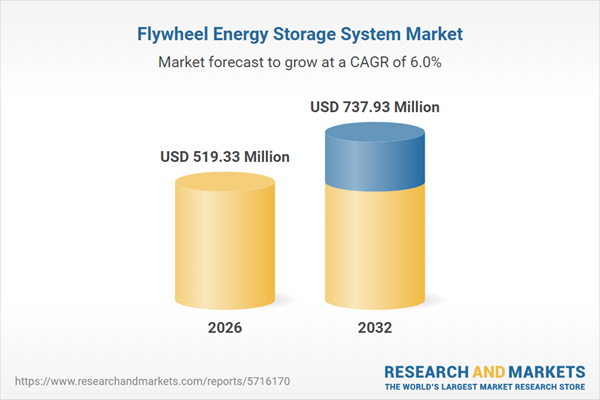
AI
Flywheel Energy Storage System Market - Global Forecast 2026-2032
GlobeNewswire·July 20, 2026
AI Summary
The global flywheel energy storage system market is projected to grow significantly between 2026 and 2032, driven by increasing demand for grid stabilization and renewable energy integration. Key applications include critical-power backup, rail energy recovery, microgrids, industrial power quality improvements, and AI-optimized hybrid storage solutions.
Full story reconstructed from GlobeNewswire. Formatting and media may differ from the original.
View original at GlobeNewswireWas this useful?