Dublin, July 20, 2026 (GLOBE NEWSWIRE) -- The "Digital MRO Market - Global Forecast 2026-2032" has been added to ResearchAndMarkets.com's offering.
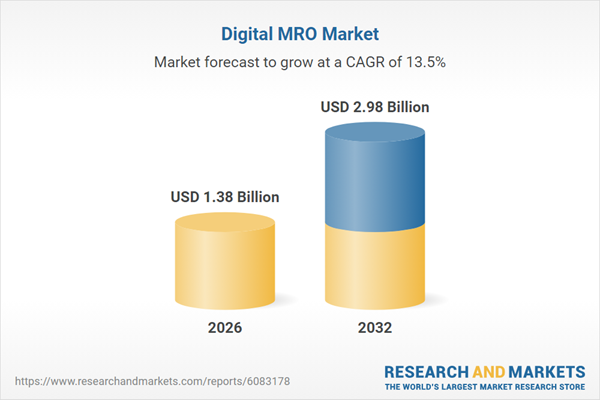
The Digital MRO Market research report provides strategic analysis of the technologies, operational priorities, competitive dynamics, and regional trends shaping aviation maintenance. The market is projected to grow from USD 1.38 billion in 2026 to USD 2.98 billion by 2032, representing a CAGR of 13.47%. The findings support investment planning, market entry assessment, and identification of emerging opportunities across commercial, defense, business aviation, and rotorcraft operations.
Digital MRO combines connected aircraft assets, predictive analytics, digital twins, electronic maintenance records, mobile technician workflows, additive manufacturing, and cloud collaboration. These capabilities are moving maintenance organizations from reactive processes toward condition-based maintenance that improves aircraft availability, regulatory compliance, lifecycle performance, and cost control.
Growth is supported by increased aircraft utilization, aging fleets, technician shortages, supply chain complexity, and demand for traceable, paperless, audit-ready maintenance. Airlines, operators, lessors, defense organizations, and MRO providers increasingly view digital platforms as essential to safety, resilience, and operational efficiency.
Integrated digital ecosystems are replacing disconnected maintenance systems, manual inspections, fragmented inventory records, and paper-based work cards. Modern platforms unify engineering data, maintenance planning, parts visibility, technician execution, and regulatory documentation.
• Predictive maintenance enables earlier fault detection and stronger component reliability planning.
• Digital twins support simulation-based maintenance decisions.
• Augmented reality and remote expert assistance improve technician productivity and first-time fix rates.
• Interoperability, cybersecurity, workforce readiness, and aviation safety requirements remain major implementation considerations.
Analysis of these shifts enables decision-makers to prioritize technologies that deliver measurable operational value while reducing implementation and compliance risks.
