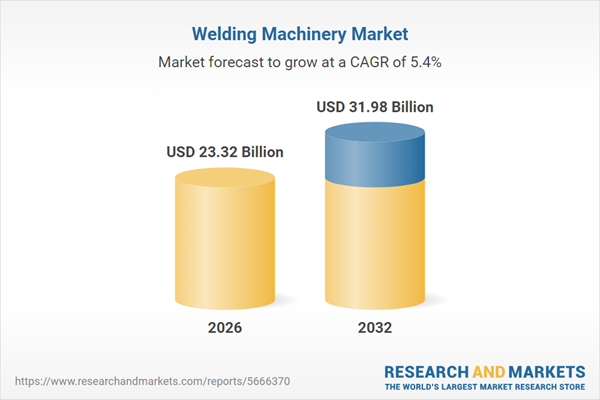
Dublin, July 20, 2026 (GLOBE NEWSWIRE) -- The "Welding Machinery Market - Global Forecast 2026-2032" report has been added to ResearchAndMarkets.com's offering.The Welding Machinery Market is projected to reach USD 23.32 Billion in 2026. It is expected to continue growing at a CAGR of 5.35%, reaching USD 31.98 Billion by 2032. Welding machinery is a critical enabler of industrial production, infrastructure development, energy systems, shipbuilding, automotive manufacturing, rail, aerospace, construction equipment, and repair and maintenance operations. The sector spans arc welding equipment, resistance welding systems, laser welding platforms, plasma welding units, oxy-fuel equipment, robotic welding cells, inverter welding machines, power sources, wire feeders, torches, welding consumables interfaces, safety systems, fume extraction, and digital quality monitoring tools. Demand is closely linked to capital investment in manufacturing, public infrastructure, renewable energy installations, oil and gas assets, defense production, and transportation networks.The welding machinery landscape is being reshaped by automation, skilled labor constraints, stricter weld-quality requirements, workplace safety regulations, and the transition toward lighter, stronger, and more complex materials. Manufacturers are prioritizing equipment that improves repeatability, energy efficiency, uptime, traceability, and operator productivity. At the same time, fabricators are adapting to hybrid production environments where manual welding remains essential for flexibility, while robotic and cobot-assisted welding expands in high-volume and precision applications.Search interest and industrial procurement activity increasingly center on keywords such as welding automation, robotic welding systems, arc welding equipment, laser welding machinery, inverter welding machines, resistance welding, welding power sources, smart welding, AI welding inspection, and industrial welding equipment. These themes reflect a sector moving beyond conventional fabrication toward data-enabled, quality-assured, and digitally connected welding operations.Transformative Shifts in the Welding Machinery LandscapeThe welding machinery industry is undergoing structural transformation as fabricators respond to tighter production tolerances, labor shortages, reshoring initiatives, and the need for lower lifecycle operating costs. One of the most visible shifts is the migration from transformer-based power sources to inverter-based welding machines, which offer improved energy efficiency, lighter form factors, more precise arc control, and compatibility with digital interfaces. This transition supports broader adoption across automotive workshops, heavy fabrication, maintenance, and field welding applications.Automation is another defining shift. Robotic welding systems are increasingly used in repetitive, high-throughput environments, while collaborative welding robots are gaining traction among smaller fabricators seeking flexible automation without fully reconfiguring production lines. Laser welding machinery is also expanding in applications requiring high-speed joining, narrow heat-affected zones, and clean weld seams, particularly for electric vehicle components, battery systems, electronics housings, and precision metal fabrication.Material innovation is changing equipment requirements. The growing use of advanced high-strength steels, aluminum alloys, stainless steels, titanium, and coated metals requires welding machinery with advanced process control, pulse functionality, waveform management, and integrated monitoring. Simultaneously, environmental and worker-safety regulations are pushing adoption of fume extraction, reduced-spatter processes, lower-energy systems, and better personal protection integration.Supply chain resilience is also influencing procurement. Industrial buyers are placing greater emphasis on serviceability, availability of spare parts, local technical support, cybersecurity for connected equipment, and compatibility with existing production systems. These changes are shifting purchasing criteria from upfront equipment cost alone toward total cost of ownership, weld quality consistency, workforce enablement, and measurable operational performance.Cumulative Impact of Artificial IntelligenceArtificial intelligence is becoming a cumulative force across welding machinery by improving process planning, weld execution, inspection, training, and maintenance. AI-enabled welding systems can analyze parameters such as voltage, current, wire feed speed, travel speed, arc stability, heat input, torch angle, and shielding gas behavior to support more consistent weld quality. When paired with sensors, cameras, acoustic monitoring, thermal imaging, and machine vision, AI helps identify porosity, undercut, lack of fusion, burn-through, distortion, and other weld defects earlier in the production process.AI is especially relevant in robotic welding and automated welding cells, where adaptive control can adjust welding parameters in real time based on joint fit-up, seam tracking, part variation, and material conditions. This reduces rework and improves first-pass yield in applications where dimensional variability has traditionally limited automation. Machine learning models are also being used to optimize welding procedures by comparing historical weld data, inspection outcomes, and operator inputs.Predictive maintenance is another practical impact. Connected welding machinery can monitor duty cycles, thermal loads, consumable wear, cooling performance, wire feeding consistency, and power-source behavior to identify equipment degradation before unplanned downtime occurs. In workforce development, AI-supported simulators and augmented training tools help welders practice procedures, receive feedback, and build competency while reducing material waste.The cumulative impact of artificial intelligence is not the replacement of skilled welders, but the augmentation of welding expertise. AI supports decision-making, increases process visibility, strengthens quality documentation, and enables scalable welding automation. However, successful implementation depends on data quality, integration with production systems, cybersecurity controls, operator acceptance, and validation against industry codes and customer specifications.Key Regional Insights for Welding MachineryAsia-Pacific is a central engine for welding machinery adoption due to its deep manufacturing base, large-scale infrastructure programs, shipbuilding capacity, electronics production, automotive manufacturing, and expanding renewable energy supply chains. China remains a major production and consumption hub for welding equipment, supported by heavy industry, rail, machinery, construction, shipbuilding, and electric vehicle manufacturing. India is strengthening demand through infrastructure expansion, industrial corridors, defense manufacturing, automotive production, railways, and energy projects. Japan and South Korea contribute advanced demand for precision welding, robotic welding systems, electronics, shipbuilding, battery manufacturing, and high-quality fabrication, while Southeast Asian economies benefit from manufacturing relocation, export-oriented industrialization, and construction activity.Europe emphasizes high-efficiency welding machinery, regulatory compliance, automation, and advanced joining technologies. The region's industrial base in automotive, rail, aerospace, machinery, renewable energy, shipbuilding, and metal fabrication supports demand for robotic welding, laser welding, resistance welding, arc welding equipment, and digitally traceable welding processes. Sustainability requirements, occupational safety rules, and energy-efficiency priorities support equipment upgrades that reduce energy use, fumes, emissions, spatter, and rework. Germany, Italy, France, Spain, and the United Kingdom remain important centers for welding technology adoption and industrial fabrication.North America is characterized by demand for high-productivity welding machinery, automation, skilled-labor support tools, and equipment suited to infrastructure renewal, energy, defense, aerospace, automotive, and heavy equipment manufacturing. The United States leads regional adoption of robotic welding, advanced arc welding systems, digital weld monitoring, laser welding machinery, and automation for reshored manufacturing. Canada's demand is influenced by energy, mining, transportation, construction, shipbuilding, and fabrication industries, while Mexico benefits from automotive, appliance, metal fabrication, and nearshoring-linked manufacturing activity.Latin America's welding machinery demand is tied to construction, mining, oil and gas, transportation, agricultural machinery, and industrial maintenance. Brazil and Mexico are the region's most prominent industrial users, with welding equipment applied across automotive, infrastructure, energy, mining, and metalworking sectors. Adoption patterns vary by country, with cost-effective arc welding machinery remaining important, while automated, energy-efficient, and higher-productivity systems gain relevance in export-oriented manufacturing and large industrial projects.Africa's welding machinery landscape is driven by mining, construction, power infrastructure, oil and gas, transportation, agricultural equipment repair, and general fabrication. Demand is diverse, ranging from durable manual welding equipment for field operations to industrial systems used in mining services, ports, pipelines, rail, and infrastructure projects. Skills development, equipment affordability, power reliability, and after-sales support remain important adoption factors, while localized fabrication and maintenance needs support continued demand for dependable welding solutions.The Middle East shows strong demand linked to energy infrastructure, petrochemicals, construction, ship repair, pipelines, water infrastructure, and industrial diversification programs. Welding machinery procurement is often tied to large-scale project execution, code-compliant fabrication, corrosion-resistant materials, and maintenance of oil and gas assets. Gulf economies are also increasing investment in manufacturing, renewable energy, transport networks, and industrial zones, creating demand for both heavy-duty welding equipment and automated fabrication solutions.Key Economic and Strategic Group InsightsNATO countries influence welding machinery procurement through defense readiness, naval shipbuilding, aerospace, armored vehicle production, infrastructure resilience, and secure supply chain requirements. Welding systems used in these contexts must often meet demanding standards for material integrity, traceability, repeatability, and repair capability. Investments in domestic manufacturing capacity, military maintenance infrastructure, and interoperable industrial supply chains reinforce demand for reliable industrial welding equipment, automated welding cells, qualified welding procedures, and digital weld documentation.The G7 group demonstrates strong demand for high-performance welding machinery in advanced manufacturing, defense, aerospace, automotive, energy transition projects, and infrastructure renewal. These economies place emphasis on productivity, process control, skilled labor optimization, weld quality documentation, and compliance with stringent safety and quality standards. Adoption of robotic welding, laser welding, digital weld monitoring, inverter welding machines, and AI-assisted inspection is particularly relevant where labor availability, product quality, and manufacturing resilience are strategic priorities.BRICS economies collectively influence welding machinery demand through large-scale industrialization, infrastructure investment, energy systems, mining, transportation, and manufacturing expansion. China and India contribute substantial industrial activity, Brazil supports demand through energy, agriculture, construction, automotive, and mining-related fabrication, Russia maintains requirements in energy, defense, heavy machinery, rail, and transport infrastructure, and South Africa anchors regional mining and industrial maintenance activity. Across BRICS, the balance between cost-effective welding equipment and advanced automated systems varies by sector, material, and application complexity.The European Union represents a mature but technology-intensive market for welding machinery, shaped by manufacturing competitiveness, strict safety rules, energy-efficiency expectations, and sustainability-driven industrial policy. EU-based fabricators prioritize advanced welding processes, robotic integration, fume control, traceability, process qualification, and reduced environmental impact. Demand is supported by automotive electrification, renewable energy infrastructure, rail, aerospace, machinery, shipbuilding, and precision fabrication.ASEAN plays an increasingly important role in welding machinery demand as manufacturing capacity expands across automotive components, electronics, shipbuilding, construction materials, metal fabrication, and infrastructure. Industrial relocation and regional supply chain diversification are supporting investment in welding automation, arc welding equipment, inverter welding machines, and fabrication machinery, while small and medium-sized manufacturers continue to rely on versatile manual and semi-automatic welding systems for cost-effective production.The GCC is closely linked to demand for welding machinery in oil and gas, petrochemicals, desalination, power generation, construction, ship repair, pipelines, and industrial diversification initiatives. Code-compliant weld quality, corrosion-resistant materials, pipeline integrity, and heavy fabrication needs are central to purchasing decisions. As regional economies invest in renewable energy, transport networks, industrial zones, and localized manufacturing, interest is increasing in automated welding systems, digital inspection support, reliable service networks, and heavy-duty equipment designed for demanding operating conditions.Key Country Insights for Welding MachineryChina is a major center for welding machinery production and use, driven by manufacturing scale, infrastructure, automotive and electric vehicle output, shipbuilding, rail, machinery, and renewable energy supply chains. The United States is a leading adopter of welding machinery for automotive, aerospace, defense, energy, shipbuilding, construction equipment, infrastructure, and industrial fabrication, with buyers emphasizing automation, productivity, skilled-labor support, digital weld documentation, and equipment suited for reshoring and advanced manufacturing. Japan uses welding machinery in automotive, robotics, electronics, shipbuilding, infrastructure maintenance, and precision manufacturing, with strong adoption of automation and high-quality joining processes.India is expanding demand through infrastructure, industrial development, automotive, railways, defense manufacturing, construction, and power projects, while also requiring equipment that supports skills development and productivity improvement. Germany remains one of the most technologically advanced welding machinery environments, supported by automotive engineering, machinery manufacturing, industrial automation, rail, and precision fabrication. The United Kingdom emphasizes welding equipment for aerospace, defense, offshore energy, rail, shipbuilding, and advanced manufacturing, with growing attention to digital quality control, workforce training, and high-integrity fabrication.Australia's demand is supported by mining, defense, shipbuilding, construction, energy, and infrastructure maintenance, where field reliability, safety, and service support are important. France's demand is influenced by aerospace, nuclear energy, rail, defense, shipbuilding, and infrastructure, where process qualification and high-integrity welding are essential. South Korea remains a significant user of welding machinery in shipbuilding, automotive, electronics, construction equipment, steel fabrication, and battery-related manufacturing, with strong interest in robotic welding, laser welding machinery, and precision joining.Italy supports demand through machinery, automotive components, shipbuilding, construction equipment, metal furniture, and small-to-medium fabrication enterprises, where flexible and efficient welding systems are widely used. Canada's welding machinery demand is shaped by energy, mining, rail, construction, shipbuilding, and maintenance-intensive industrial sectors, with cold-climate infrastructure and resource projects supporting heavy-duty equipment requirements. Russia's welding machinery requirements are tied to energy pipelines, heavy machinery, defense, rail, mining, and large-scale infrastructure maintenance, with an emphasis on durable equipment and localized capability.Brazil's welding machinery use is linked to oil and gas, mining, agricultural equipment, construction, automotive manufacturing, and industrial maintenance, combining rugged manual systems for field fabrication with more advanced machinery for energy and transportation applications. Mexico continues to benefit from automotive, appliance, electronics, metal fabrication, and nearshoring-driven production, creating demand for arc welding equipment, resistance welding systems, robotic welding, and flexible fabrication tools. Spain's welding machinery demand is connected to automotive production, renewable energy, shipbuilding, rail, construction, and general metalworking, with increasing relevance for automated, digitally monitored, and energy-efficient systems.Actionable Recommendations for Industry LeadersIndustry leaders should prioritize welding machinery strategies that improve productivity, quality assurance, energy efficiency, and workforce flexibility without compromising safety or code compliance. Equipment portfolios should include efficient inverter welding machines, advanced arc welding systems, laser welding platforms, resistance welding systems, robotic welding cells, collaborative welding solutions, and integrated fume extraction where applicable. Vendors and industrial buyers should evaluate total cost of ownership, including consumables, downtime, training, maintenance, energy use, spare parts availability, and service response.To accelerate adoption, leaders should invest in application engineering, operator training, procedure qualification support, and digital documentation capabilities. Welding machinery that integrates with manufacturing execution systems, inspection platforms, and asset monitoring tools can provide stronger traceability and better production insight. AI-enabled weld monitoring and predictive maintenance should be deployed first in high-value or high-repetition applications where measurable improvements in rework reduction, uptime, and quality consistency can be validated.Manufacturers should also align product development with material trends such as advanced high-strength steel, aluminum, stainless steel, titanium, coated materials, and battery-related components. For regional competitiveness, local service networks, technical support, spare parts logistics, and training partnerships are essential. Safety and sustainability should be embedded into procurement and product design through lower-energy systems, fume control, ergonomic interfaces, and processes that reduce spatter, rework, and material waste.Research MethodologyThe research methodology for this executive summary is based on verified secondary research, industry standards analysis, regulatory review, and cross-sector demand mapping. Inputs include publicly available information from government industrial statistics, trade and customs agencies, manufacturing associations, welding standards bodies, infrastructure and energy policy documents, occupational safety authorities, and technical literature related to welding processes, automation, and industrial fabrication.The analysis focuses on qualitative, data-backed indicators rather than market sizing or forecasting. Regional, group, and country insights are derived by examining industrial activity across automotive, shipbuilding, aerospace, defense, construction, energy, mining, rail, machinery, and general metal fabrication. Technology trends are assessed through evidence of adoption in welding automation, inverter power sources, robotic welding, laser welding, digital weld monitoring, AI-enabled inspection, and predictive maintenance.To maintain reliability, insights are triangulated across multiple credible sources and validated against known welding applications, manufacturing patterns, material trends, and regulatory drivers. The methodology excludes speculative claims, unverified projections, company-specific promotion, and unsupported estimates. The result is an executive-level view of welding machinery that supports strategic planning and informed decision-making without relying on market size, market share, or forecast figures. ConclusionThe welding machinery sector is entering a more automated, connected, and quality-driven phase as industrial users pursue higher productivity, stronger weld integrity, safer workplaces, and more resilient production systems. Traditional arc welding equipment remains essential across construction, repair, maintenance, and fabrication, while robotic welding systems, laser welding machinery, inverter-based power sources, and AI-assisted monitoring are reshaping advanced manufacturing environments.Regional demand patterns reflect the structure of each industrial economy: Asia-Pacific is anchored by large-scale manufacturing and infrastructure; Europe by advanced fabrication, regulatory compliance, and sustainability; North America by automation, energy, defense, and reshoring; Latin America by mining, energy, construction, and manufacturing; Africa by mining, construction, infrastructure, and maintenance needs; and the Middle East by energy infrastructure and industrial diversification.For industry leaders, the strongest opportunities lie in equipment reliability, process intelligence, workforce enablement, service depth, and alignment with evolving material and quality requirements. Welding machinery that combines efficient power delivery, automation readiness, digital traceability, safety integration, and practical AI capabilities will be best positioned to support the next generation of industrial fabrication.Key Attributes:
Back to News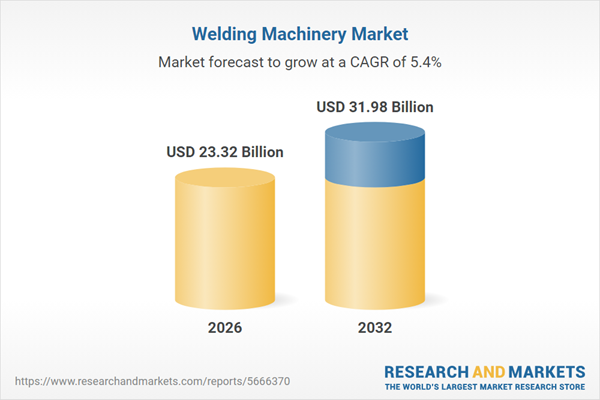
AI
Welding Machinery Market Growth Accelerates as Robotic Welding, Laser Systems and AI Inspection Gain Adoption
GlobeNewswire·July 20, 2026
AI Summary
The welding machinery market is experiencing accelerated growth driven by increased adoption of robotic welding systems, laser technologies, and AI-powered inspection solutions. Key growth opportunities span robotic and laser welding, inverter technology upgrades, predictive maintenance, digital traceability, fume control systems, and workforce training initiatives.
Full story reconstructed from GlobeNewswire. Formatting and media may differ from the original.
View original at GlobeNewswireWas this useful?