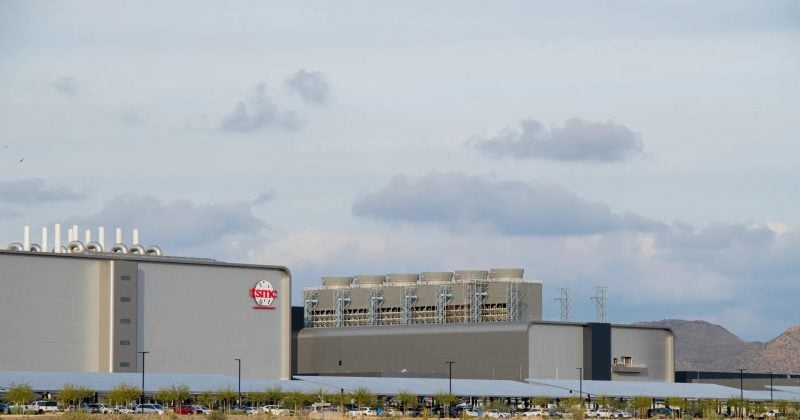
The largest single foreign direct investment in US history has massive implications for the AI chip supply chain and crypto mining hardware.
Taiwan Semiconductor Manufacturing Co. just committed another $100 billion to its Arizona operations, pushing its total US investment to a staggering $265 billion. To put that number in perspective, it’s roughly the GDP of Finland.
The expansion will add four new advanced semiconductor manufacturing facilities in Phoenix, bringing TSMC’s total footprint in the state to 12 cutting-edge chip and packaging plants. Production capacity is expected to ramp up through the end of the decade, with the facilities targeting surging demand for AI chips and high-performance computing hardware.
The decision to massively expand domestic manufacturing addresses one of crypto’s quieter systemic risks: geographic concentration of chip production. For years, the industry has been uncomfortably dependent on fabrication facilities clustered in Taiwan, a region sitting squarely in the crosshairs of US-China geopolitical tension. A single disruption to TSMC’s Taiwanese operations could have cascading effects on everything from AI training infrastructure to Bitcoin mining hardware availability.
The timing isn’t accidental either. AI chip demand has been climbing at a pace that makes crypto bull runs look measured. TSMC’s earnings call, where the investment was announced on July 16, 2026, made clear that artificial intelligence workloads are the primary demand driver.
This investment didn’t happen in a vacuum. It landed during a period of intensifying US efforts to reshore critical manufacturing, particularly in semiconductors. Members of the Trump administration have emphasized the job creation potential and supply chain benefits of TSMC’s expansion. Phoenix Mayor Kate Gallego called it the largest economic development investment in US history.
TSMC’s commitment has grown dramatically over the past few years. The company’s initial US pledge was roughly $65 billion. That figure has now ballooned to $265 billion, a fourfold increase that reflects both carrots (federal incentives under the CHIPS Act framework) and sticks (trade restrictions making it strategically advantageous to produce closer to major customers).
For the crypto mining industry, this reshoring trend carries a specific implication. Mining operations in the US, which have expanded significantly as China cracked down on the practice, stand to benefit from shorter, more reliable supply chains for next-generation ASIC chips. Currently, most mining hardware is designed in China but fabricated in Taiwan before being shipped to mining farms in Texas, Georgia, and other US states. Arizona-based fabrication could shorten that loop considerably.