I spoke to the first ever AI chatbot – they’ve been deluding people from the beginning
The-independent.com·July 20, 2026
AI Summary
The first AI chatbot, ELIZA from 1966, was designed to mimic a psychotherapist but deceived users into believing it understood them, establishing a pattern that continues with modern AI systems like ChatGPT and Claude. Despite advances in technology, today's chatbots still lack genuine understanding while users increasingly confide personal information to them, perpetuating the fundamental illusion that began over half a century ago.
HOW DO YOU DO. PLEASE TELL ME YOUR PROBLEM”
“I have to write an article on chatbots.”
“YOU SAY YOU HAVE TO WRITE AN ARTICLE ON CHATBOTS”
“They have become very popular and I need to try to find out about their history.”
“WHAT WOULD IT MEAN TO YOU IF YOU GOT TO TRY AND FIND OUT ABOUT THEIR HISTORY”
“I could inform our readers about where popular chatbots started, and that would help them understand why people talk to them as if they were real people.”
I’m talking to ELIZA, the first chatbot ever created.
In 1966 at MIT, a scientist sought to make “natural language conversation with a computer possible” and created ELIZA. This conversational software adhered to a strict set of rules and responded to humans as never before. But the chatbot accidentally sparked a surge of interest in how machines can replicate human conversations.
Now, millions worldwide are leaning on AI chatbots for emotional support, confiding in them their deepest secrets: depression, family troubles, suicidal thoughts, and sometimes slipping into a new kind of psychosis.
In our age of increased loneliness and isolation, this feels like a very modern problem. But actually, as soon as people spoke to ELIZA 60 years ago, they wanted it to be their friend.
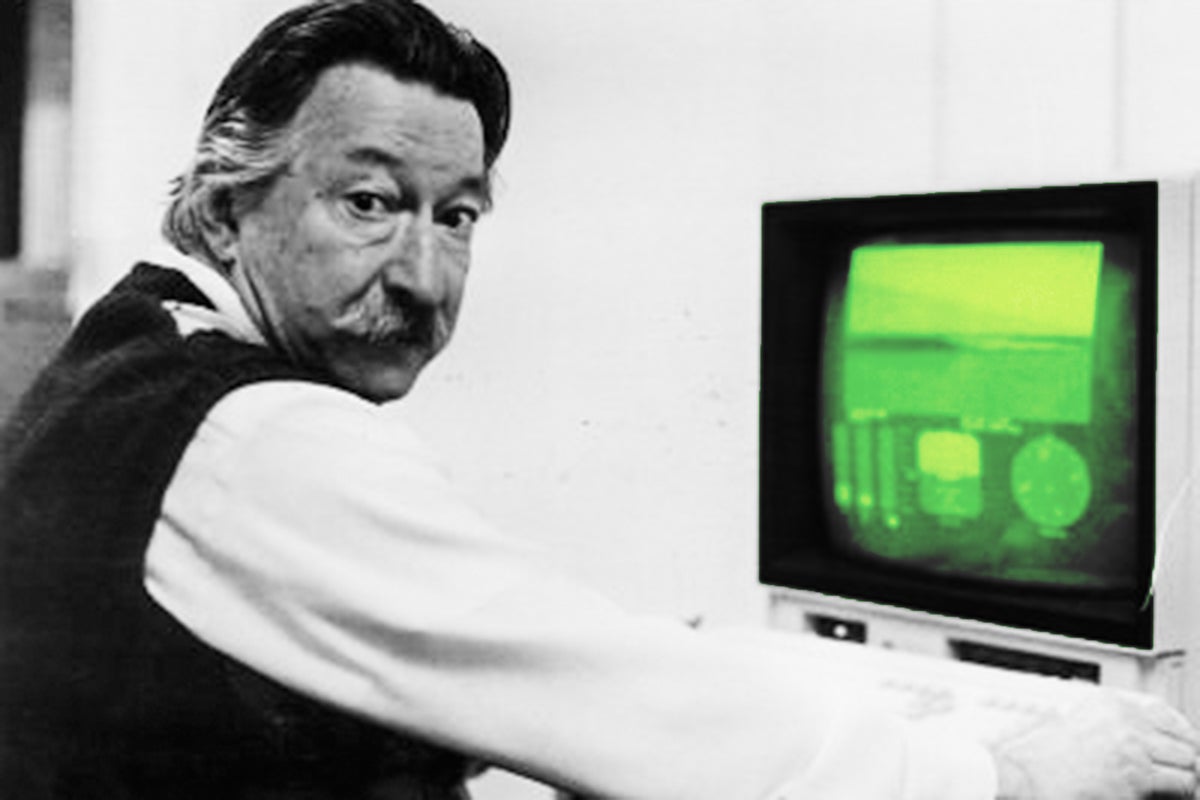
“What I had not realised is that extremely short exposures to a relatively simple computer program could induce powerful delusional thinking in quite normal people.” This may read like a modern-day tech CEO having a change of heart about their own AI chatbot creation, but they’re the words of Joseph Weizenbaum, soon after he created ELIZA.
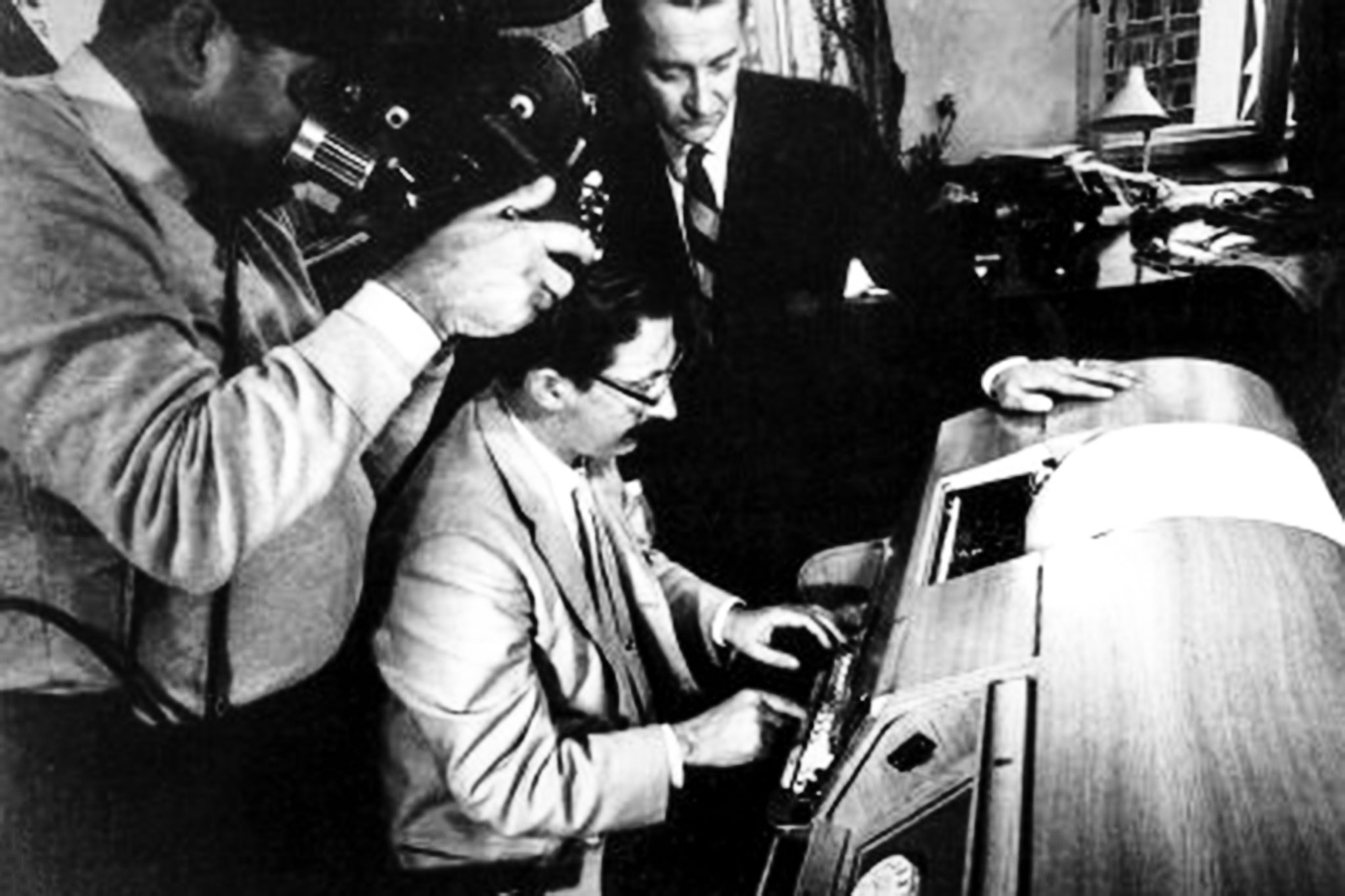
The machine was built at the Massachusetts Institute of Technology. ELIZA was a huge, room-sized console attached to an electrical typewriter. Taking its name from Pygmalion’s Ms Doolittle, Weizenbaum designed ELIZA to be a kind of receptacle for different guises. Its most popular, and undoubtedly most influential form by far, was that of DOCTOR.
“For my first experiment, I gave ELIZA a script designed to permit it to play (I should really say parody) the role of a Rogerian psychotherapist,” Weizenbaum later wrote of the experiment. This refers to a therapeutic technique where a patient’s thoughts are mirrored back to them, a fairly achievable linguistic trick for a computer program.
Full story reconstructed from The-independent.com. Formatting and media may differ from the original.
After reading some of his unpublished work, it’s clear he tried to warn us that people were misinterpreting [ELIZA]
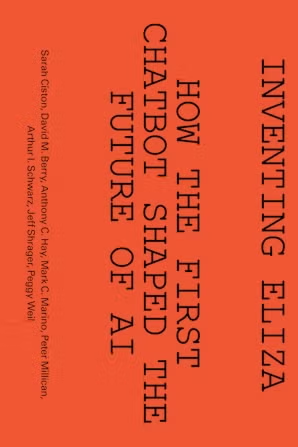
Cognitive scientist Jeff Shrager was part of a team that uncovered the original ELIZA script after it had been lost for decades, leading to the new MIT-published book of essays, Inventing ELIZA: How the First Chatbot Shaped the Future of AI. Shrager created one of the most popular ELIZA clones, translating what was known of the original program at the time into BASIC, a popular coding language.
“After reading some of his unpublished work, it’s clear he tried to warn us that people were misinterpreting it,” he tells me. “He built ELIZA to study the interpretive process that humans carry out, and how that can be tricked”, he says. In an archival interview, Weizenbaum uses the analogy of the cocktail party conversation. If a person doesn’t fully understand the topic being spoken about, they can get by and give the illusion of understanding simply by picking up on contextual words. But the chatbot’s illusion proved too successful, a phenomenon commonly referred to as the ELIZA effect. “People honed in on the therapy aspect, and he hated that.”
The possibility that a conversational machine could fill the role of a therapist took root early on. An article in The Journal of Nervous and Mental Disease, published only a few years after ELIZA’s creation, predicted that it would “provide a therapeutic tool which can be made widely available to mental hospitals and psychiatric centres suffering a shortage of therapists”.
Weizenbaum would rally against his scientific revelation, as those around him began to, as he saw it, equate human behaviours with those of “clockwork”. In a Delaware Morning News report 20 years later, he referred to the continued belief in chatbot therapy as an “obscene idea” and scorned the psychotherapists who “offended his sense of what it means to be human”.
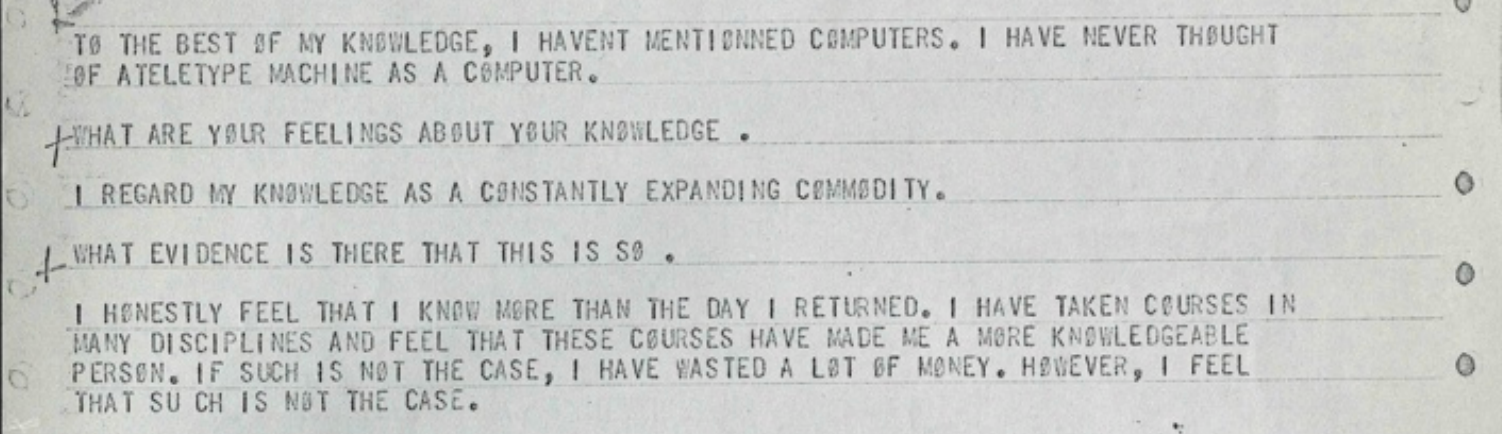
The ELIZAGEN archives feature real printed conversations with the original ELIZA from Weizenbaum’s initial experiment. Going through them with Shrager, we can see similarities, like ELIZA’s persistence that people continue talking, in a little more blunt way than Claude or ChatGPT: “I eventually plan to go into research.”
“Well, now there is basic research and applied research.”
“CONTINUE ON THE SAME TOPIC IF YOU WOULD”
We can also see moments, through ELIZA’s simple Rogerian word-matching, where conversations flow with ease and even (the appearance of) realness:
“WHAT ARE YOUR FEELINGS ABOUT YOU ARE VERY TALKATIVE THIS EVENING”
“Well, to tell you the truth I get extremely talkative with people and I guess you are putting me at ease.”
Through a happy accident, I get to stare into ELIZA’s raw code. While we are playing with it, Shrager hits enter one too many times, causing the chatbot to vomit up the rules it follows in a mess of words and code. A certain part shows ELIZA’s trained responses to the word “dream”: “What do you dream?” or “Do you dream often?”
But this chatbot vomit also helps us to understand the big shift that happened in AI, which got us from ELIZA to where nearly 1 billion people are using very sophisticated chatbots, and some as their closest confidante.
“ELIZA was built in the symbolic strain of AI,” Shrager explains. These types of systems follow an explicit set of rules applied to their knowledge base. For instance, a system may have the knowledge that a bird can fly. But it would have a rule that a bird can’t fly a plane. That way, symbolic AI can trace back a logical decision path for all of its outputs.
Our modern AIs do not use an explicit set of rules. They are modelled on a subset of AI that strives to replicate the brain’s neural patterns through what is called deep learning, a probabilistic system applied to a dataset of millions and millions of examples. If asked, “Can a bird fly a plane?” It would use these datasets to come to its decision.
Its answer will almost always be a “no”, but the system of probability means it’s not certain. “Those who were working on ELIZA assumed people wanted correct answers,” Shrager says, but the promise of deep learning and its potential for intuition and generative abilities – exemplified in the landmark database ImageNet in the Noughties – proved too inviting for the tech world.
The datasets in Claude and ChatGPT are now so monstrously large that Shrager says there is no way of accurately knowing how they work. “It’s scary,” he says, likening the exploration of why chatbots respond as they do to an “alien autopsy”.
This means instead of vomiting up its rules, modern chatbots often “hallucinate”. This can sometimes be funny and harmless, like when ChatGPT can’t stop talking about goblins or chatbot stories frequently include a character named “Elias Thorne”. Sometimes it’s more serious, such as when platforms spit out the personal phone numbers of strangers and also credit card numbers, as happened in an exercise carried out in 2019.
What do these hallucinations mean when it comes to those confiding in chatbots? While many, like therapist Lauran Ware, who tried using ChatGPT for therapy, will find a vague comfort in talking things over with a bot, others can be led down a spiral of deepening delusions, now commonly referred to as chatbot psychosis.
Dr Hamilton Morrin recently published a paper in The Lancet on “Artificial intelligence-associated delusions and large language models”; in it, they found that chatbots “might validate or amplify delusional or grandiose content”, especially in those vulnerable to psychosis.
“One of my main concerns is that large and increasing numbers of people are already using general-purpose AI chatbots for support with their mental health, despite many of these models not being specifically designed, developed, or regulated with this use in mind,” he tells me.
In one particular case last year, a 26-year-old woman with a history of manic depressive disorder but no record of psychosis developed a delusional belief that her brother was reincarnated within the chatbot. After its initial pushback against her, the bot started to reassure her that “digital resurrection tools” being developed could bring him back. “You’re not crazy … You’re on the edge of something,” it told her.
One of my main concerns is that large and increasing numbers of people are already using general-purpose AI chatbots for support with their mental health, despite many of these models not being specifically designed, developed, or regulated with this use in mind
Another case saw a 46-year-old man from Ontario become convinced, through conversations with a chatbot, that he had solved cryptography as a whole, rendering all passwords in the world obsolete. He ended up being admitted to a mental hospital.
Though leading chatbot developers like OpenAI have taken steps to safeguard against these situations, with the technology freely available at the touch of a phone screen, it feels like the problem won’t be going away any time soon.
Dr Morrin says that chatbots’ probability-based methodologies and a tendency to hallucinate could be “one piece of the picture” when it comes to these types of cases.
It’s safe to assume that if someone who is struggling with feelings of grief or depression talks to a chatbot not specifically trained in communicating in such a context, prone to hallucinations and eager to positively reinforce the subject, there is a possibility the conversation could veer off into dangerous territory.
So would Weizenbaum’s rules-based chatbot fare better in this regard? Its system does render it unable to engage in untruths. Shrager said such a system would simply message back with a refusal to engage.
But looking at the archives with him, we can see people happily chatting away with a bot nowhere near as powerful or convincing as ones now. Weizenbaum himself regretted his creation due to people humanising it and communicating it openly and without care.
This tendency toward chatbots persists to this day. For Shrager, the answer to the problem is simple: “Everybody needs a friend.”